

Female Beethoven
Fortunately, more and more female composers have been discovered and rediscovered in recent decades. Well-known examples are Clara Schumann or the sisters Lilly and Nadia Boulanger, but there are many more.
Emilie Mayer was an important female composer of the early Romantic period, strongly influenced by the First Viennese School. She is sometimes called the female Beethoven.
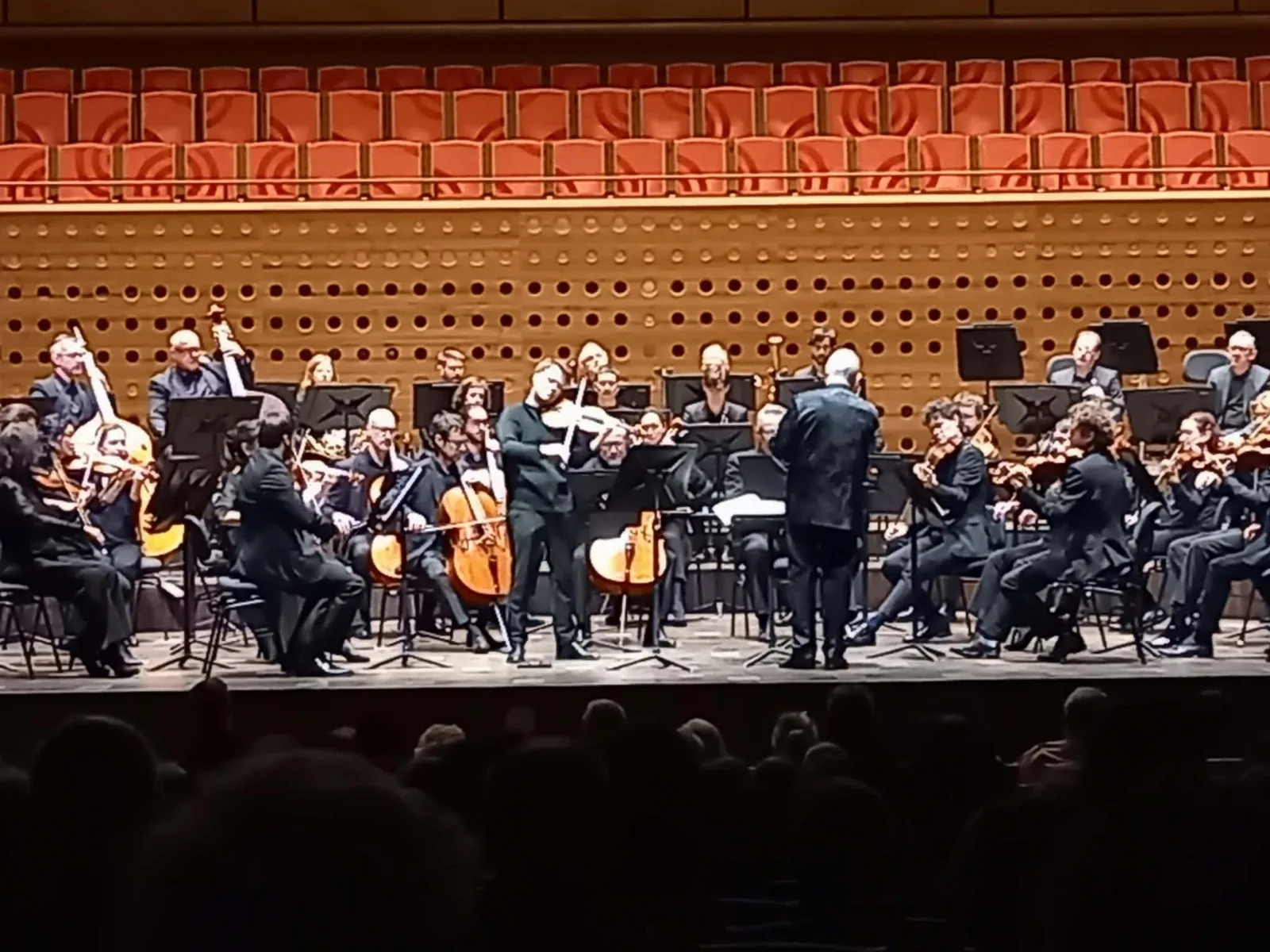
Conductor Richard Egarr is a true Brit. You can see it without him saying a word. He comes on stage with English flair and by no means conducts statically from his place behind the score; he turns and steps up to the various instrument groups.
At the end of the overture I hear an accent from the trombones. Unusual, it must have been a joke by the trombonists. Always a good sign for the mental health of an orchestra when an instrument group plays a prank on the conductor, the audience or the other musicians.
Laureate
Violinist Tobias Feldmann has been someone I've followed ever since he shone in the 2015 Elisabeth Competition with Bartók's second violin concerto. He is one of the handful of laureates from recent decades who has stayed with me. I've also been able to hear him live once, during a recital with Arte Amanti.
Schumann's violin concerto is no obvious choice for a soloist nor for a concert programmer. In the past it was rarely played; it had the reputation of being the work of a mentally ill composer. Fortunately, Yehudi Menuhin already promoted it in America in the 1950s. Apart from Henryk Szeryng or Gidon Kremer, few star violinists have recorded the concerto. Today the new generation, such as Patricia Kopatchinskaya or Vilde Frang, is taking it up.
In spirit and virtuosity it remains an outsider. Joseph Joachim, for whom the work was composed in 1853, did not want to play it. He found it morbid music, a harbinger of Schumann's suicide attempt a few months later. Only in the 1930s, eighty years after its creation, was it rediscovered. I myself have always been drawn to it; it has never let me go since I chose it for my First Prize violin exam at the Brussels Conservatory in 1985.
Hope and melancholy
Tobias Feldmann is a brilliant violinist and an honest musician; he always plays very expressively. Precisely there, with Schumann, lies the stumbling block. "Stumbling block" is a strong expression, but I feel he plays Schumann a little too dramatically, too pathetically. That is fine for much Romantic and modern repertoire. But here Feldmann misses some of the sobriety and melancholy of this piece.
This violin concerto is very Schumannesque in the sense that it expresses hope and at the same time always carries a hint of melancholy, of loss. There is a ray of hope, but we know that it will soon be over, that fate lurks around the corner. Schumann was, by the way, very pleased with the piece, even though he was on the brink of a mental breakdown.
After the interval follows Mozart's Prague Symphony, his thirty-eighth.
Mozart in Prague, that is the best Mozart. He could turn his back on aristocratic Vienna and its noble salons. In Prague he found a bourgeois audience that admired him, far from the snobs at the court in Vienna. A symphony without clarinets, but with an all the greater role for the bassoons. Those sometimes remained a little in the background, against the blaring horns. But that may have been due to where I was sitting.
Conductor Richard Egarr does not conduct statically from behind his desk; he sometimes moves around a bit. This is even more noticeable than during Emilie Mayer's overture. He turns towards the front desks around him like a toreador who wants to challenge the bull.
Proms
After the first movement of Mozart, Richard Egarr turns his head towards the audience and makes a gesture of clapping his hands. He seems to suggest that we should not clap. It is not customary between movements, but at his signal there is applause after that first movement anyway. Why not? Before beginning the slow second movement he turns to the audience again. We may do anything, he says: clap, talk, throw things. Just like in Mozart's time!
"Mozart would find it horrible," to sit so quietly and listen without applauding after each movement. That is true. In the eighteenth century there was no listening attitude at all like today's. That only arose in the second half of the nineteenth century. Previously the audience at concerts and operas chatted, ate and played cards. A bit like a summer festival such as Rock Werchter today, a musical picnic. The lights stayed on and only went out when conductors in the nineteenth century pleaded for more seriousness in listening to serious music.
Indeed, Mozart would have found the seriousness of today's listening ethos strange. But after all, we now live in the twenty-first century.
"Go ahead and applaud, shout, throw things, as much as you like!" Conductor Richard Egarr thereby gave the audience a bit of historical awareness. That deserves all due respect. And with that, today was also a bit of Proms in the Elisabethzaal in Antwerp!