

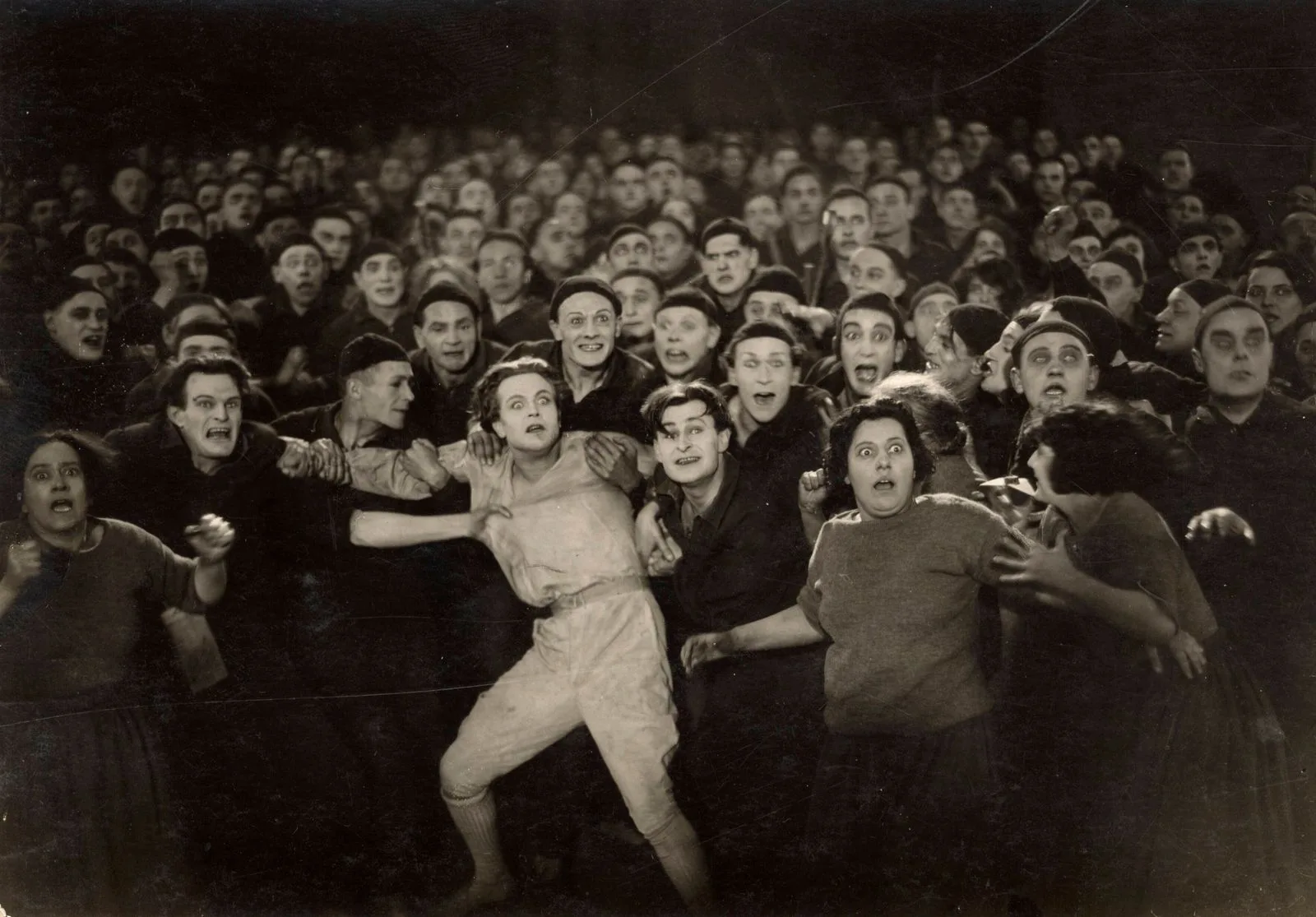
Wishful Singing et le compositeur et clarinettiste Steven Kamperman ont déjà collaboré à une bande-son live pour Der Müde Tod de Fritz Lang, sorti en 1921. Entre-temps, il a composé avec son propre trio une nouvelle musique pour Die Abenteuer des Prinzen Achmed de 1926, de Lotte Reiniger, l'un des premiers longs-métrages d'animation. C'est maintenant au tour de Metropolis de Lang, sorti en 1927, à nouveau une collaboration avec Wishful Singing.
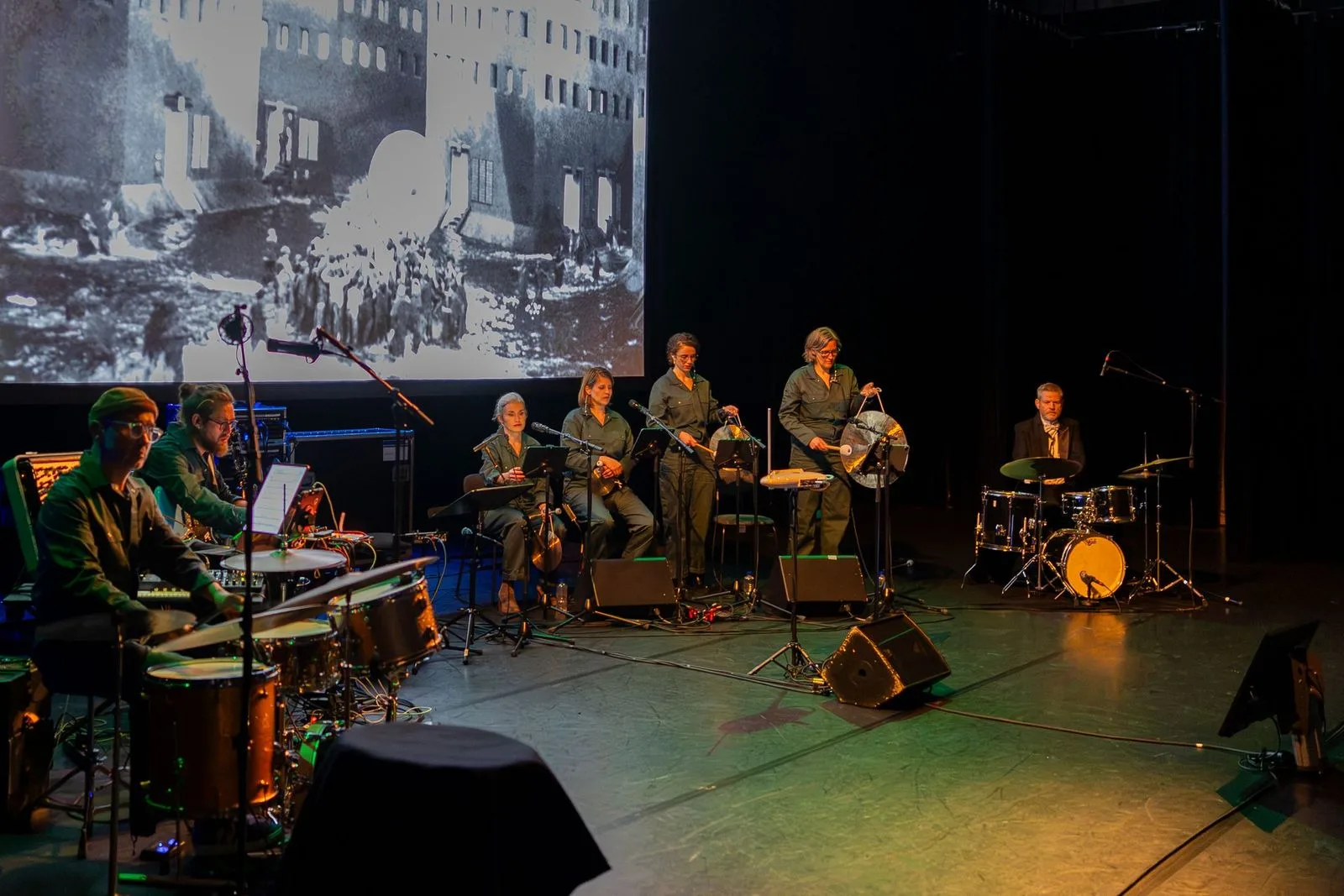
Metropolis est peut-être l'œuvre la plus légendaire de Lang de sa période allemande (avant son exil à l'étranger) et l'un des sommets de l'âge d'or de l'expressionnisme allemand au cinéma.
Plusieurs bandes-son ont déjà été composées pour Metropolis.
Google Gemini affirme : « The most famous soundtrack for Fritz Lang's 1927 silent film Metropolis is the 1984 Giorgio Moroder version, which combined the film with a new rock and synth-pop soundtrack featuring major 1980s artists. » Mais ce n'est pas exact. Une nouvelle raison de faire preuve d'esprit critique face à l'IA. Moroder est parti de la version la plus longue alors disponible du film, dont certains passages semblaient perdus au fil du temps, et l'a dotée d'une série de tubes pop qu'il avait produits. Et même si Moroder est connu pour une grande série de chansons pop géniales, où il a souvent utilisé ses fameuses boucles répétitives révolutionnaires sur synthétiseurs, comme dans les grands succès de Donna Summer, une grande partie de sa musique pour ce film n'a pas résisté à l'épreuve du temps.
La plus ancienne musique composée pour ce film était la partition orchestrale symphonique wagnérienne originale de Gottfried Huppertz (1887-1937), qui avait déjà écrit la musique des Nibelungen de Lang (1924).
La musique de Huppertz est magnifique, mais, dans sa caractérisation et ses couleurs « musico-dramaturgiques », elle n'est pas très spécifiquement adaptée aux différents épisodes du film. Steven Kamperman, lui, caractérise et colore fortement chaque scène et met à profit l'ensemble vocal pour ajouter à la partition des textes chantés et parlés. Il a emprunté ces textes aux « cartons intertitres » utilisés à l'époque du cinéma muet pour clarifier l'histoire, ainsi qu'à des textes appropriés de Marx, Hannah Arendt, Omar Khayyam et de l'Apocalypse de Jean.
Les styles musicaux sont variés. En principe, la musique reste proche du bagage de Steven Kamperman, le jazz de sa clarinette. J'y entends du jazz-rock, un peu dans la veine du légendaire groupe d'art rock King Crimson, c'est-à-dire avec des riffs anguleux et des rythmes complexes. Celui-ci est à son tour interrompu par de beaux passages polyphoniques des quatre chanteuses de Wishful Singing, sur les cartons intertitres utilisés à l'époque du cinéma muet pour clarifier la progression de l'histoire, complétés par des commentaires chantés et quelques textes parlés.
Dans les scènes du film qui parodient la vie nocturne de Metropolis, il paraphrase la musique de bal de jazz, alternée avec un shoobidoobidoo à quatre voix de l'ensemble vocal.
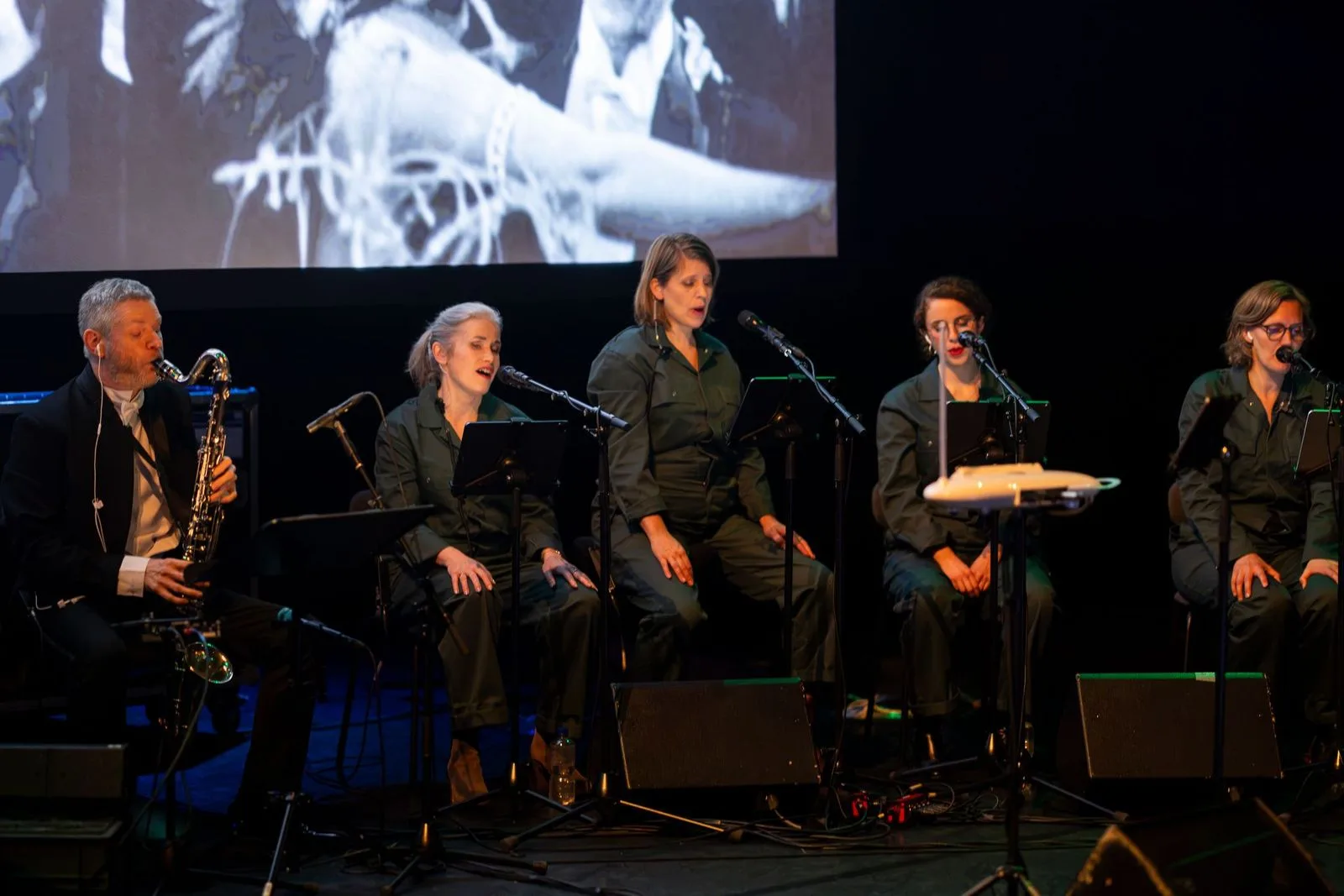
L'un des membres de l'ensemble vocal s'avance régulièrement pour jouer du théremine, un instrument électronique qui réagit aux mouvements de la main au moyen d'une antenne par une note sinusoïdale flottante. Inventé vers 1920 par le Russe Léon Theremin, il est donc un symbole de la mécanisation croissante de cette époque. J'avais déjà échangé des idées avec Steven Kamperman à propos de cet instrument et j'étais ravi de le voir sur scène, même si le spectacle utilise un exemplaire moderne. (NB Pendant longtemps, on a cru que les Beach Boys utilisaient cet instrument pour leur succès de 1967 « Good Vibrations », mais il s'agissait d'un « Tannerin », un instrument produisant un son comparable, mais via une sorte de clavier, ce qui permettait de mieux contrôler les hauteurs ; les hauteurs exactes du théremine sont difficiles à justifier les mains en l'air. Les deux instruments sont devenus très populaires dans les premiers films de science-fiction.)
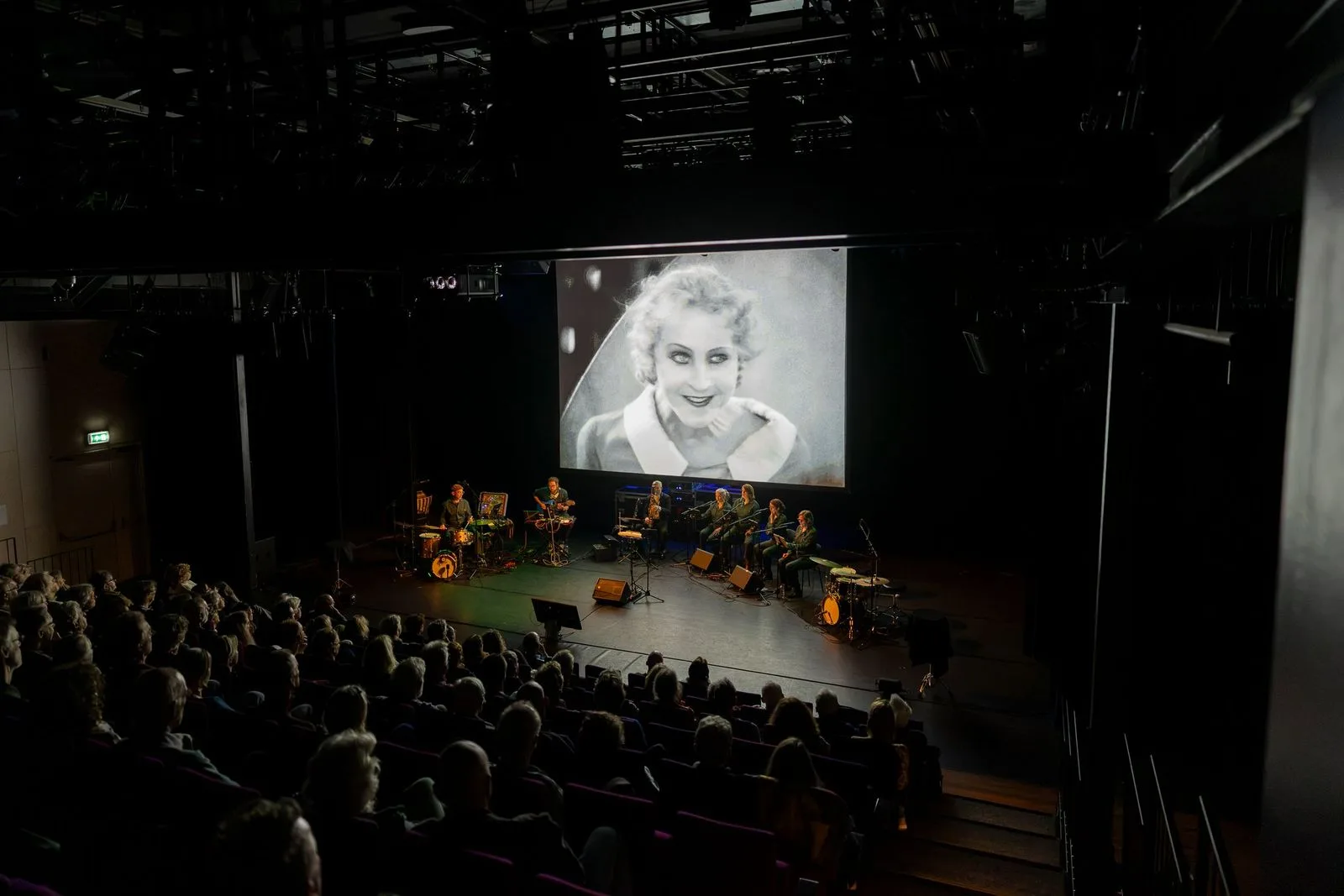
Le percussionniste et concepteur sonore Yonga Sun joue également sur un synthétiseur « modulaire », un instrument plus récent que le théremine, mais également antérieur à l'ère numérique, dont le son est tout aussi « brut ». Et lorsque Steven Kamperman prend également place derrière une batterie, l'ensemble est capable de générer des masses sonores qui rappellent la façon dont Stanley Kubrick utilisait les grandes œuvres orchestrales de Ligeti dans 2001 : L'Odyssée de l'espace et Shining. À ces moments-là, cette nouvelle bande-son fait aussi réaliser à quel point Metropolis était en avance sur son temps.
La musique nouvellement composée « dé-wagnérise » Metropolis, par rapport à la partition wagnérienne de Huppertz. Bien que je défende toujours volontiers tout ce que l'art cinématographique expressionniste allemand doit au concept wagnérien de Gesamtkunstwerk, Metropolis était en quelque sorte une Gesamtmedienwerk.
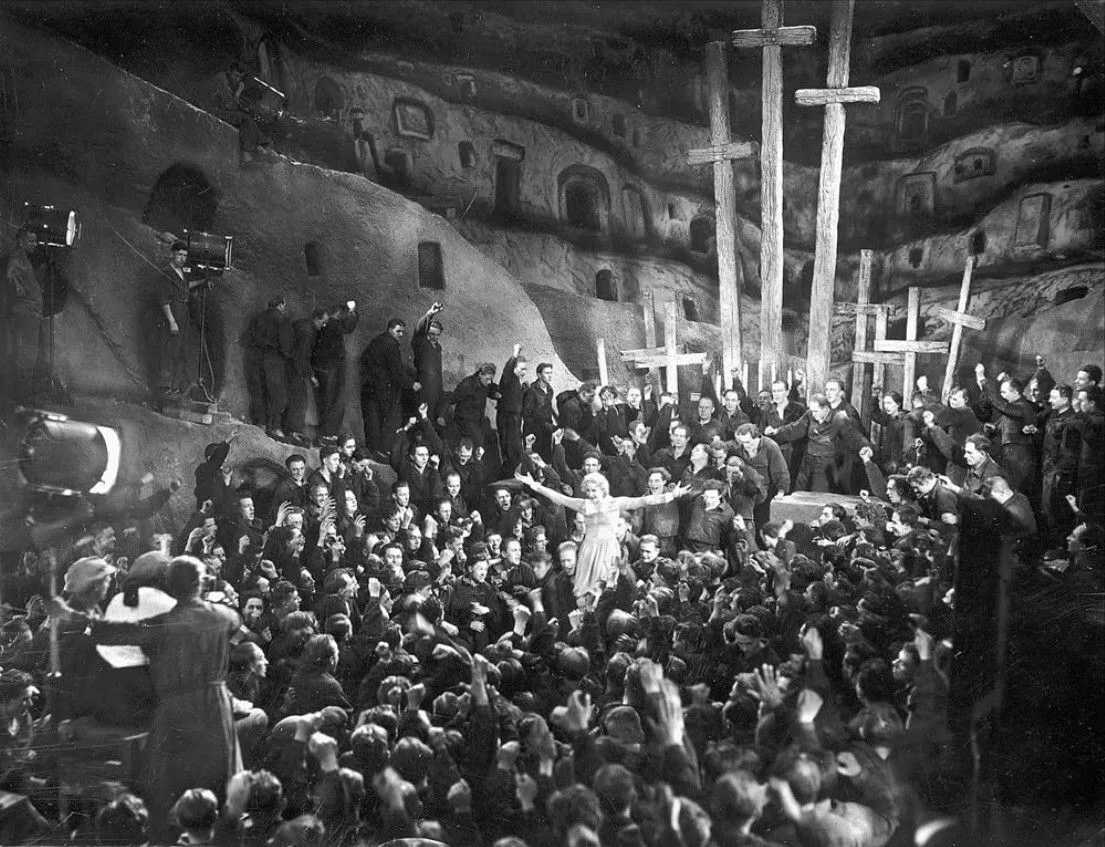
Prior to the performance, the makers apologised for misogynistic and racist caricatures. These included, among other things, the stereotypical victim role of women in horror films, such as the scene in which the 'real' Maria is pursued by the mad professor Rotwang, who, on the orders of the industrialist Fredersen, must create a robot Maria that preaches the opposite of the message of brotherly love and equality with which the real Maria succeeds among the workers in Fredersen's factory. In the film we indeed see a classic horror scene. Incidentally, I am not sure whether this scene would not be just as frightening if it were a man being pursued.
Furthermore, one can also think of stereotypes in the portrayal of Black people in the film, briefly seen as a musician in a jazz nightclub and as men carrying a large bowl on their backs, like the lions of the Lion Fountain in the Alhambra. But could Lang have intended those scenes himself as parody? In the US, extremely racist films had already been produced, such as The Birth of a Nation (1915) by D.W. Griffith, and the notorious blackface films from the very beginning of the film industry; the infamous The Jazz Singer dates from 1927. In any case, Lang did not use blackface actors. And his first American film, Fury from 1936, was meant to be about a lynching of a Black man in the American South. Although, under Hollywood censorship, the main character still had to be a white man and he had to move the location to the Midwest. Nevertheless, the message remained clear.
Regarding those caricatures, I do have questions about the character Rotwang, whose portrayal in the film recalls pre-Nazi caricatures of Jewish characters during the Weimar Republic. Rotwang lives in an eccentric hermit's house in the city and also bears a strong resemblance to the Golem figure from the Golem films of 1915 and 1920, in which actor/director Paul Wegener was involved, and who would later go on to make Nazi propaganda films. Incidentally, both Golem films also involved Jewish actors/directors and actors and directors who would flee from the Nazis. And Lang himself was (half-)Jewish. (On his mother's side, but according to Jewish law, someone is Jewish in that case.)
The thrust of the film, including the original texts in the film, initially seems Marxist: control over the means of production to the working class and workers instead of machines; the members of Wishful Singing even wear a kind of Mao suits.
But the people prove easily misled and bring about their own ruin through a prophecy from a manipulative leader, and that is perhaps what appealed to the Nazis in the film. Fritz Lang's until recently regular screenwriter and wife, Thea von Harbou, had already joined the Nazis in 1932.
Lang's film Das Testament des Dr Mabuse from 1933 was banned by the Nazis. Nevertheless, Goebbels reportedly asked Lang to become head of the entire German film production, despite the fact that Lang was Jewish (on his mother's side). Lang, however, decided to emigrate, first to Paris and then, in 1934, to Hollywood, where his first film Fury became an artistic and commercial success and where he would help create the film noir genre, with, among others, The Big Heat from 1953.
Lang later said about Metropolis: "When I made it, I liked it. When I finished it, I hated it.
And for a very simple reason: because the thesis of my wife, Thea von Harbou, that the go-between, between capital, the brain, and the hands, workers, should be the heart. I didn't believe it."
Lang referred to the opening motto of the film "Mittler zwischen Hirn und Händen muss das Herz sein" ("The heart must be the mediator between brain and hands"). In the music it returns several times in sung form. It is in any case an alternative to the 'Tod den Maschinen!' ("Death to the machines!") that the false Maria preaches, which also returns a few times in the sung texts.
The Gregorian Dies Irae plays a role in the score, always a beloved melody for warning of the end of times. In trusted hands with Wishful Singing, which, for KRO-NCRV's Tussen Hemel en Aarde on NPO Klassiek, has delved into a series of Gregorian chants for the Sundays of Advent and Lent.
The Gregorian Ave Maria also resounds, as a regular Leitmotif whenever the "real" Maria appears in the film.
Fun: each time the gigantic factory steam whistle appears on screen, the singers imitate a steam whistle with dissonant harmonies. Does the vocal part also become, a few times, almost-Ligeti, the Ligeti of the Requiem, also used in 2001: A Space Odyssey?
The currently available longest version of the film is now also available in full on YouTube, with the music originally written for the film by Gottfried Huppertz from 1927.
(NB This version is almost completely complete since, in Buenos Aires in 2008, about 20 minutes of the film, thought to be lost, surfaced; it is suspected that about 5 minutes are still missing, which can be inferred, among other things, from a section of the story being absent and from the amount of music by Huppertz. In the YouTube version and in the film used for this performance, the missing story is indicated with text slides.)
De destijds beschikbare, maar dus ernstig onvolledige versie uit 1984, waarvoor popproducer en componist Giorgio Moroder de muziek verzorgde, is ook op YouTube te vinden. (NB Dat deze versie in 1984 uitkwam, het jaar waarnaar George Orwells futuristische roman was vernoemd, is niet toevallig.)
Metropolis (1927), film van Fritz Lang met muziek van Steven Kamperman
Uitvoerenden
Wishful Singing
Yonga Sun percussie, modulaire synthesizer
Steven Kamperman compositie, basklarinet
Jorrit Westerhof elektrische gitaar
Gezien 11 oktober, Muziekgebouw aan ’t IJ Amsterdam
Trailer: