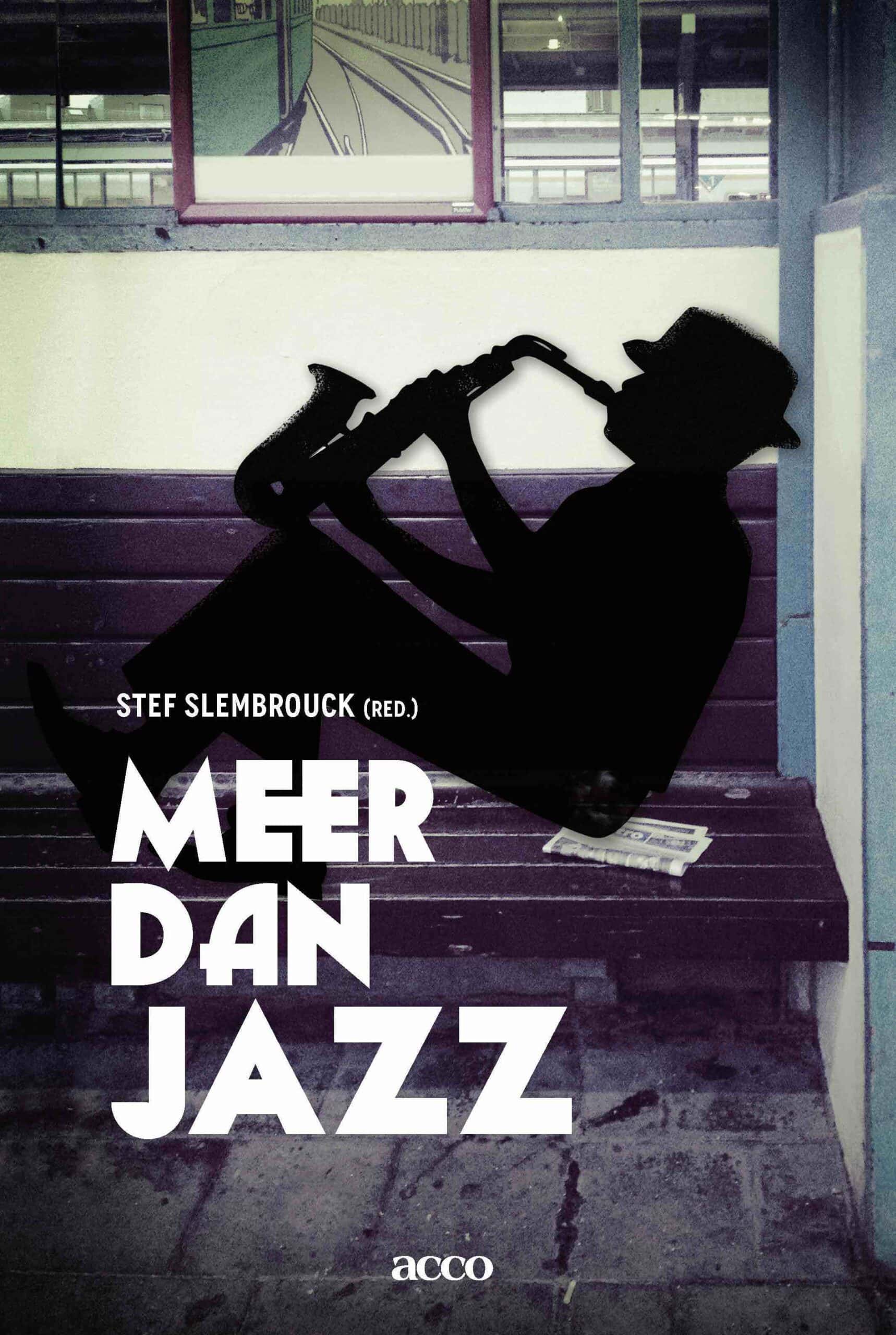
And yes, jazz has also caught the attention of serious composers: in 1918 Stravinsky already came up with his Ragtime, Georg Antheil wrote "A Jazz Symphony" in 1925, and later there was Shostakovich with his two Jazz Suites. And jazz too has, just like classical music, its "iron" repertoire. But has jazz, with its improvisations on those many American Songbook "standards" not become a museum music genre, tied to a bygone era? A professor of linguistics at U Gent sought out a select group of jazz companions to describe that nevertheless exceptional 20th century music genre with him from a multitude of perspectives. They each do so from their own expertise: musicologically, historically and art historically, sociologically, journalistically…. The title is therefore "More than Jazz" edited by prof. dr. Stef Slembrouck.
All of this based on an academic lecture series he organized at U Gent. What prompted it? The hundredth anniversary in 2017 of jazz music. At least if you take the appearance of the first recording in 1917 in New York as the birth year. But is it still successful or accessible in its contemporary forms? In a first chapter, musicologist Maarten Weyler tries to help us understand how those jazz musicians work. It is the most difficult chapter but also the most thorough. With an explanation of how a "song" is musically constructed, what chords can go with it etc. He compares different performances of a "standard", sung versions and instrumental. Jazz turns out not always to be "easy listening". But you are helped with references to YouTube videos where you can easily find and listen to things. A more than excellent analysis, also on improvisation and instruments. With for example an extremely precise description of what a rhythm section or drum kit can mean: and how that works with those "brushes", "sticks", "snare drums", "cymbals"….. A brilliant example of jazz instruction.
Musicologist Marc Leman (IPEM-Gent) talks about "listening to jazz". That sounds simple but it isn't. He investigates that scientifically. What music does to our body. And yes, with jazz you often can't sit still, that's right. Academic studies on this exist and have even produced the concept of "embodied music cognition". In his lab, motion sensors and cameras come into play, neuroscience and mathematical models. High-tech research. Fortunately there is also the anecdote about how Miles Davis moves with his big toe and what that does for the synchronization between the musicians and the jazz fans, for their body and brain.
Easier and more pleasant to read is Matthijs De Ridder's story about how that Jazz Age spread in Europe. Watch out, here speaks a literature scholar and he travels through the European literature of that time for it. And he also passes by "Jazz in little Belgium." It is full of lesser-known facts about that jazz history during that interbellic period. And very instructive too about the evolving career of Paul Van Ostaijen. How the poet-activist, fleeing from Berlin where he had gone, preached his popular revolution: jazz and dada. How it should be done, he described in his film scenario "The Bankruptcy of Jazz". A wonderful piece of forgotten Flemish literary history! As a bonus you also get how jazz was dealt with in a few novels from other Western European countries.
A separate story comes from Christopher Hall from London where jazz also arrived far removed from the "homeland…." Was there room for a European jazz there, for example in that famous jazz club of Ronnie Scott? In that London jazz scene there were according to him four important musicians and he briefly portrays them: the immigrant Jamaican Joe Harriot, (mixing Caribbean music with "free form jazz"), the white South African Chris McGregor who with his mixed jazz groups such as the Brotherhood of Breath challenged the apartheid regime, the influence of rock and pop music via John McLaughlin and the London improvisation music with figures such as Derek Bailey and Evan Parker (both also welcome guests in the Bruges temple of free jazz, "De Spiegel" of Maurice vande Vannet, where I often saw them at work.)
About how important technology has been for documenting jazz, lecturer and researcher Matthias Heyman tells extensively: from early piano rolls via 78s and the longplayer to sophisticated recording studios and the role of sound engineers (such as Rudy Van Gelder). About how important radio was in the thirties in the States for the popularization of swing. And about the consequences for the emergence of bebop during the musicians' strike in the conflict over copyright. With, also in jazz, attention to the "historical performance practice".
Jazz and film is right up the alley of film historian Pascal Vandelanoitte from LUCA Brussels. You'll learn all about the use of jazz in films: accompanying silent films, sound films and biopics about jazz musicians. Also how that music was often connoted with sexual and moral decay. Attention is also paid to the different film genres: the "film noir", the difficulties in the States to bring white and black musicians/actors together in times of segregation. And also about the European "nouvelle vague" with iconic films such as "Ascenseur pour l'échafaud" (with Miles Davis) and the soundtrack of "A bout du souffle". I myself would also add "Odds against tomorrow" as a film noir with that intriguingly dark music by the Modern Jazz Quartet.
It is a literature scholar, Sarah Posman (and that is evident from the attention paid to the written word alongside the performed music) who in a separate chapter tries to get a grip on voracious John Zorn. Jazz musician, yes, but also so much more. Saxophonist and perhaps even more of a kind of ideologue of his own avant-gardism and who tries to formulate that as well. Musically he does that by playing in constantly changing formations with which he sets up his projects. And he writes that down in the essay "Memory and Immortality in Musical Composition" which is discussed extensively here. Also read the interesting pages about his Jewish identity that John Zorn rediscovered with his group Masada.
In a smooth and clearly written contribution, Didier Wijnants, long-time jazz critic of De Morgen, introduces us to quite a special figure. He situates in a small monograph the life and work of pianist Andrew Hill. According to him, this jazz musician stands in the tradition of Thelonius Monk but also grows beyond it to evolve towards an idiosyncratic and sometimes bizarre sonic world. He also studied composition with Hindemith and was a university lecturer for a while. Picked up by the new record label Blue Note, he enjoyed particular success. With his piano playing he brought a new swing to the free improvisational jazz of that time with his "characteristic refusal to land exactly on the beat". An "anti-metronome" writes Wijnants, with "tilting music". A very nice portrait by a great fan of the "well-kept secret" Andrew Hill.
And how I would have liked to be at that interactive masterclass by the trio of Ben Sluijs with which that lecture series was concluded then. You might get some sense of it if you read in the transcript of what happened how their playing, the accompanying explanations and the dialogue with the audience present proved to be a real improvisational experiment. Central was the question improvisation, what is that really, "playing in the moment"? From the many possibilities choosing what feels right, also in relation to the people you play with.
With "More than Jazz" this book does not provide yet another jazz history or another photo book about the genre. Quite a few academics populate this book, but it is a thoroughly worked-out piece of work that lets you discover many unknown aspects and figures of that music. What makes it unique? We read the approach to this phenomenon from a scientific research interest. That's right. Recommended!
WHAT: "More than Jazz"
WHO: Stef Slembrouck (ed.)
PUBLICATION: ACCO