

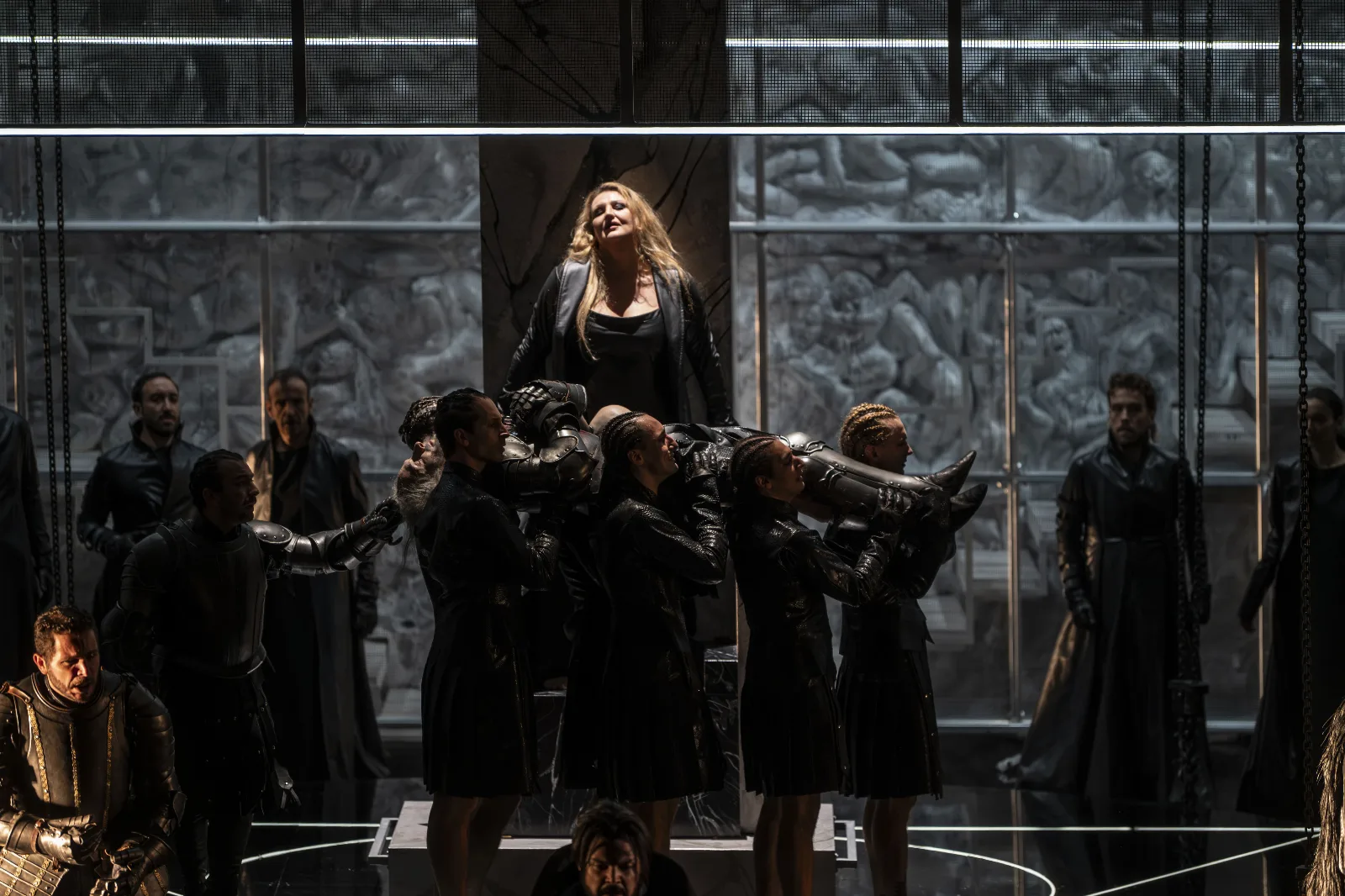
The Opéra Royal de Wallonie opens its season with a fascinating staging of Verdi’s opera, Macbeth. Although Macbeth still belongs to Verdi’s early works, the dramatic concision and musical power of his oeuvre are already fully present.
Director Stefano Poda succeeds very well in his production in exploiting the machinery of the drive for power. From the very first scene, the set design emphasizes how frightening the lust for power is. The unified set that fills the entire scene consists of contorted and deformed bodies, piled up like a charnel house. The gothic, unsettling atmosphere is further intensified by the black costumes. Poda underlines the role of the witches as the driving force of the drama, and their performance in the opening scene is therefore particularly spectacular. The witches crawl, hang and sneak across the stage. A magical image and a theatrical tour de force. Their performance in the third act is also choreographically accomplished and makes the scene in which Macbeth’s ghost is haunted by apparitions hallucinatory. Hallucinatory may well be the best adjective to describe this staging. Stefano Poda also has an inventive solution for the bizarre passage of the “Wood of Birnam,” which according to the libretto comes into motion, with the red poles serving as trees or weapons.
Giampaolo Bisanti: magnificent
Besides the witches, Lady Macbeth is the second driving force in Verdi’s opera about the drive for power. Poda’s direction is also precisely worked out for her. The cold-bloodedness with which Lady Macbeth dominates the scene, both during the murder of Duncan and in the banquet scene, makes her the true protagonist of the production. In her sleepwalking scene in the last act, where Lady Macbeth’s ambition gives way to distress, with her second great aria Una macchia è qui tuttora, Ewa Plonka absolutely has her moment of triumph as a performer. She sings this aria chillingly well, “hard, muffled and dark,” as Verdi desired for Lady Macbeth. The biography of baritone Luca Micheletti sets high expectations for his portrayal of Macbeth, and he fulfills them convincingly. His powerful yet warm voice goes together with a perfect empathy. The greatest praise goes to conductor Giampaolo Bisanti. He has lifted his orchestra to an admirable height in this demanding score. Both the mysterious atmosphere of the witch scenes and the emotional impact of every passage receive the right nuance in rhythm and dynamics. He lets fear and distress sound from the instruments, keeps the tension continually sharp, and the result is the perfect expression of the consistent tragedy of Verdi’s opera. Splendid.