

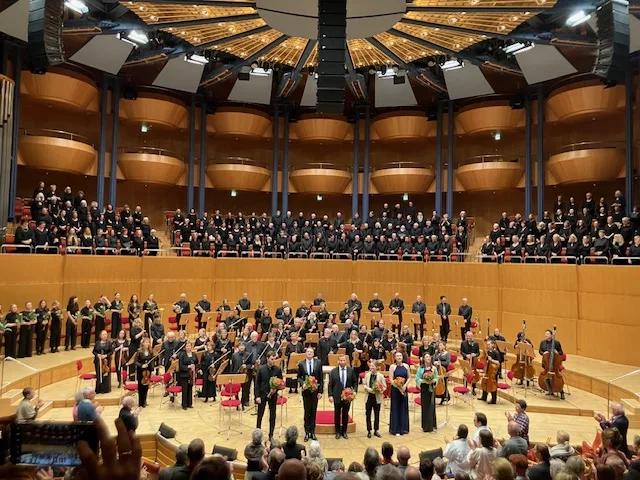
On Sunday morning, 18 October, the Kölner Philharmonie programmed Robert Schumann's (1810–1856) Requiem für Mignon and Michael Tippett's (1905–1998) A Child of Our Time. The Rodenkirchener KammerChor und Orchester, the Philharmonischer Chor Köln and Onzemble Coeln performed with the Neues Rheinisches Kammerorchester Köln under the direction of Nico Köhs.
The two works differ greatly in character. Schumann's music is lyrical and restrained, while Tippett takes the listener into a harrowing story about persecution and violence. Yet both works touch on the feeling of never truly belonging anywhere and of being excluded by others. In Schumann, one hears the grief over Mignon, the young woman who seems to find no shelter anywhere. In Tippett, the suffering of one boy takes on a much larger meaning: it exposes how prejudice and hatred can grow into persecution and brutal violence. However different the two works are, neither remains with sorrow alone. Their music also carries the hope that, despite everything, there remains room for consolation and reconciliation.
Between melancholy and consolation
In the Requiem für Mignon, Schumann was inspired by the character of the same name from Goethe's Wilhelm Meisters Lehrjahre. Mignon's death forms the starting point for music in which grief and consolation are closely intertwined. Schumann does not seek grand drama but lets the emotion speak above all through the lyricism and restraint of his musical language.
The choral parts carry the work. The female voices of Onzemble Coeln, who sang the separately notated soprano and alto parts, added a refined, transparent sound. The full choral mass sometimes sounded a little intense for the intimacy of Schumann's music, but the musical lines remained sufficiently clear not to crowd out the melancholy. Towards the end, baritone Konstantin Paganetti also stepped forward. His excellent diction made the text clearly audible and gave the close a personal accent.
The performance remained restrained and avoided grand dramatic gestures. In this way, Schumann's Requiem acquired a human warmth that contrasted beautifully with the much sharper indictment of exclusion and persecution in Tippett's A Child of Our Time.
Between menace and rhythm
Michael Tippett composed A Child of Our Time between 1939 and 1941, during the Second World War. The occasion was the assassination in Paris, in November 1938, of the German diplomatic official Ernst vom Rath by the seventeen-year-old Jewish refugee Herschel Grynszpan. The Nazi regime used this event as a pretext for the November Pogroms against Jewish citizens. Tippett did not make this history a mere reconstruction. The boy of the title also stands for everyone who is struck by prejudice and hatred and rejected by society. Thus the oratorio remains, regrettably, a current indictment of persecution and intolerance. The five Afro-American spirituals Tippett wove into it give collective suffering a human voice and at the same time open a perspective on liberation and reconciliation.
The more than 130 singers made an impression, not only through their numbers but above all because they functioned largely as a single sound mass. In the high registers the choir sometimes sounded less free and secure and lost some of its brilliance. In the spirituals this limitation largely fell away. There the ensemble sang with conviction and rhythmic suppleness.
The orchestra also did much more than accompany. The music was allowed to grate and twist where necessary. The orchestral sound gave the work its unrest and menace, although the balance was not always ideal, especially when the soloists were set against the full choral mass and orchestra. Nevertheless, the orchestral contribution gave the performance an important dramatic force.
Conductor Nico Köhs held the large forces together without robbing the music of its tension. Especially in the rhythmic passages of the spirituals, choir and orchestra remained well coordinated. He succeeded in guiding the large ensemble musically while also giving room to the dramatic contrasts.
From Steal Away to Go Down, Moses
The soloists gave the individual drama a voice against the collective strength of the choir. Baritone Konstantin Paganetti made the strongest impression in this respect. As narrator, he seemed truly to experience what he sang. As a result, his interpretation did not stop at depicting sorrow but acquired a human immediacy that gave the music additional weight.
In I have no money for my bread, tenor Stefan Sbonnik brought the boy's distress close to the listener. Soprano Elena Harsányi fitted well into the whole with her warm voice. As had been announced beforehand, illness prevented her from fully exploiting her vocal possibilities, but her contribution remained sensitive. Mezzo-soprano Ruth Häde also contributed to the drama. The voices did not always rise sufficiently above orchestra and choir, however, so that parts of the text were sometimes lost, even though it is precisely the words that make the personal suffering tangible.
Steal Away brought a first highlight. Here the choir seemed entirely at ease. The spiritual acquired a natural flow and a sustained sound, so that the melody could speak for itself. The size of the ensemble sounded here not as a challenge but as an asset.
In the second part, the letter to the mother once again gave the soloists room to illuminate the personal side of the drama. The rhythm of the following Nobody Knows the Trouble I See then created a striking contrast. The music gained momentum and worked infectiously. Despite the large choral mass, the rhythmic interplay remained supple.
The most powerful choral moment was Go Down, Moses. The call to liberation acquired a piercing, collective force. The song did not sound like a resting point, but like an urgent indictment against oppression. The passages that followed, centred on the young man in prison, brought the listener once again close to the hopelessness of his situation. The transition from the collective cry for liberation to the personal suffering of the young man made the dramatic core of Tippett's work sharply felt.
An Open Ending
In the third part, the perspective shifts. With I would know my shadow and my light, the thought of reconciliation gains more space. The music does not seek an easy solution, but insight into the contradictions that lie hidden in every human being. This turn leads to the closing section, in which the tension gradually gives way to stillness.
The oratorio ended quietly with Deep River. After the powerful choral passages, the music sounded like a final look back on the suffering endured. No triumphant victory followed that erased all questions. In that stillness lay no ready-made answer, but the possibility that compassion can be stronger than hatred.