'From Among Us' - reviews of work by and of musicians from among us...
Pianist Hans Ryckelynck lets Debussy embrace Belgian composers
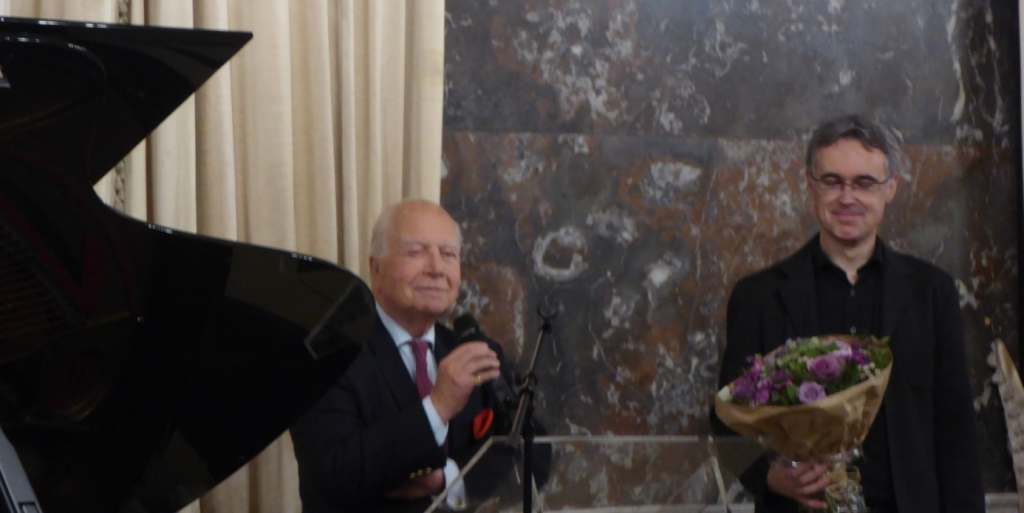
It was Mark Eyskens, chairman of the organizing Academic Cultural Forum, who used that metaphor in his introduction to sum up the evening's programme. Pianist Hans Ryckelynck indeed brought a number of works by Flemish composers, all members of the Arts class at the Royal Flemish Academy of Belgium for Sciences and Arts, but began and ended with work by Claude Debussy.
It was a select academic gathering that came to listen to that recital in that distinguished Marble Hall of the Palace of Academies. And I always find it a privilege when, as a listener, you can sit almost in the piano in such a beautiful but small hall and feel those sounds waft over you like a warm wind. He opened with that familiar Suite bergamasque and yes, that Clair de Lune extracted from it still moves you. It is inspired by that poem by Verlaine with those languorous lines about the "....calm moonlight, sad and beautiful that makes the birds dream......". Impressionism and symbolism par excellence. It always makes you quiet. Debussy also surprises you time and again with those unexpected turns and solutions. A innovator he certainly was. Very different sounding were then five short pieces, "Preludes" by Luc Van Hove. A youthful work, post-romantic and at the same time modernistic. The two works by Wim Hendrickx also have their own and different style. Rhythm is hardly ever absent from his work, but especially his "Elegy" pianist Hans Ryckelynck played beautifully, also by letting the sounds of the chords resonate almost endlessly.
"That was indeed noted in the score, 'al niente', let it fade away to infinity towards nothingness. At such moments, if executed properly, there is a certain tension in the hall until the sound dissolves itself. And ending too early is then actually a curse, but if it works, there is concentration in the hall, like a kind of mystery."
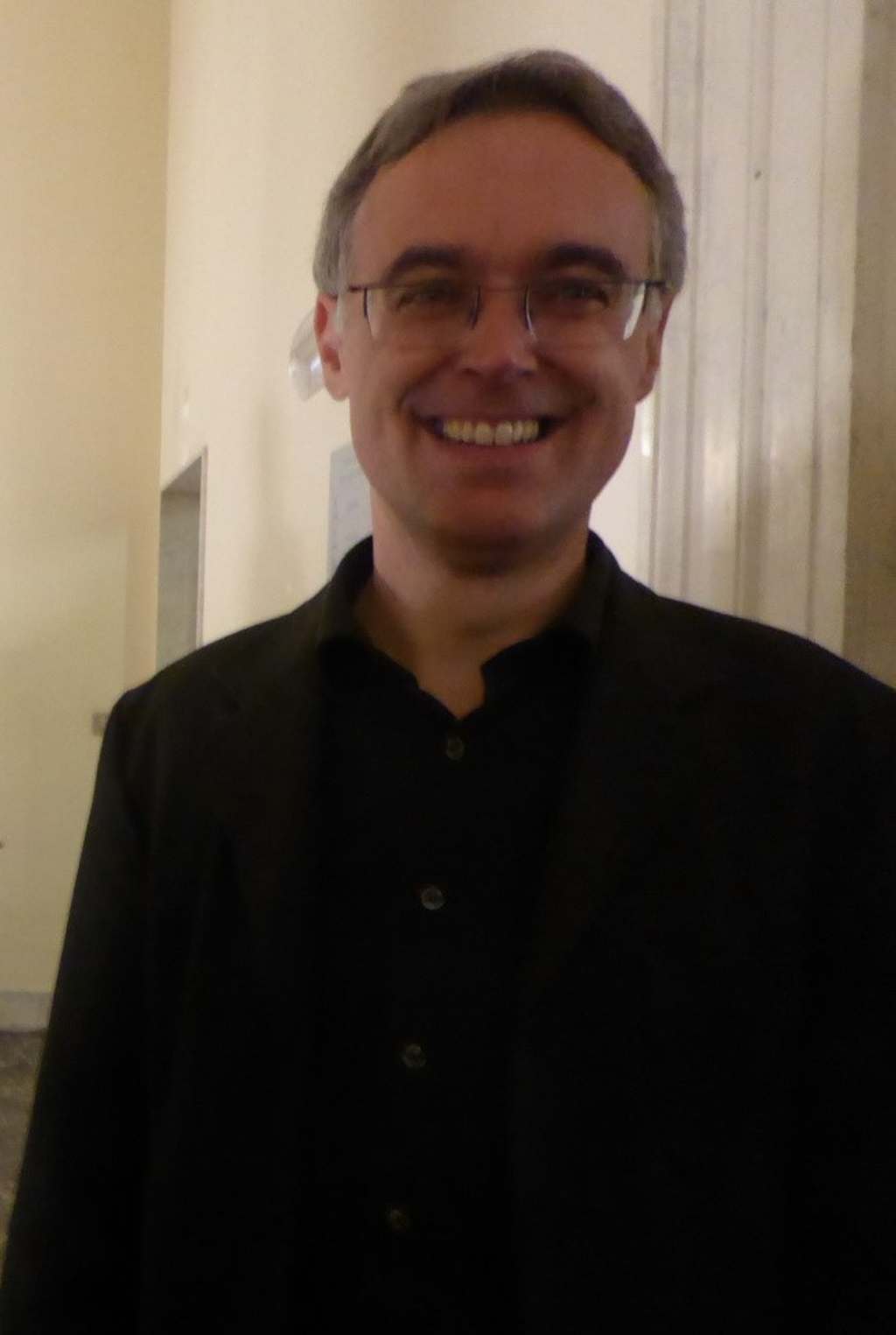
Hans Ryckelynck studied, among others, with Abdel Rahman Bacha, teaches at the Conservatories of Brussels and Bergen and has already made 15 CD recordings. From the oldest among the Belgian composers of the evening, André Laporte, there were three pieces in the programme, including a Prelude built from a twelve-tone series. You should know that in the sixties he still participated with modernists such as Boulez, Maderna and Stockhausen at those famous music days in Darmstadt and Cologne. Those who want to know more about Laporte might be able to read about it next year in his autobiography which he is writing and which will be published then. From Piet Swerts we first heard "Le jardin à Giverny". More characteristic of Swerts and more homage to Debussy cannot be: he calls it neo-impressionistic himself, but the most impressive was that more substantial "Seeker of Truth". A real concertante fantasy and also the most 'pianistic' work of the evening, which puts the entire piano to work from high to low. He himself refers to it as an onomatopoeia towards a cryptic-poetic line by American poet E.E. Cummings: "Seeker of truth, follow no path, all paths lead where truth is here." Partly by dwelling in that "here and now" Swerts continues to write very accessible music. Second to last in the line came composer Roland Coryn, with 3 pieces for solo piano, opus 2 from 1970 by the then still young 'tone poet'. They are his first piano compositions, "based on a tone series from which distinct themes develop". "How do you play all these works then," I asked Hans Ryckelynck, "confronted with such diverse styles from six such different composers. Don't you have to gasp for breath every time?"
"The difficulty is in any case to try to understand each work, each composer as well as possible during rehearsal, to feel in which direction it goes in terms of expression, also what is not on paper, what is between the notes, which is actually the most important thing, what is the message of each composer, in short: by working a lot with it, by reading about it, by absorbing it. But of course you are never sure. And then yes, making the switch with each piece separately, from innermost poetic to percussive, from very expressive to impressionistic. They are many different angles, styles, sometimes totally different worlds and then it is especially a mental matter of being able to switch quickly. And once you have worked on it, those fingers will eventually do what they must, even if it is sometimes a kind of zapping…"
Finally, Debussy was allowed to warmly embrace us again with his "L'isle Joyeuse" where you hear the notes like teeming water continually rippling around that island until it begins to storm exuberantly. Mark Eyskels thanked the performer and the composers, "whom you could hear whisper between the notes". The only downside of this live concert was that you cannot experience it a second time. A pity, but no matter, because after all we have been able to sharpen our hearts, minds and senses again, discovered something new and made our lives a little richer.
- WHO: Hans Ryckelynck, pianist
- WHAT: piano works by Claude Debussy (Suite Bergamasque, L'isle joyeuse), Luc Van Hove (5 Preludiën) Wim Hendrickx (Untitled and Elegie), André Laporte (3 pièces), Piet Swerts (Le jardin à Giverny, Histoire perdue and Seeker of truth), Roland Coryn (3 stukken voor pianosolo, opus 2).
- WHERE: Paleis der Academiën, Brussel
- WHEN: 29 November 2019