

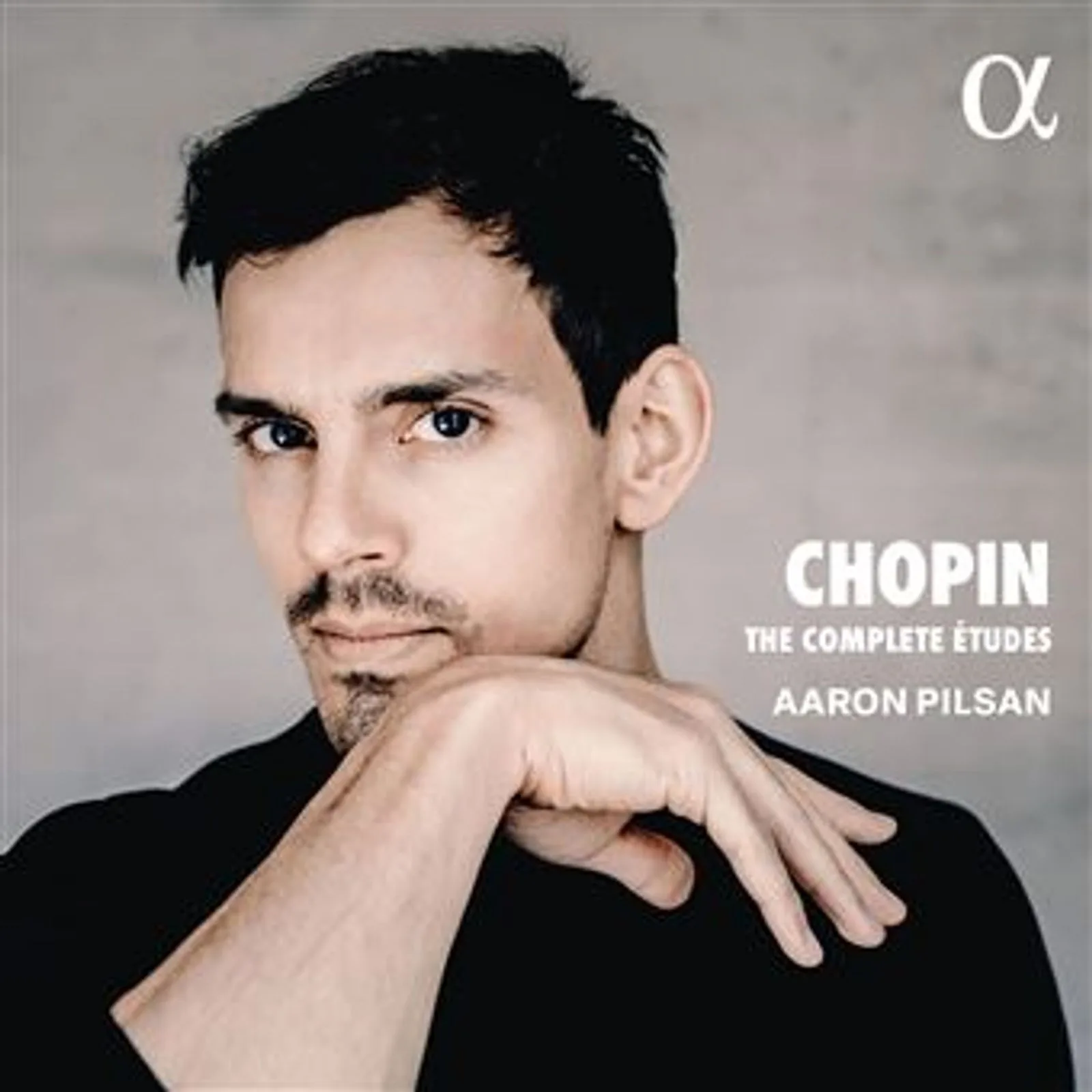
Chopin's Études (1810-1849) are among the most remarkable works in the piano repertoire: they are at once technical study, virtuoso repertoire and full-fledged concert music. It is precisely in this duality that their appeal lies. The pianist must master the technical challenges, while behind the virtuosity lies a rich musical and expressive universe. In his recording of the complete Études, the Austrian pianist Aaron Pilsan constantly lets these two aspects come together. His playing is virtuosic, but the technique never becomes an end in itself.
Pilsan presents the twelve Études op. 10 and the twelve from op. 25 together with the three posthumously published Études, making 27 pieces and over 66 minutes of music. The recording also follows on from his earlier Bach projects. In the accompanying interview, Pilsan emphasizes the polyphonic qualities of Chopin's piano music and the importance of the left hand as harmonic and rhythmic foundation. This perspective also determines the way he plays these Études: different voices and musical lines remain audible alongside and beneath the melody. As a result, a performance emerges in which technical mastery serves mainly to make the musical layering of Chopin's music audible.
Between technique and song
From the very first Étude of op. 10, you hear how naturally Pilsan masters the technical difficulties. The broad arpeggio figures remain clear and at the same time acquire a distinct musical direction. The right hand could easily claim the attention here, while the harmonic development recedes into the background. With Pilsan, that underlying layer also remains constantly audible. This gives the more lyrical Études extra depth.
In No. 3, Pilsan never makes the melody bigger than necessary. The song arises from the phrasing and the balance between the voices, and precisely for that reason it touches the listener. Simple, yet deeply felt. In No. 6, with its dark and introverted character, he also remains remarkably precise. As a result, the melancholy is given full space. Pilsan adds nothing on top and lets the music do the work itself.
In this performance, op. 10 also regularly receives an energetic impulse. In Études Nos. 2, 4, 5 and 7, Pilsan displays his finger agility, always within the musical movement. At the same time, a clear joy in playing comes through. In No. 8, the graceful character takes on a light romantic undertone, while tension remains beneath the surface. No. 9 has something searching and is played very refinedly. No. 10 gains more dynamism and mobility and brings the series to its high point. In No. 12, Pilsan finds the necessary drama and romanticism to conclude op. 10 powerfully.
Also beautiful is how, in Pilsan's hands, the Études sound as a whole. They follow one another like twelve chapters of a single novel. Each Étude has its own character, while you simultaneously feel how the pieces are connected.
More than virtuosity
In op. 25 the musical landscape changes. Pilsan clearly produces a different sound here than in op. 10. The music gains more contrast and constantly moves between lightness, lyricism and drama. Especially in the way he handles rhythm, tempo and the different voices, a great variety emerges.
You hear this already in No. 1, where rhythm strongly determines the character. No. 2 sounds almost like a gallop and receives from Pilsan a playful character, with a light touch. No. 3 also has a faster tempo, without ever sounding hurried, and additionally acquires something modern. In No. 5, Pilsan gives the unexpected harmonic turns full room, while the music retains its natural flow. No. 7 becomes almost a small musical world in itself: the melody takes on a vocal quality, while the accompaniment carries the emotional undercurrent. In No. 11, Pilsan makes an impressive drama, in which power and refinement constantly stand against each other. No. 12 connects intensely to this, without the drama ever becoming too heavy.
Pilsan also plays the Études of op. 25 as a continuous cycle, without treating the individual pieces as loose virtuoso numbers. Musically, I find this second series perhaps even more exciting than op. 10, precisely because he reveals so many different sides of this music. Anyone looking in Chopin's Études mainly for the extremes of pianistic bravura will find less spectacle in Pilsan. His reading is thoughtful and controlled.
After the intensity
The three posthumously published Études then form a fine conclusion. After the richness and intensity of op. 10 and op. 25, this music sounds smaller in scale and more concentrated. The technical challenges remain present, but Pilsan places the emphasis mainly on precision and musical expressiveness. He therefore treats these three pieces as fully fledged parts of the whole.
After the vehemence with which op. 25 ends, they bring the listener back to a smaller musical scale. Precisely for that reason, the nuances receive full space. Pilsan plays them with great attention to detail, without unnecessarily weighing the music down.
His handling of rhythm is one of the strong points of the recording. Fast passages remain mobile and are given enough freedom to avoid mechanical rigidity. At the same time, Pilsan preserves the precision needed to keep Chopin's harmonic and rhythmic lines clear. This combination of suppleness and control works especially well in the technically demanding Études.
That is also why the comparison with Bach, which Pilsan makes in the interview, fits this recording so well. He has a constant ear for the voices beneath the melody. The left hand not only provides the harmonic foundation but also carries the movement and rhythm of the music. Even less prominent lines thus gain weight. This gives the individual Études a strong sense of mutual connection.
The quality of the recording also supports this clarity. The piano sounds spacious and natural, without the recording imposing itself on the instrument's tone. The recording was made in March 2026 at the Beethoven-Haus in Bonn. The acoustics reveal enough detail to follow the different layers of Chopin's pianistic world, while retaining enough resonance to preserve the warmth of the music.
With this recording, Pilsan moreover realises a project that had existed alongside his Bach recordings for some time. His two volumes of Bach's Wohltemperierte Klavier previously appeared on Alpha; now he turns to the Romantic piano repertoire. The link with Bach is more than a biographical detail. It helps explain why Pilsan pays such close attention to voices, rhythm, and the way different musical lines come together in Chopin.
Behind the fingers
In a complete recording of Chopin's Études, technical mastery alone is not enough. Pilsan does more than that. His Chopin is virtuosic without showiness, lyrical without sentimentality, and precise without losing spontaneity.
What stays with the listener is the coherence of the whole. Pilsan does not turn this collection of technical challenges into a showcase of pianistic skill. He shows how rich Chopin's pianistic world becomes when technique functions as a means of expression. In Pilsan's playing, technique never stands between the listener and the music. Rather, it makes the music audible.
