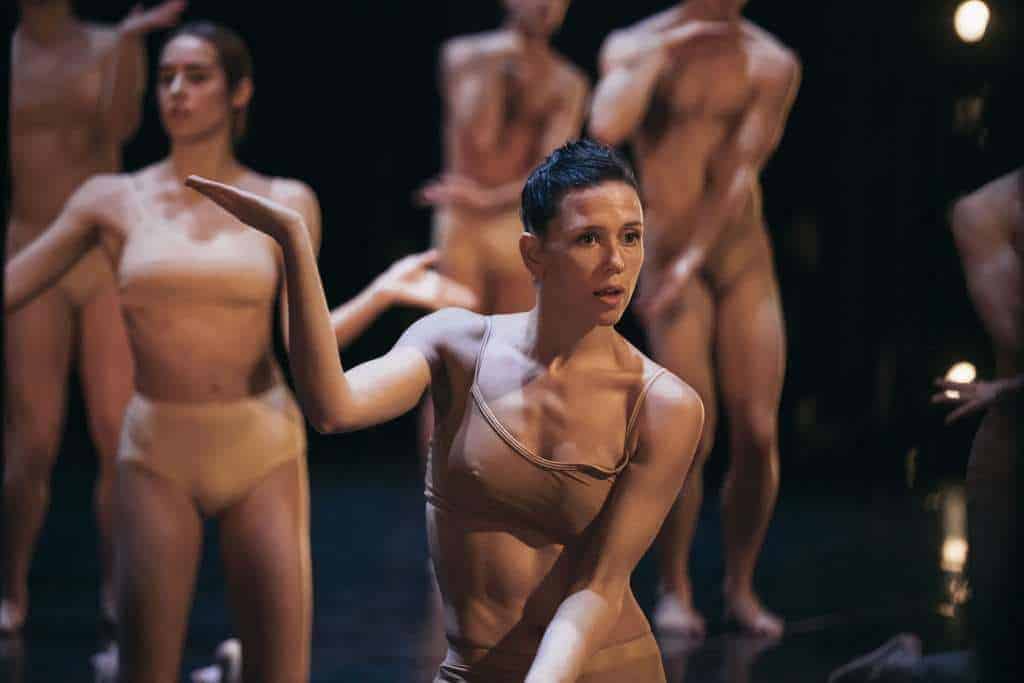
Opera Ballet Vlaanderen, a beneficiary meeting point, is keen to present the great classical ballets with a facelift. Artistic director Sidi Larbi Cherkaoui is deliberately seeking choreographers who will create a new, fresh version of the classics. For the 50th anniversary of Ballet Vlaanderen, he invited the promising Argentine choreographer Daniel Proietto to update La Bayadère by Ludwig Minkus.
Origin and new context
La Bayadère (The Temple Dancer) is one of the showpieces of the classical ballet repertoire and was first staged by the Imperial Ballet at the Bolshoi Theatre in Saint Petersburg, in a choreography by Marius Petipa, on 4 February 1877. The ballet combined the exotic 19th-century setting of India with the astonishing virtuosity of Russian ballet technique. The original story tells of the forbidden love between a temple dancer and the warrior Solor.
Choreographer Proietto moves the story to the 21st century and to present-day India, highlighting the neocolonial gaze of the West on the East. Structural factors such as social and cultural norms. The bayadères still exist in India but have lost every social status. The bayadère in RASA is a gender-fluid prostitute who runs up against the boundaries of a misogynist world. The ballet thereby takes on a completely new colouring. It sheds light on phenomena such as gender, community, isolation and power relations. This results in a complete rift with the original work. An enormous gap yawns between past and present. The social order of the 19th century cannot be erased. The notion of calling this production a "contestation" is far-fetched.
In his choreography, Proietto combines techniques from classical ballet with elements from traditional Indian dances and contemporary movement.
The Swedish composer Mikael Karlsson wrote a completely new score with various kinds of music and influences from all corners of the world. It is performed live by the Casco Phil Orchestra, conducted by Benjamin Haemhouts. A fine match: the dramaturgical analysis fed the musical interpretation and vice versa. A surprising appearance is that of the apostle of the Flemish "levenslied" (songs about life), Guido Belacanto, who acts as a tuk-tuk driver. With his long grey locks, he embodies a wise man who, through his life experience, has gained insight into the winding paths of love. The monumental staircase over three different levels, with small platforms in between, offers many possibilities for play and dance. The costumes by fashion designer Tamai Hirokawa are worth seeing.
Performance
Giving a ballet content, tension and relaxation, resistance and compliance, cultural backgrounds in a connected vision is an extremely difficult task. Daniel Proietto wants to do too much. In terms of the performing arts, we live in an age of hybridisation, mixed forms and crossovers, and there is nothing wrong with that at all; it is usually enriching, but the audience comes to a ballet to enjoy, first and foremost, the dance.
Part one
This young choreographer pulls out all the stops and goes into overdrive. It is a hackneyed cliché, but less is more. The story is stretched out interminably and fragmented into anecdotes and a jumble of styles to give the whole thing some lightness. The robotically moving nurses, the fulminating Queen Victoria and Empress of India (Zoë Ashe-Browne) who is wheeled around in a wheelchair, the constantly orating Faker in a rhetorical flood (Matt Foley). It becomes somewhat of a pastiche. The action and storyline shoot from here to there like a ball in a pinball machine. Nevertheless, there are beautiful scenes in between, such as the duet between the street boy Nicky, who struggles with his gender identity (Daniel Domenech), and Solor, danced by the charismatic Cuban guest dancer Osiel Gouneo, in an intimate, intense interaction. Moving is the little street urchin who tries to get an education and wants to be noticed in society. There is also a skilful duet between Solor and Gamzatti (Nicha Rodboom), who are forced to marry. Solor responds coldly and dismissively, Gamzatti submissively. Only at the end of part one does real dancing break out in an explosion of vitality, and the whole takes on a cabaret-like character.
Part two
Choreographer Proietto does not, however, break away entirely from the original work. The "Kingdom of the Shades" takes on a particularly intriguing and hallucinatory form in his hands. Solor wanders lost among the white shades, a technical tour de force and an aesthetic experience. It looks metaphysical. The figures get lost in the border region where shadows move like waves in a gripping storm of images. The dead and the living brush past each other in their coming and going, and present and past touch and overlap each other.
Part three
In this final scene he goes all out once more with a water feature in which star dancer Osiel Gouneo shines. Here too there is an abundance of images: a frolicking elephant, bulls, monkeys, dancers with little wings, highly stylised Indian dance, exuberant Bollywood dancers in the water, everyone finds a place on the stage in an eclectic mix. Solor is alone in the crowd. Gradually the stage empties. What remains are a few beggars among whom Solor wanders, leading the audience back to the opening images. The circle is complete.
The audience no longer sees a 'ballet' but a gesamtkunstwerk that has expressive power and seeks to move and stir on a spiritual, intellectual and emotional level. Choreographer Proietto, however, does not fully succeed in this. The whole thing slips through your fingers like water, lacking tension and sparkle. The audience is left wanting more, which was palpable in the appreciative but not immediately enthusiastic applause. This young choreographer undoubtedly has talent but is still searching for himself and wants to display too much. For the dancers of Ballet Vlaanderen, nothing but praise.
- WHAT: RASA (after La Bayadère)
- WHO: Ballet Vlaanderen,
- CHOREOGRAPHY: Daniel Proietto
- COSTUMES: fashion designer Tamai Hirokawa
- MUSIC: Mikael Karlsson (composer), Casco Phil Orkest o.l.v. Benjamin Haemhouts
- PHOTOS: © Filip Van Roe
[embed]https://youtu.be/l_bFzWUxdXs[/embed]
[embed]https://youtu.be/oIibjUnG9_E[/embed]