

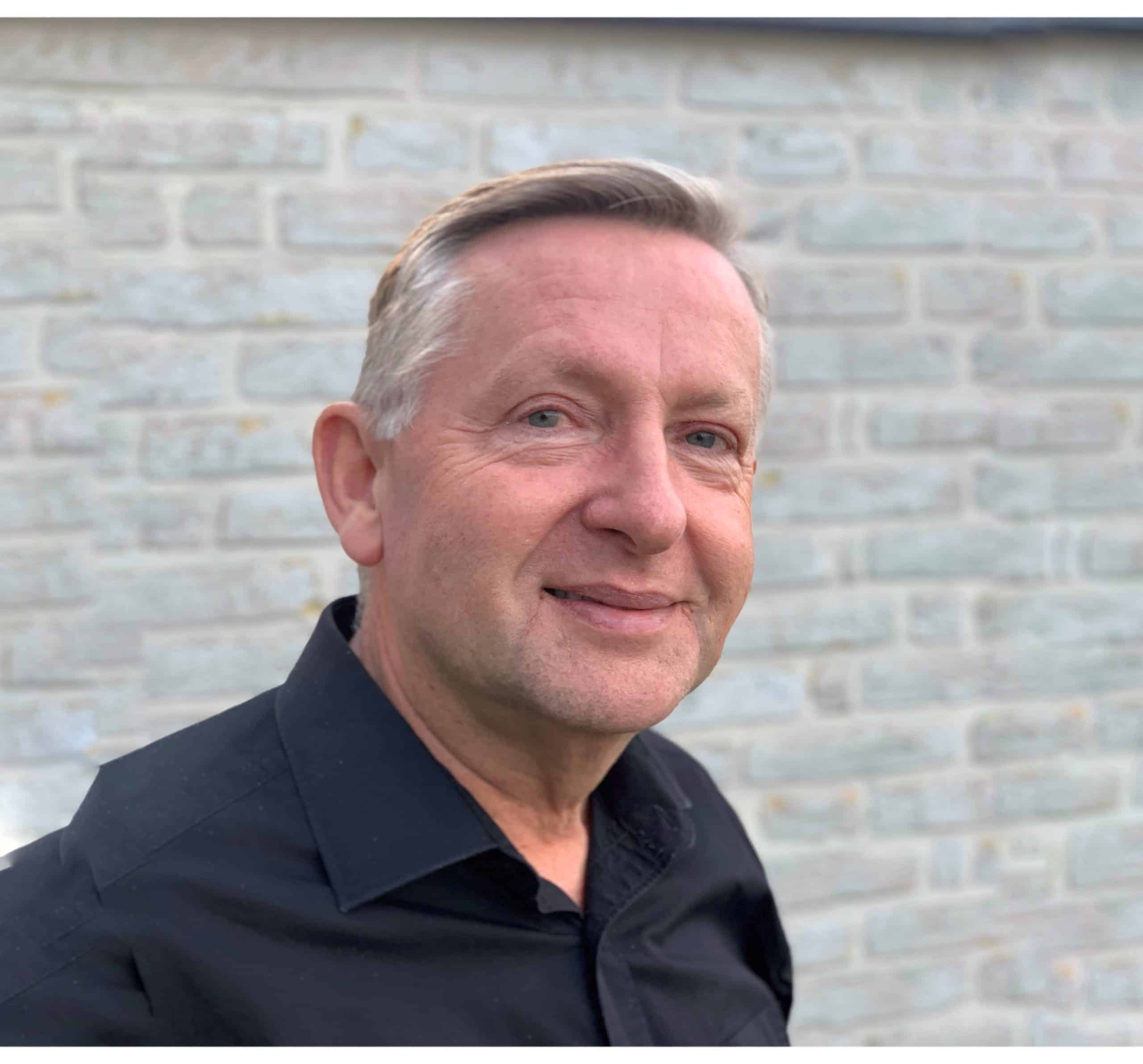
Pianist, conductor, composer and publisher. A repertoire ranging from piano, violin, opera, oratorio and wind orchestra to chamber ensembles. His musical toolkit is overflowing, but it didn't come easily. An candid conversation about the hard and soft sides of the profession.
"A piece must work. Ultimately, that's the only thing that matters to me. A score works once you have the feeling that every note you remove creates a problem. For me, perfect mastery of the craft comes first. Sometimes that's treated with disdain. But if you don't master that craft, then you're not a master. Pronounced complexity is sometimes an excuse or smokescreen because the composer hasn't reached the essence. I'll admit: nothing is as difficult as being transparent and clear. That's become my creed. You can write atonally or tonally - all music is essentially tonal - but it has to work."
Piet Swerts (Tongeren, 1960) actually wanted to become a writer. When he was small, he went to Flemish films and wrote letters to the actors. He then received handwritten letters in return. ("That was fantastic"). But his first written product was a musical piece. Swerts was then 11 years old. And for his 14th birthday he received a score of Strawinsky's Le Sacre du printemps. A year later he wrote his first orchestral work. After that, the train had left the station.
Little Aspirin
Swerts: "At 17/18 I was seized by avant-gardism. I then wrote Parallaxis, a hyper-complex work. It consisted of musical modules that you could combine, a complete role-play with detailed instructions. The notations were graphic, so the pitch wasn't precisely determined, but I had no problem with the ultimate sound result at the time. It sounded avant-garde, but allez, I was open to it.
I was then a very sensitive person and struck by the gigantic resistance of musicians to play something like that. I concluded that the freedom in that complex score was too great and moreover that the sound result always remained the same. But the musicians became so irritable that one of them put down his instrument, stood up and said: 'does anyone have an aspirin?' That deeply affected me. Those are moments that stay with you, because if that hadn't happened I would have been an enormously progressive composer."
The renowned Queen Elisabeth Competition ultimately worked as a turbo for Swerts' compositional trajectory. In 1987, his chance came when 'Elisabeth' announced a national competition for the mandatory work and Swerts' Rotations for piano and orchestra was selected. That gave a catapult effect and Swerts became musically famous overnight.
But perhaps 1993 was even more important because the Elisabeth Competition then announced the mandatory work through an international competition. There Zodiac for violin and orchestra was awarded, with 154 entries from 28 countries. A concrete consequence presented itself immediately: the commission for the opera Les Liaisons Dangereuses.
Swerts: "In retrospect, that was a poisoned gift. Usually you get such a commission as a fin de carrière but I was 33 years old – ambitious, young and inexperienced. I simply let myself be walked over. The collaboration with the conductor, director and librettist was a major problem. It started with the librettist, an expert in old French literature, but not in opera. He had never written a libretto before. The director had rarely directed an opera. In my case, I let myself be too influenced by the conflicts between the librettist and the director. I was caught in the middle and that conductor making his debut had an enormous opinion of himself. There was a major communication problem and I basically let myself be steamrolled. Terrible, terrible. I made five or six versions. I know that the day after I submitted the score I had acute pneumonia. Pure exhaustion. Fortunately, it didn't become a dramatic story because commercially it was a success, the ten performances were sold out. But the reception was very mixed, so that did give me a serious setback. I must say I learned an enormous amount from that."
Artistic Need
"Will I ever write an opera again? Absolutely. I think about it often. I don't need a commission for that. Take Debussy: he worked 10 years on Pelléas et Mélissande, without a client. Alban Berg, Beethoven the same. They went out of their own artistic need and presented the piece after it was finished. I think that's a healthy attitude, because you're not dependent on a client. Due to the financial aspect, they have something to say about the content. That's my greatest lesson: make no compromises on that front. At the moment I'm not working on an opera but I am toying with the idea of putting Jedermann by Hugo von Hofmannsthal into operatic form. I can say that I'm ready for it, technically and especially mentally."
Composition Process
"My working method is to start around 8:30 a.m. and if I have the opportunity, I simply continue working until I can't go on anymore. That's usually a maximum of 3 hours and then it just stops. The next day I play it back and continue. I try not to intervene consciously, actually I just want to let it happen. You try something and you see if it can take on meaning or not. Sometimes it's very difficult but after 3-4 versions you've moved on and then it points itself out. A creative process is unconscious, you let your intuition speak. Cutting is a conscious action where you tap into your intellect, based on everything you know and understand, but it must not be present during creation. For me, creating is an unconscious and natural process."
Music Publisher
"The big problem with large and established publishers, such as Schott or Boosey & Hawkes, is that they work with contracts for the duration of copyright, which is 70 years after your death. What company can guarantee that it will represent you in good faith 70 years after you die? Why would you go to a publisher and sign a contract by which you give up all your properties? So I started for myself. I now have my own publishing house Zodiac. I have approximately 130 publications, plus a digital web shop. That was a lot of work. I edited 5,000 pages in one year. The means are there: video recordings, audio recordings and you can view digital scores. It's worth the effort. I also see how many people visit the site and which visitor has made contact. In fact, it's not different from the working method of the Bach family, which was a whole business that sold the first copies of Das Wohltemperierte Klavier very expensively - they flew off the shelves."
Education
"In my teaching activities within the LUCA School of Arts in Leuven, the focus is on teaching skills. A student must already have the essence of composing within them. We basically try to create situations in which students can develop as many concrete projects as possible. I share experience with students. I see that many composition students always make the same kind of mistakes that I myself also made earlier. That is: not being aware of the materials. Many students have good ideas, but turn out to be unable to develop them into a meaningful whole. Sometimes someone comes with one page of score after a week. I sometimes write 200 measures in a day, but many students block quickly because they haven't examined the material from all angles. Then I say: also look at the texture, the orchestration, the power of repetition, the anacrusis, etc., so very small things that have an enormous impact."

Chamber Ensemble
"The orchestral medium is fantastic, but I'm now leaning more towards the chamber orchestra, so more intimate. Although everyone always dreams of the large symphony orchestra, as a composer you can put a lot into it. But it's always a lot of work and programming remains difficult.
I still dream of cycles. I've been thinking about that for a couple of years now, a cycle of 7 symphonies, but the challenge is to connect them cyclically with each other. Of those large-scale works, works that last longer than half an hour, that's always a challenge, especially because of the requirement of form control. I certainly saw that in my oratorio A Symphony of Trees (2017), but also in my collection of 24 Straight strung piano sonatas (2018)."
Communicative
Composition is an essential part of my existence. I learned that through hard experience, because I've had many commissions and yet also went through artistic depressions. Around my 40s, at the time of the Second Symphony, I really didn't see a way forward. Then I started a doctorate to open up a horizon again. I immersed myself in polyphony. Not out of frustration but to try to create perspective again. Through that, there eventually came a balance with the rest of my life. Writing music must be communicative, communicative to yourself and thereby also to others. If you see the craft as the highest thing, you invest a lot of yourself in it. So somewhere you communicate through yourself with the audience.
My oeuvre is very diverse. Does that mean I have no personality? Not at all. Versatility is a quality. In the past I had too little technique, but all the opportunities, and now I might have too much technique. My toolbox has become very large and so I can afford to make something out of the little that I have. That's fantastic."
- AGENDA
- February 26, 2022: Masterclass and subsequent concert and discussion (moderator: Olav Grondelaers – Klara) at the Stedelijk Conservatorium Hasselt (all day from 09:00)
- March 29, 2022: Masterclass for pianists at the academy in Genk
- April 7, 2022: Piet Swerts plays his 24 sonatas in the chapel of Hof88 in Almelo (NL). Dutch premiere. https://www.kamermuziekalmelo.nl/concerten/
- May 15, 2022: 24 sonatas in the Abbey of Averbode.https://www.averbodeklassiek.com/
- May 2022: premiere of Big Ben Rhapsody for carillon and orchestra, Cathedral of Mechelen. Info to follow at: pietswerts.be
- PHOTOS: Wynold Verweij
- LINKS: www.pietswerts.be www.zodiaceditions.com