

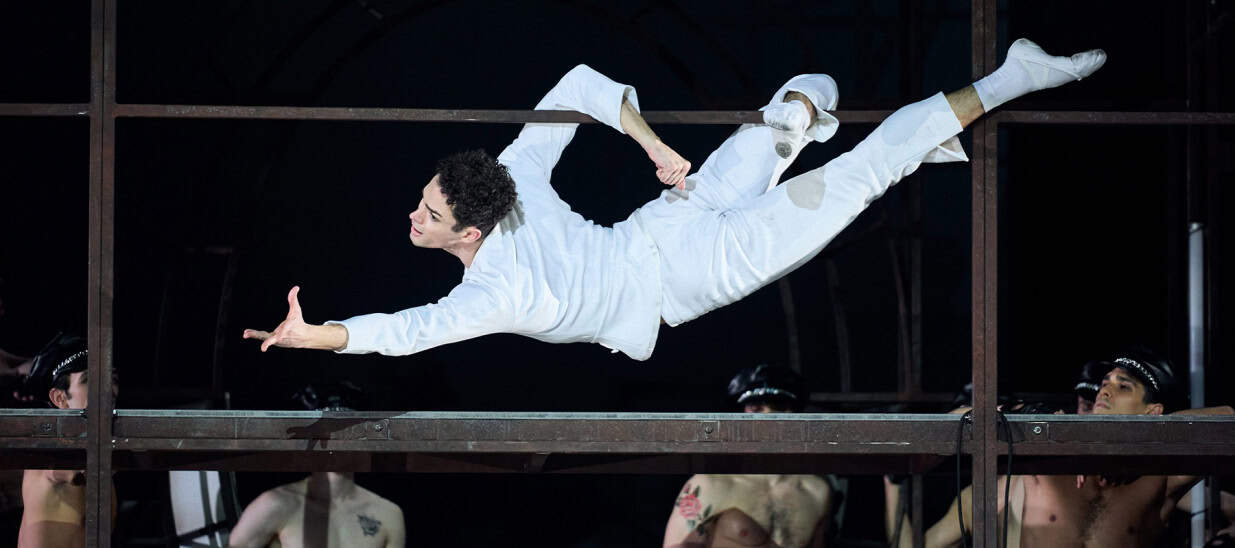
Some performances lend themselves willingly to retelling. Others – and Nurejew by the Staatsballett Berlin is a striking example of this – elude that urge to order. What one takes from the theater is not a clear story, but an impression, a tension, an aftershock. It is theater that does not reveal itself immediately, but only slowly articulates itself in memory.
Fragments of a biography
 This experience is deployed programmatically from the start. The performance opens with the auctioning of Nurejew's possessions after his death. The auctioneer serves as narrator and connecting thread, in both acts, linking the fragments together without ever fully explaining them. What follows is not a linear biography, but a fragmented reconstruction: objects, scenes and musical fragments appear and disappear, without allowing themselves to be definitively fixed. The procedure initially seems detached, almost cerebral, but gradually becomes inescapable: as if a life can only be approached through what it leaves behind – tangible, yet essentially incomplete.
That starting point aligns seamlessly with the figure of Rudolf Nurejew himself. This production refuses to reduce him to the familiar narrative of the brilliant dancer who escaped the Soviet Union and triumphed in the West. Instead, choreographer Yuri Possokhov and director Kirill Serebrennikov construct a portrait in fragments. At the Waganova school we see a young Nurejew arriving late for class and adopting a wilful attitude towards his fellow students – a body that early on resists discipline. The political context asserts itself forcefully when portraits of tsar, Lenin, Stalin and Khrushchev appear behind him in succession: history as backdrop, but equally as a pressing frame.
The break with the Soviet Union and arrival in Paris are not worked out as triumph, but as an existential leap into the unknown. Doubt, even fear, creeps into his movements: what does freedom mean when it offers no foothold? This ambiguity finds a counterweight in the scene in the Bois de Boulogne, where Nurejew discovers free love – not as unambiguous liberation, but as a space that remains equally uncertain and fleeting.
Within this fragmented dramaturgy, moments of striking intimacy arise. The letter to "Rudi", delivered by two students (Charles Jude and Laurent Hilaire), unfolds into a tender intermezzo, carried by harp and orchestra. Even more striking is the ensuing dance of the student, exceptionally deeply performed by Anthony Tette. Together with what follows, this belongs to the absolute highlights of the first act. It is a moment in which text, music and movement converge in a rare concentration.
 This intimacy finds an echo in the relationship with Erik (Martin ten Kortenaar). Their cautious approach and the subsequent farewell, marked by his lung cancer, together with the student's dance form the emotional centerpiece of the first act. This too is undeniably among the most moving and strongest passages of the performance. They contrast sharply with the public figure that Nurejew cultivates at the same time, for example in the reconstruction of a photoshoot in New York, where he poses naked and visibly seeks out confrontation with paparazzi, clearly enjoying the game of provocation and challenge that he himself sets in motion.
Music, body and (im)potence
Musically too, a deliberately independent course is chosen. The score by Ilya Demutsky does not function as a traditional accompaniment, but as an autonomous, cinematically inclined collage that propels the stage action. Even when the Vokalconsort Berlin launches into a song about the Heimat that resembles a Soviet anthem, there resounds not unambiguous nostalgia, but a wry ambiguity. Striking is how Demutsky never lapses into gratuitous modernism, but always finds the right tone and thus deepens the dramatic fabric.
Dance forms the beating heart of the production. Possokhov starts from the classical idiom but undermines it from within. Virtuosity is never mere display, but is deployed as an expression for a body that resists, collides and refuses to comply.
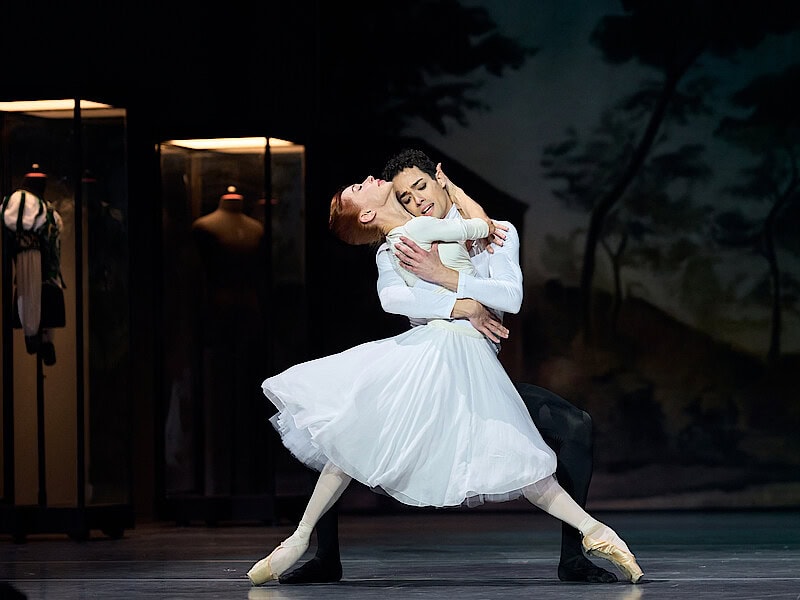 In the second act the auction returns as a structuring principle. Costumes from Nurejew's acclaimed roles gradually give way to recognizable fragments from Raymonda, Don Quichote and Swan Lake, which Demutsky subtly adapts. The appearance of Margot Fonteyn (Michelle Willems) forms a touching tribute, crowned with an intimate kiss, before the focus again splinters into a series of dancers and scenes.
At the same time, the flip side of artistry becomes visible. Nureyev is constantly being redressed, repositioned, but rarely appears satisfied. His frustration culminates in a moment where he lashes out at everyone – he was and remains the master. This tension between control and powerlessness runs as an undercurrent through the second act.
The performance slows down again when fragments from letters to Rudi from Alla Ossipenko and Natalia Makarova resound. To the strains of Mahler's adagietto, adapted by Demutsky to his taste, an affecting dance solo by Polina Semionova unfolds. As earlier in the first act, the performance achieves here a rare symbiosis of text, music and dance.
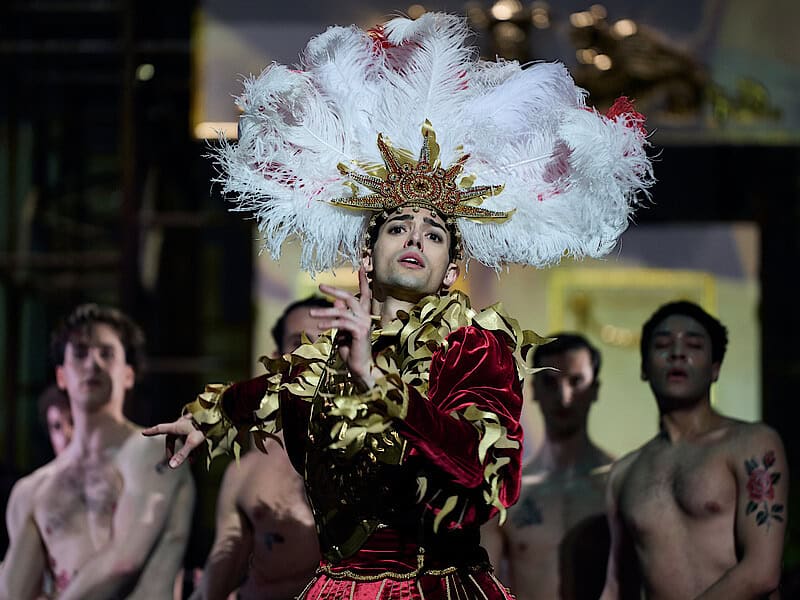 In the section around Le Roi Soleil, Nureyev's ego is magnified to an almost grotesque degree. Stunning costumes, neobaroque music and an ethereal solo by countertenor Edu Hojas create a facade of grandeur that is simultaneously unmasked as illusion. Behind that splendor lurks a deeply unhappy and lonely person.
That loneliness reaches a peak in the Pierrot scene. Nureyev appears as a broken figure: afraid, uncertain and consumed by illness. Male bodies move around him, but remain beyond his grasp. The image in which he hangs himself like a crucified figure from a pole and then assumes the posture of Saint Sebastian makes his inner state painfully tangible.
Throughout all this, a woman in white with lilies also returns, a discreet but significant motif that only gains its full weight in the final scene. In the last section, which also includes fragments from La Bayadère – Nureyev's last production as a director – the auction returns one last time. His conducting baton forms the endpoint. The hall falls silent. A visibly weakened Nureyev slowly descends into the orchestra pit and begins to conduct. The woman lets her lilies fall one by one among the dancers – a clear symbol of transience. The music stills, the dance fades and yet he continues to conduct. Then the curtain falls.
A Forbidden Freedom
What elevates this production above the biographical is its political undertone. The themes of exile, identity and control remain implicit, but are continuously palpable, without ever descending into pamphleteer discourse, but as a consistently executed, deeply human approach to a complex figure. The production does not shy away from the homosexuality of its protagonist, but treats it nowhere as a statement or provocation, rather as an integral and self-evident part of a deeply human portrait.
One could argue that the hybrid form – half ballet, half music theater – sometimes gets out of balance. But it is precisely in that excess that its strength also lies: it reflects the complexity of a life that cannot be reduced to one truth. One thus leaves the hall without the reassuring impression of having seen a rounded whole. What remains is the feeling of having witnessed a collision – between art and life, between individual and system, between memory and reconstruction.
That the applause lasts more than a quarter of an hour, first hesitantly and then increasingly exuberantly, underscores how deeply this performance strikes. With an impressive David Soares in the title role, who effortlessly switches between flamboyance and vulnerability, and an excellent Orchester der Deutschen Oper Berlin under the direction of Dominic Limburg, this rarely successful Gesamtkunstwerk in which word, music and dance converge receives a performance that lives up to its ambition.
Perhaps this is an atypical ballet. But one with character – and with the courage to make the human behind the icon visible.
And perhaps that is the very essence of this Nureyev: not a monument, but a field of tension.
And that is, at best, what theater can achieve.
P.S. Those who want an idea of the performance can watch https://www.arte.tv/de/videos/131544-000-A/nurejew/, but nothing can match a live experience. For that, you need to go to Berlin in April or May 2027.