

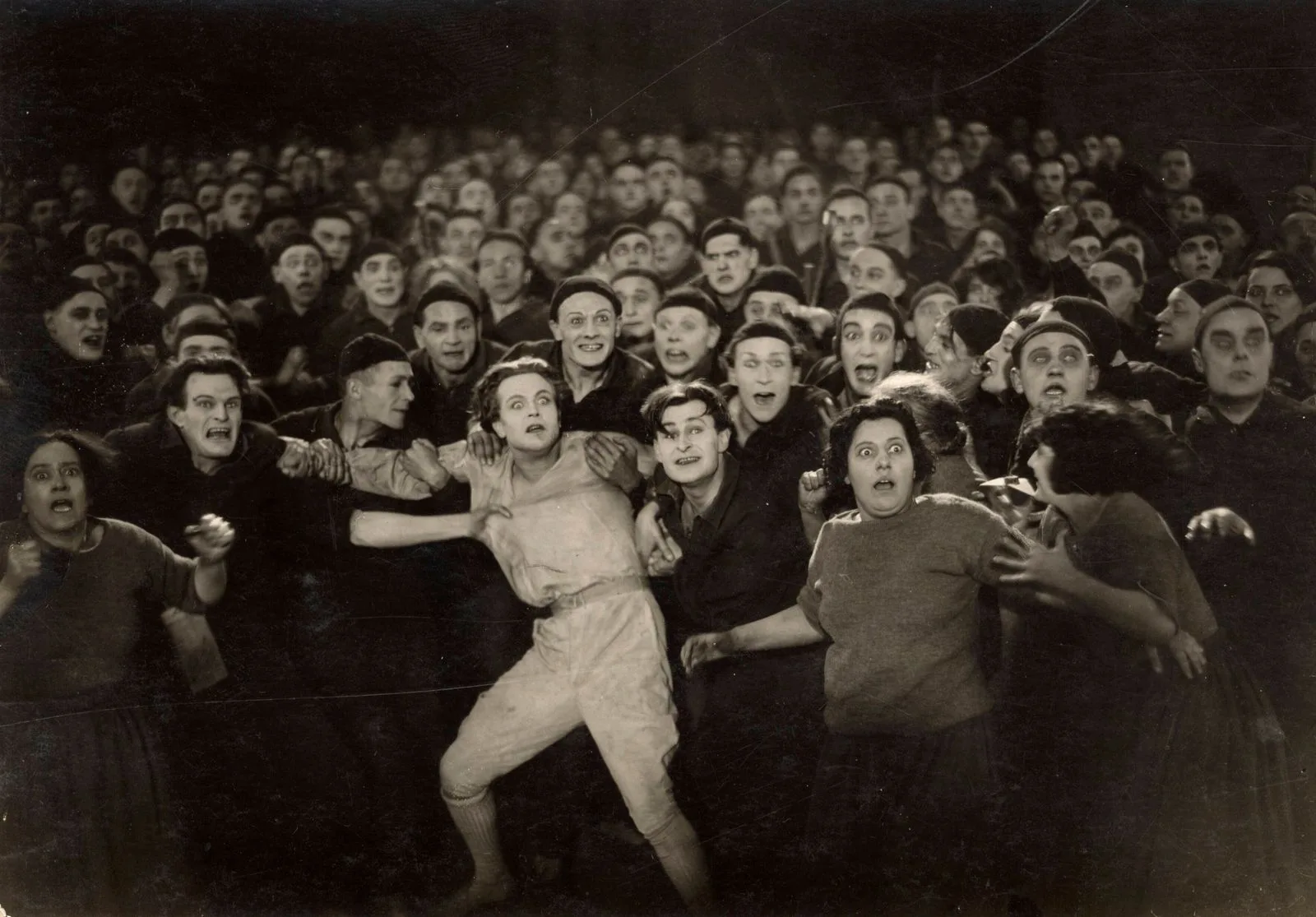
Wishful Singing and composer and clarinettist Steven Kamperman previously collaborated on a live soundtrack for Fritz Lang's Der Müde Tod from 1921. In the meantime, he created new music with his own trio for Die Abenteuer des Prinzen Achmed from 1926 by Lotte Reiniger, one of the first full-length animated films. Now it is the turn of Lang's Metropolis from 1927, again a collaboration with Wishful Singing.
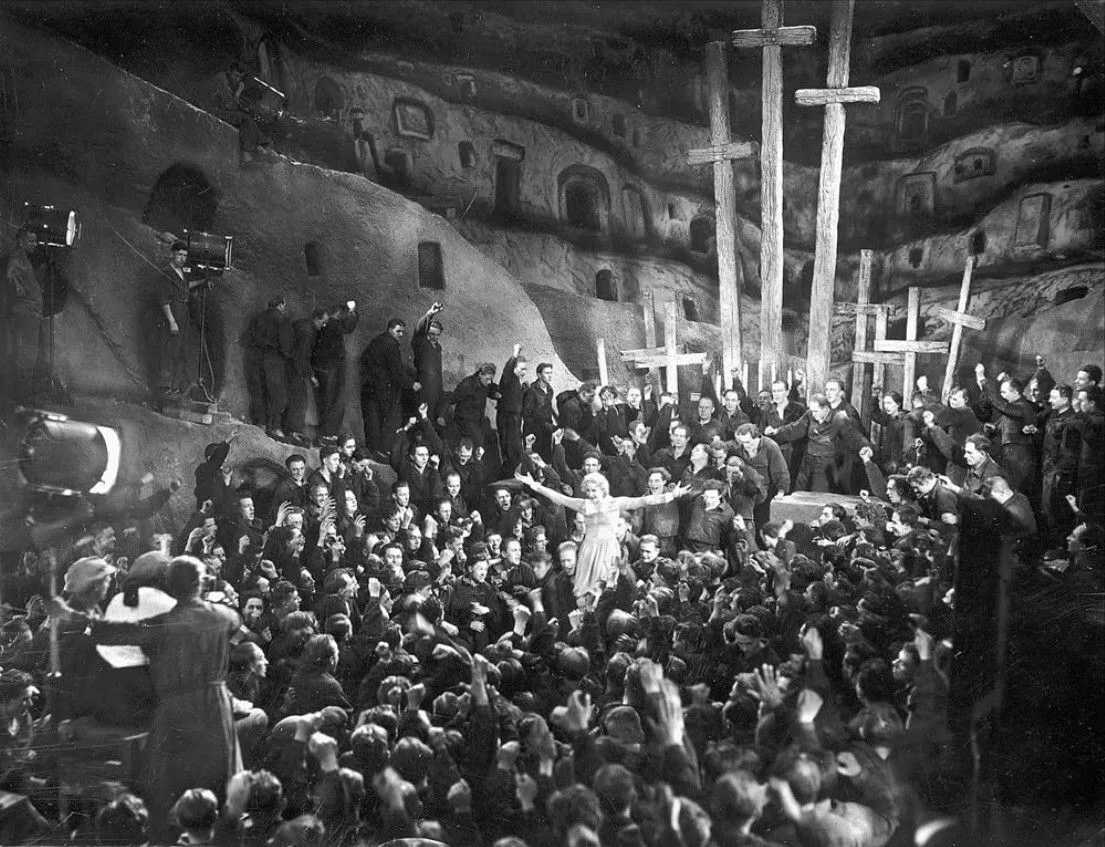
Metropolis is perhaps Lang's most legendary work from his German period (before he went into exile abroad) and one of the highlights of the flourishing of German Expressionism in film.
Several soundtracks have already been written for Metropolis.
Google Gemini states: "The most famous soundtrack for Fritz Lang's 1927 silent film Metropolis is the 1984 Giorgio Moroder version, which combined the film with a new rock and synth-pop soundtrack featuring major 1980s artists." But that is not true. Another reason to approach AI critically. Moroder worked from the then presumably longest available version of the film, from which entire passages had seemingly been lost over time, and furnished it with a series of pop hits he produced. And although Moroder is known for a large body of brilliant pop songs, in which he often applied his characteristic, at the time revolutionary, repetitive synthesizer loops, as in the major hits of Donna Summer, much of his music for this film has not stood the test of time.
The oldest music for this film was the original Wagnerian symphonic orchestral score by Gottfried Huppertz (1887-1937), who had previously written music for Lang's Die Nibelungen (1924).
Huppertz's music is beautiful, but in its 'musical-dramaturgical' characterization and tonal color it is not very specifically tailored to the individual episodes of the film. Steven Kamperman, by contrast, characterizes and colors strongly per scene and makes use of the vocal ensemble to add sung and spoken texts to the score. He drew the texts from the 'title cards' as they were used in the era of silent film to clarify the story, and from fitting texts by, among others, Marx, Hannah Arendt, Omar Khayyam and the Revelation of John, or the Apocalypse.
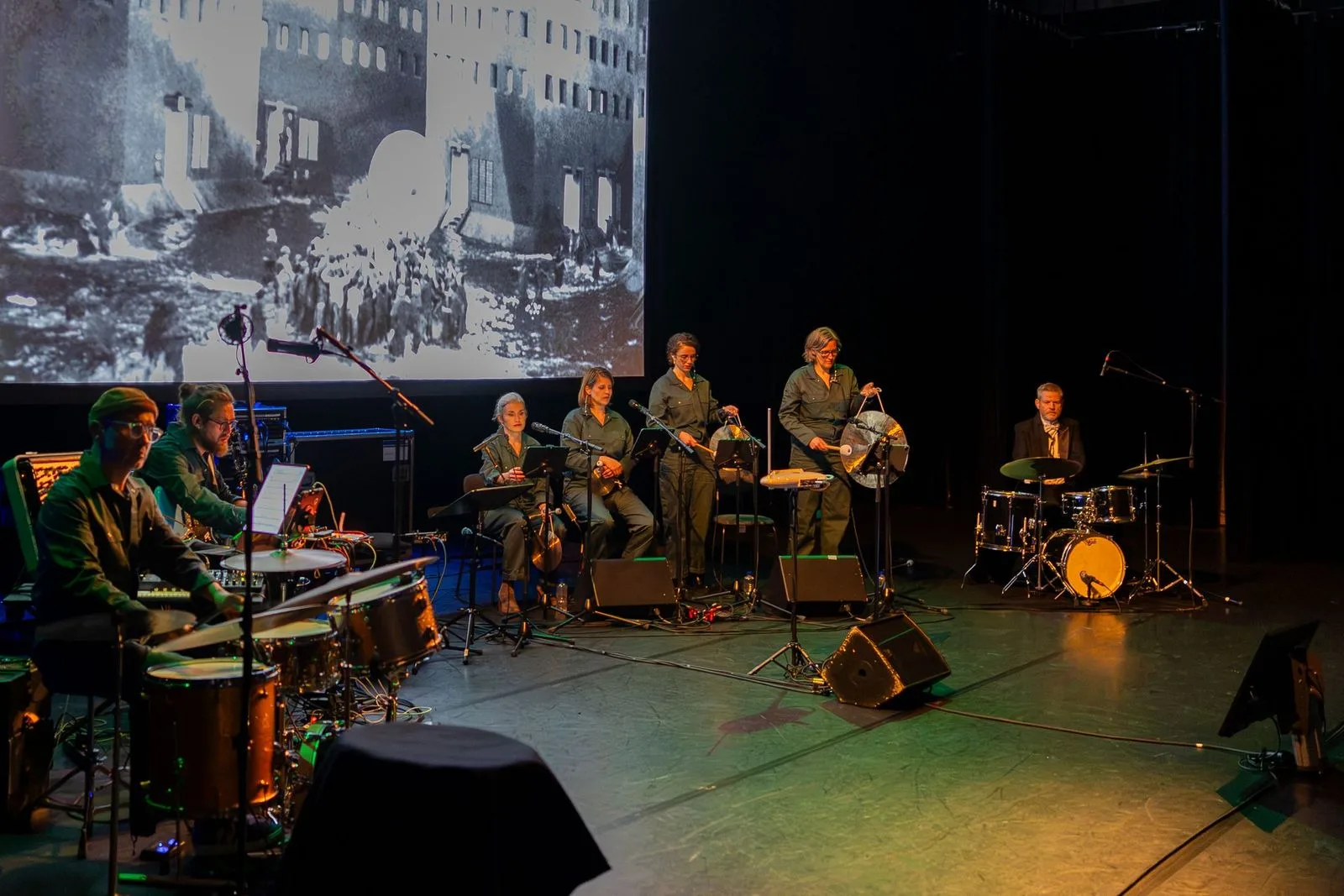
The musical styles are diverse. In principle the music stays close to Steven Kamperman's background, the jazz of his clarinet. I hear jazz rock, somewhat in the direction of the legendary art rock group King Crimson, that is, with angular riffs and complex rhythms. This in turn is then interrupted by beautiful polyphonic vocal passages from the four singers of Wishful Singing, on the title cards as used in the era of silent film to clarify the progress of the story, supplemented with sung commentaries and a few spoken texts.
In the scenes in the film where the nightclub life of Metropolis is parodied, he paraphrases ballroom jazz music, alternating with a four-part shoobidoobidoo from the vocal ensemble.
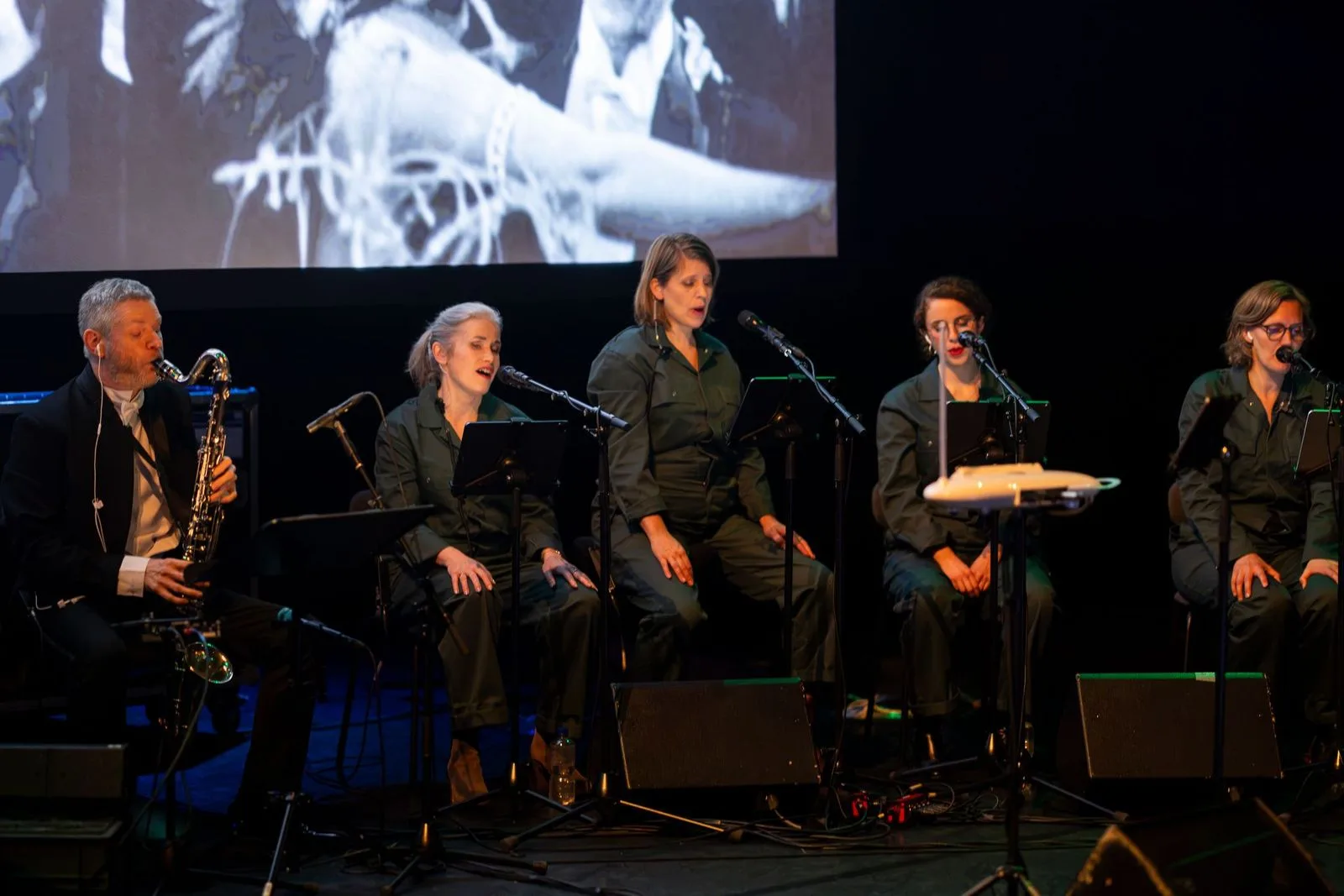
One of the members of the vocal ensemble regularly steps forward to operate a theremin, an electronic instrument that responds to hand movements via an antenna with a floating sine-like tone, which was invented around 1920 by the Russian Leon Theremin and is thus a symbol of the advancing mechanization of that time. I had already exchanged thoughts with Steven Kamperman about the instrument and I was glad to see it on stage, although in the performance we see a modern version. (NB For years it was believed that the Beach Boys used the instrument for their 1967 hit "Good Vibrations", but that was a 'Tannerin', an instrument that produced a similar sound but via a kind of keyboard, making the pitches easier to control; the exact pitches of the theremin are difficult to hit with hands in the air. Both instruments became very popular in early science-fiction films.)
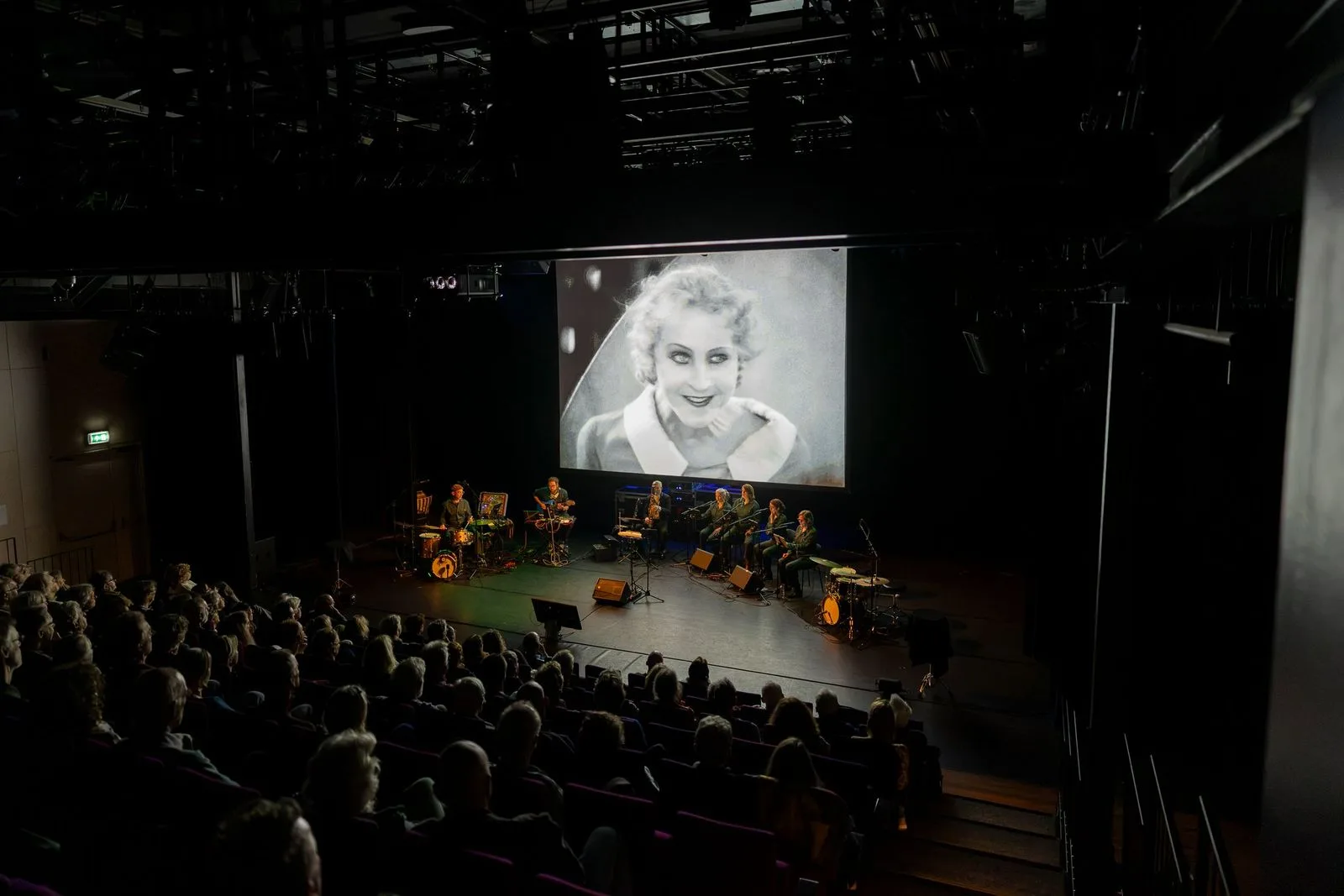
Percussionist and sound designer Yonga Sun also operates a 'modular' synthesizer, a newer instrument than the theremin, but also from long before the digital age, with a correspondingly 'rough' sound. And when Steven Kamperman also takes a seat behind a drum kit, the ensemble is able to generate masses of sound that recall how Stanley Kubrick used large orchestral works by Ligeti in 2001: A Space Odyssey and The Shining. In such moments, this new soundtrack also makes you realize how far ahead of its time Metropolis was.
The newly composed music 'de-Wagnerizes' Metropolis, compared with Huppertz's Wagnerian score. Although I always like to argue how much German Expressionist film art owes to the Wagnerian concept of the Gesamtkunstwerk; Metropolis was, as it were, a Gesamtmedienwerk.
Prior to the performance, the makers apologised for misogynistic and racist caricatures. These included the stereotypical victim role of women in horror films, such as the scene in which the 'real' Maria is pursued by the mad professor Rotwang, who on the orders of the industrialist Fredersen must create a robot Maria that preaches the opposite of the message of brotherly love and equality with which the real Maria succeeds among the workers in Fredersen's factory. In the film we indeed see a classic horror scene. Incidentally, I am not sure whether this scene would not be just as frightening if it were a man being pursued.
Furthermore, one can also think of stereotypes in the portrayal of Black people in the film, briefly shown as a musician in a jazz nightclub and as men carrying a large basin on their backs, like the lions of the Lion Fountain in the Alhambra. But could Lang have intended those scenes himself as parody? In the US, extremely racist films had already been produced, such as The Birth of a Nation (1915) by D.W. Griffith, and the notorious blackface films from the very beginning of the film industry; the infamous The Jazz Singer dates from 1927. Lang in any case did not use blackface actors. And his first American film Fury from 1936 he wanted to be about a lynching of a Black man in the American South. Although, under Hollywood censorship, the main character still had to be a white man and he had to move the location to the Midwest. Nevertheless, the message remained clear.
Regarding those caricatures, I do have questions about the character Rotwang, whose portrayal in the film recalls pre-Nazi caricatures of Jewish characters during the Weimar Republic. Rotwang lives in a peculiar hermit's dwelling in the city and also greatly resembles the Golem figure from the Golem films of 1915 and 1920, in which actor/director Paul Wegener was involved, who would later make Nazi propaganda films. Incidentally, Jewish actors/directors and actors and directors who would flee from the Nazis were also involved in those two Golem films. And Lang was himself (half-)Jewish. (On his mother's side, but according to Jewish law a person is then Jewish.)
The tenor of the film, including the original texts in the film, initially seems Marxist: power over the means of production to the working class and workers instead of machines; the members of Wishful Singing even wear a kind of Mao suits.
But the people prove easily misled and bring about their own ruin through a prophecy by a manipulative leader, and that is perhaps what appealed to the Nazis in the film. Fritz Lang's until recently regular screenwriter and wife, Thea von Harbou, had already joined the Nazis in 1932.
Lang's film Das Testament des Dr Mabuse from 1933 was banned by the Nazis. Nevertheless, Goebbels reportedly asked Lang to become head of the entire German film production, despite Lang being Jewish (on his mother's side). Lang chose instead to emigrate, first to Paris and then, in 1934, to Hollywood, where his first film Fury became an artistic and commercial success and where he would help create the film noir genre, with, among others, The Big Heat from 1953.
Lang later said of Metropolis: "When I made it, I liked it. When I finished it, I hated it.
And for a very simple reason: because the thesis of my wife, Thea von Harbou, that the go-between, between capital, the brain, and the hands, workers, should be the heart. I didn't believe it."
Lang referred to the opening motto of the film, "Mittler zwischen Hirn und Händen muss das Herz sein" ("The heart must be the mediator between brain and hands"). In the music it returns several times in sung form. It is in any case an alternative to the 'Tod den Maschinen!' ("Death to the machines!") that the false Maria preaches, which also returns a few times in the sung texts.
The Gregorian Dies Irae plays a role in the score, always a beloved melody for warning of the end of times. In trusted hands with Wishful Singing, which for KRO-NCRV's Tussen Hemel en Aarde on NPO Klassiek has immersed itself in a series of Gregorian chants for the Sundays of Advent and Lent.
The Gregorian Ave Maria also sounds, as a regular Leitmotiv whenever the "real" Maria appears in the film.
Amusingly: each time the gigantic steam whistle of the factory appears on screen, the singers imitate a steam whistle with dissonant harmonies. Does the vocal part thus also become almost Ligeti-like a few times, the Ligeti of the Requiem, also used in 2001: A Space Odyssey?
The currently available longest version of the film is now also available in full on YouTube, with the music Gottfried Huppertz composed for the film in 1927.
(NB This version is almost completely complete since, in Buenos Aires in 2008, approximately 20 minutes of a film thought to be lost resurfaced; it is suspected that about 5 minutes are still missing, which can be inferred, among other things, from a piece of the story being absent and from the amount of Huppertz's music. In the YouTube version and in the film used for this performance, the missing story is indicated with text slides.)
The contemporary version from 1984, for which pop producer and composer Giorgio Moroder provided music, is also available on YouTube, though it was seriously incomplete at the time. (Note that this version was released in 1984, the year George Orwell's futuristic novel was named after, which is no coincidence.)
Metropolis (1927), film by Fritz Lang with music by Steven Kamperman
Performers
Wishful Singing
Yonga Sun percussion, modular synthesizer
Steven Kamperman composition, bass clarinet
Jorrit Westerhof electric guitar
Seen 11 October, Muziekgebouw aan 't IJ Amsterdam
Trailer: