

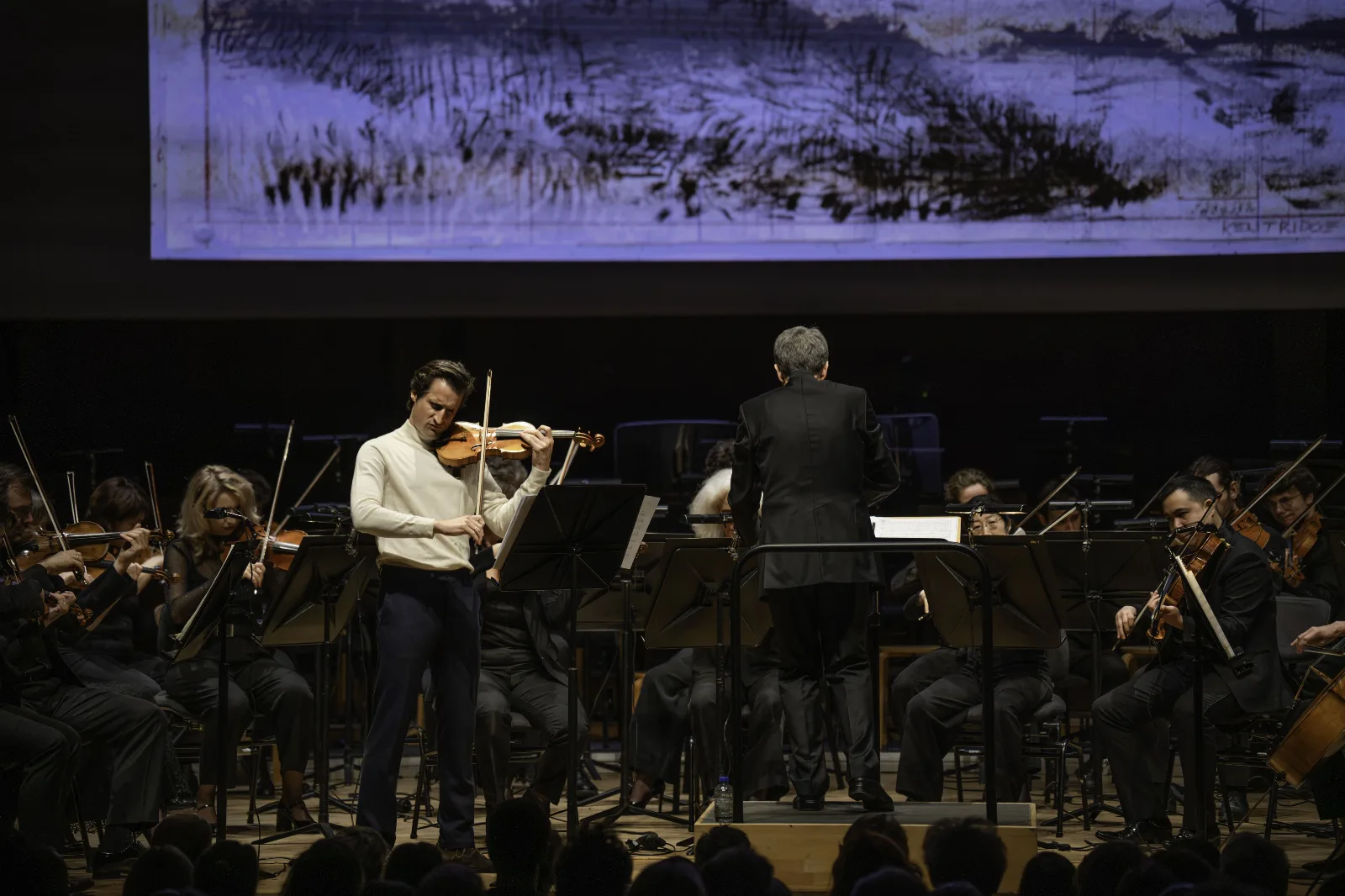
There are evenings when an orchestra does not so much play a programme as hold a conversation – between a soloist and an orchestra, between a composer and history, between music and image. At Bozar, Pēteris Vasks (b. 1946), Dmitri Shostakovich (1906-1975) and William Kentridge (b. 1955) met one another on Friday 18 September, in a programme in which light and darkness, power and vulnerability, memory and imagination constantly touched. The Belgian National Orchestra (BNO) was conducted by Eivind Aadland, with Lorenzo Gatto as soloist in Distant Light and Kentridge's film Oh To Believe in Another World as visual counterpart to Shostakovich's Tenth Symphony.
Listening to the light
Some music calls for that peculiar collective silence in which an audience ceases to be spectators and does nothing but listen. Distant Light by the Latvian composer Pēteris Vasks received exactly that attention. The work, written for Gidon Kremer, moves between stillness and surge, between an almost fragile intimacy and moments when the orchestral sound thickens. It is music that could easily dissolve into mere atmosphere, but this performance stayed far from that.
Lorenzo Gatto had made the score his own in an almost inimitable way. He did not play as if he had to explain a complex composition to the listener, but as if every sound arose from an inner necessity. He dosed each mood with precision. The violin could withdraw into the most fragile pianissimo and then swell again, without a trace of effect-seeking.
Beneath him, the strings of the BNO formed a deeply felt, intense undercurrent. The soloist was never detached from the orchestra, but seemed constantly in conversation with it. The violin as a lonely voice that is never quite alone: precisely there lay the power of this performance. It was a penetrating experience. As far as I am concerned, the applause could well have lasted longer, for this performance stood firm as a house.
Sarcasm beneath the surface
After the interval came Shostakovich's Tenth Symphony. A work that almost automatically carries historical baggage, but which fortunately is far more than a musical reconstruction of the Stalin years. Eivind Aadland opted for a classical, clear interpretation in which the various layers of the score were given full room. As a result, the music remained constantly in motion between menace, irony, capriciousness and tragedy, without any one of these elements overpowering the others.
The BNO delivered a strong performance. The horns had just the right presence, the percussion set the dramatic accents without exaggerating them, and above all the deep string sound gave the symphony a dark foundation on which the different voices could be built. Aadland avoided an overly dramatic treatment of what is already one of Shostakovich's most charged scores.
The composer's sarcasm came beautifully to the fore in this. Behind the seemingly simple movements and at times almost dance-like passages, something uneasy continually lurked. That ambiguity kept the music tense even in its most exuberant moments.
When the image wants to say too much
Oh To Believe in Another World naturally fits within Kentridge's residency at Bozar. The South African artist connects Shostakovich's music with a visual world of revolution, Stalin, terror, propaganda and the individual trying to survive within a totalitarian system. Archival footage, hand-drawn projections and life-size puppets alternate. The puppets in particular work strongly: people literally and figuratively steered by a system. At the same time, this is the strongest element of the film.
But as the film progresses, it becomes too much of a good thing for me. Kentridge piles up questions, quotations, references and new images on top of one another. What initially intrigues begins to tire. The film demands so much attention for its own visual language and meanings that the viewer is increasingly occupied with deciphering them and less and less with what the music itself is saying. The strong premise of the puppets also loses force as a result. And what the recurring image of a swimming pool – now empty, now full, with Shostakovich on the diving board waving a little flag – is supposed to add to the whole remained, for me, a riddle afterwards.
The music stands tall
What ultimately made this evening so strong was that the BNO's performance was by no means a soundtrack to Kentridge's film. The Tenth Symphony stood entirely on its own two feet. Aadland and his orchestra made the tragedy, irony and sarcasm of Shostakovich palpable without any need for the image. On the contrary: where the film gradually made me lose interest, the music held me from the first note to the last.
The collaboration between the BNO and Aadland once again proved its strength. Distant Light received, with Lorenzo Gatto, a performance that made a deep impression. Shostakovich's Tenth, too, retained its full expressive power in this performance. Musically, this was a top evening. The music did not need the image.