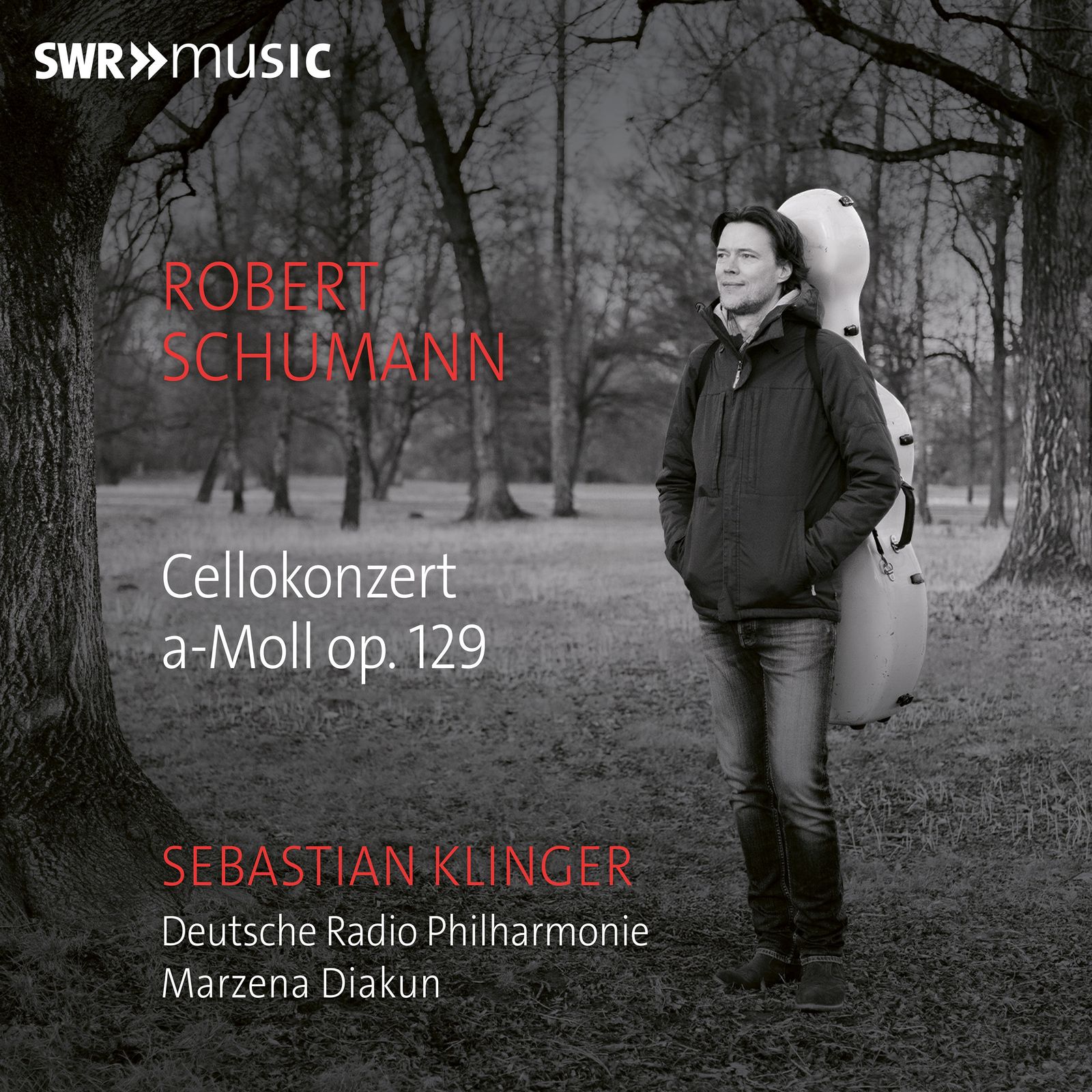
Robert Schumann (1810-1856) and Max Bruch (1838-1920) both wrote music in which the cello reveals its most lyrical side. Together they form an appealing programme: Schumann's Cello Concerto in A minor, supplemented by three works by Bruch, namely Kol Nidrei, Canzone and Ave Maria. Cellist Sebastian Klinger is accompanied by the Deutsche Radio Philharmonie under the direction of Marzena Diakun. Refined sonorities are not lacking, but the performance ultimately fails to captivate sufficiently.
Too polite
Schumann completed his Cello Concerto in 1850, during his first months as music director in Düsseldorf, in barely two weeks. The work only premiered in 1860, four years after his death. The three movements follow one another without interruption, and motifs from the first movement return later. The transition to the finale is especially remarkable. The cello reaches again for the theme from the opening movement, but is abruptly interrupted by the orchestra. A second attempt, this time with the theme from the middle movement, is likewise interrupted. Only when soloist and orchestra find each other does the actual finale theme take shape.
Precisely against that background, the evenness of this performance stands out. Klinger opts from the very beginning for a restrained approach, with a warm, full tone that comes across beautifully. Diakun ensures finely crafted accompaniment with the orchestra. Everything sounds musically coherent, but even in the places where Schumann calls for a turn or a sharper contrast, the expression remains conspicuously moderate. The finale gains more momentum, but changes little in the overall approach. It sounds sound and solid, only this performance does not grip me sufficiently.
Much lyricism, little contrast
Among the general public, Bruch is known mainly for his First Violin Concerto and the Scottish Fantasy. His work for cello and orchestra is far less well known, with Kol Nidrei Op. 47 as the major exception. Bruch composed the work in 1880 for cellist Robert Hausmann. He drew inspiration from two melodies: an old Hebrew prayer that traditionally sounds on the eve of Yom Kippur, and a melody from Isaac Nathan's Hebrew Melodies, a setting of Lord Byron's poem Oh weep for those that wept on Babel's stream.
Klinger lets the melodies sing beautifully and opts for a contemplative atmosphere. The harp is clearly audible and the balance between soloist and orchestra is successful. It is pleasant to listen to, but the interpretation lacks inner tension.
Canzone Op. 55 (1890) and Ave Maria Op. 61 (1892) were likewise written by Bruch for Hausmann. The Ave Maria is based on an aria from his secular cantata Das Feuerkreuz. The original recitative was thereby transformed into a cello cadenza. Klinger approaches both pieces in the same way as Kol Nidrei: with a warm tone and much attention to the melodic line. Here too the expression remains restrained. Individually these are fine compositions, but in mood and performance they lie so close together that the programme becomes rather uniform towards the end.
The recording sounds clear and balanced: the cello is given sufficient space without the orchestra receding into the background. Technically, little can be faulted. It is mainly the interpretation that reveals too few differences in colour. Whether it concerns the contrast-rich Schumann concerto or the three lyrical works by Bruch, the expressive approach remains largely the same.
Anyone wishing to listen for almost fifty minutes to restrained, romantic cello music will certainly find their pleasure here. Personally, I mainly miss the tension and temperament that could lift these compositions above a merely beautiful performance.