

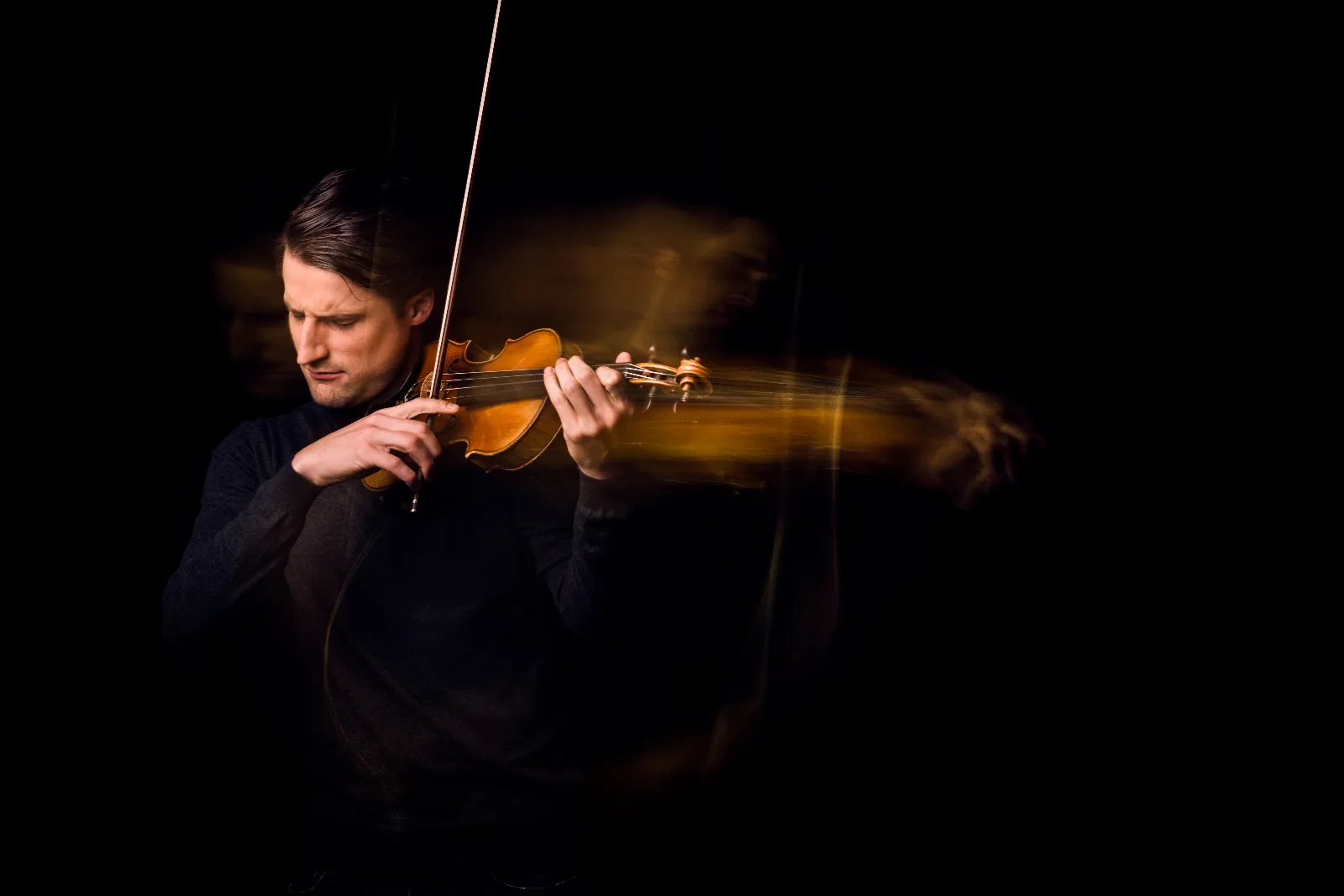
Following his performance with the Belgian National Orchestra on Friday, September 18 at BOZAR, where he will perform Distant Light by Pēteris Vasks – who is celebrating his eightieth birthday this year – Werner De Smet spoke with Lorenzo Gatto for Klassiek Centraal.
A feeling that grows
When did Lorenzo Gatto know that the violin was not just a hobby, but something he wanted to make his life about? There was no concrete turning point, he explains: "It's a feeling that grows in a crescendo, I would say. The more years pass, the more my violin seems to me an indispensable ally to overcome the difficulties and challenges of life." For Gatto, the instrument has long been more than just a means to make music: it contributes to his mental and physical well-being and gives him "probably partly a sense of existence. In a time when support becomes increasingly vague, the bond with the instrument becomes invaluable."
Outside of music, he loves the physical freedom that the open air, nature and adventure offer. Gatto walks a lot and practices paragliding and sailing, among other things: "I still dream – half in secret – of a life far from the hustle and bustle of civilization, closer to nature." As a child, he told everyone that he wanted to become a gardener later: there's still a kernel of truth in that.
On the musical side, his teacher Boris Kuschnir was a key figure. With him, Gatto prepared between 2005 and 2009 for the major competitions. "He gave me a real toolkit with which I can tackle every violin challenge," he says, "and I am especially grateful to him for the autonomy he gave me." Furthermore, Gatto emphasizes that other musicians have also influenced him for various reasons, and not only musicians from the classical world.
Queen Elisabeth Competition
The year 2009 remains a turning point in Gatto's career: he won second prize and the Audience Prize at the Queen Elisabeth Competition. Two moments have remained most vivid for him. First the first round: "The stress was so great that I felt my head pounding with every heartbeat. Fifteen minutes to convince and not to make a mistake to avoid being swept away – and that as a Belgian – that's quite a bit of pressure." When he came off the stage that day, he knew his effort had succeeded: "My competition was launched, and actually already won." The second moment was the announcement of the results: "Hearing my name after the words 'second prize', the friends screaming in the hall. An unforgettable moment."
In the months that followed, he was carried by an energy that "seemed to come from nowhere" and through which he could play an enormous amount without feeling tired. At the same time, he felt that his musical level took a sudden leap, as if something in him had been released by this recognition: "Perhaps I then moved from good student to musician."
A journey inward
For this concert with the Belgian National Orchestra, Distant Light by Pēteris Vasks is on the programme – a work that Gatto discovered in conversation with Bob Permentier, the current intendant of the BNO. He describes it as a work of remarkable density and sensitivity, one that can touch both a broad, uninitiated audience and connoisseurs.
How does he describe the piece to someone who has never heard it? Gatto reaches for an image: "Imagine you are meditating, somewhere in a forest, far from everything. At first, a barely perceptible vibration caresses you. But inexorably, that energy awakens all sorts of fears within you, struggles, devilish and jerky waltzes. Fortunately, it is up to you to surrender, accept your fate and trust in life. You return from this initiatory journey stronger and reconciled."
For Gatto, that journey applies both to the listener and to the performer. In this concerto, Vasks leaves much room for silence and extreme vulnerability, but also for great emotional peaks. His starting point for the interpretation is remarkably simple: "It's mainly about not wanting to do too much on top of it. Ultimately, you must remain more observer than acting agent in this score."
Technically, the work is demanding and contains several virtuosic passages, particularly in the cadenzas. Yet according to Gatto, the greatest difficulty lies elsewhere: "The true difficulty lies in sustaining the line – it is a single movement of more than thirty minutes – without losing the thread. You must let the sound bloom, without ever forcing it."
Familiar collaboration and outlook
With the Belgian National Orchestra, Gatto feels connected: "I love this orchestra, where I feel at home. We know each other well, and that's an asset." Because the score is written exclusively for strings, there is also a chamber music dimension to it. The musicians remain physically relatively close to each other and can thus search together for "that shared vibration" that carries the work.
Sitting still is not in the cards for now. Gatto is currently working on a complete cycle of the Mozart concerti with the ORCW and a German orchestra. He is also preparing a Paganini project, including the First Concerto, which he wants to record in 2028. He is also continuing work on Karavan, his project at the intersection of classical music and world music.
"I remain a person who is curious about everything that comes my way," he says. There are plenty of projects.
What remains
What lesson has his career ultimately taught him as a musician? Gatto’s answer is as concise as it is meaningful: “Music is a fantastic field of exploration, both inward and outward. As a musician and as a human being, you must dare to take risks and have faith. That is what gives life meaning.”