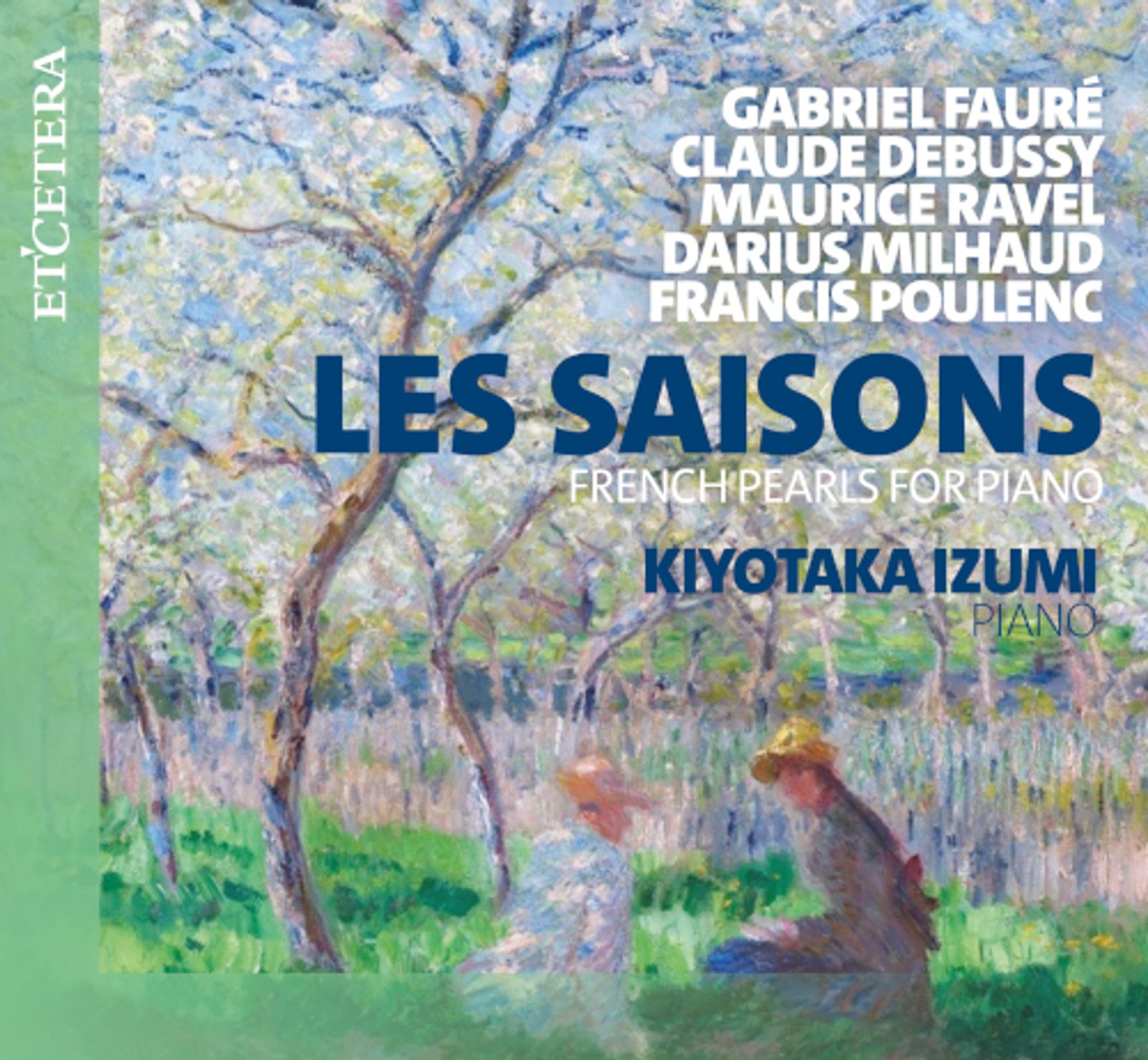
Nature and the changing of the seasons have inspired composers from various periods. This gave rise to very different musical approaches, from Vivaldi's programmatic depictions to Haydn's expansive oratorio Die Jahreszeiten and Tchaikovsky's intimate piano cycle. Within the French piano repertoire, too, we find a great deal of music in which impressions of nature and the associated emotions play a role. The Japanese-Belgian pianist Kiyotaka Izumi brings together twenty compositions, divided over four seasons, on his new CD Les Saisons. The result is not a traditional cycle by a single composer, but a personal musical journey through different styles and moods.
A French piano palette
For his programme, Izumi selected works by five composers who each occupy their own place within French music history. Gabriel Fauré (1845-1924) united the lyrical tradition of Romanticism with a refined harmonic language and a great sensitivity for melody. Claude Debussy (1862-1918) created a very distinctive universe with his suggestive musical language and subtle tone colours. Maurice Ravel (1875-1937) developed a strongly personal style in which refinement and compositional mastery go hand in hand.
Darius Milhaud (1892-1974), a member of the composers' group Les Six, combined diverse influences, including jazz and Brazilian music. Francis Poulenc (1899-1963), likewise a representative of Les Six, combined a recognisable French elegance with an expression that was sometimes playful, sometimes melancholic.
A world awakening
Spring opens with Debussy's Ballade, an early work in which elements of his later musical language can already be recognised. With his sensitive playing, Izumi gives the music a natural singing character. Initially restrained, a distinct sound world unfolds, in which the melody gradually comes more to the fore.
The two short pieces from Milhaud's Printemps then bring a light change of style. In Doucement, each hand initially seems to follow its own path. Izumi makes this interplay particularly engaging, with beautiful deep tones set against refined high notes. Vivement takes on a more playful character, without the pianist losing his attention to detail. His pleasant touch and the clear recording allow the various tone colours to come fully into their own here as well.
With Fauré's Impromptu No. 3 and Romance sans paroles, the music returns to a more pronounced lyricism. In Izumi's hands, the Impromptu acquires a supple rhythmic movement, with stylish runs and a gradual build-up. In the Romance sans paroles, the music sounds idyllic but never sentimental. In this way, the first season achieves a pleasing balance between liveliness and lyrical warmth.
Not everything under a sunny sky
The summer season brings together several well-known piano works. From Ravel's Miroirs, Izumi chose Noctuelles and Oiseaux tristes, two compositions in which nature is evoked in very different ways. In Noctuelles, the restless runs immediately draw the attention. They give the music something fleeting, with sound figures that almost suggest falling droplets. In this performance there is also a certain urgency, so that some of the unrest lingers even after the piece has ended. Oiseaux tristes connects to this in a very different way. The wistful atmosphere is movingly rendered, and once again Izumi's sense of nuance stands out.
Debussy is represented by three preludes from the first book. La danse de Puck receives a cheerful, agile interpretation, in which even a slight jazzy touch resonates. In La fille aux cheveux de lin, Izumi shows great empathy. Les collines d'Anacapri concludes with its lively character and likewise slightly jazzy inflection, connecting with the more playful side of Debussy. From the restless fantasy world of Shakespeare's Puck to the southern atmosphere of Capri: the five pieces show how differently Debussy and Ravel approach the piano. That together they represent the summer season, however, seems to me less self-evident: the performances are each successful, but the musical link with summer is not always evident in several of the compositions.
Restrained and melancholic
With autumn, the programme takes on a more introspective character. Milhaud's Adieu, from the suite L'Automne, immediately introduces this mood. Izumi gives the work a fitting wistful undertone, without overemphasising the music. Poulenc's Mélancolie fits in well with this as well. Poulenc wrote it in 1940, in a period when the war had deprived him of contact with his dearest friends. These personal circumstances form an interesting context for the pianist's thoughtful, inward-turned approach.
With the Quinzième Improvisation, a homage to Édith Piaf, the programme acquires a somewhat dreamy touch. The third Novelette, based on a theme from Manuel de Falla's ballet El amor brujo, then brings a bit more movement. Although the performance here too remains largely restrained, Izumi gradually builds up a certain drive. Debussy concludes the autumn season with Feuilles mortes, one of his later preludes. The title and the music evoke a fitting image of falling leaves and transience.
The autumn section forms a coherent, largely melancholic whole. Izumi carefully sustains the mood, but the succession of works offers little contrast. The gradual build-up in the Novelette is one of the moments where the music gains somewhat more momentum.
Stillness and colour
The winter opens with Fauré’s Nocturne No. 1, an early work in which the composer already reveals a very personal approach to the genre. Izumi initially builds the music with restraint, after which more bravura enters the playing. In the deep runs there is a faintly threatening undertone, while the melody above is shaped with great sensitivity.
With Debussy’s The Snow Is Dancing from Children’s Corner, originally written for his daughter, winter takes on a more playful face. Izumi lets the snow dart across the keyboard. The performance is clear and lively, although the emphasis here lies more on the play with sound than on lyricism.
Ravel then returns with Une barque sur l’océan, likewise from Miroirs. Here Izumi’s feeling for tone colour comes especially into its own. His interpretation sounds radiant and convincingly evokes the atmosphere of the work. Here the extra low key of his instrument moreover makes a special choice possible, as becomes clear later on.
With Debussy’s Des pas sur la neige, stillness returns. The slow, almost unchanging movement and the melancholy undertone fit well with the wintry character of the composition. The concluding Danse, originally known as Tarantelle styrienne, brings movement back into the programme with its danceable character.
The pianist and his instrument
Kiyotaka Izumi was born in Tokyo and came to Belgium in 1997 to study at the Royal Conservatory Antwerp, with Levente Kende and Heidi Hendrickx. He later specialised in chamber music at the Royal Conservatory Brussels with Boyan Vodenitcharov. Today he combines an international concert practice with his work as a pianist-accompanist at the Antwerp conservatory.
For this recording a special piano was used: a Straight Strung Piano by Chris Maene, recorded at Maene Piano’s in Ruiselede. With this instrument the strings run parallel rather than crossed, as in most modern concert grands. Moreover, it has two extra keys in the low register (G♯ and G), below the usual lowest A. As a result, Izumi was able in Ravel’s Une barque sur l’océan to replace the usual lowest A with a G♯. He suspects this is the note Ravel originally had in mind.
With Les Saisons, Izumi convincingly demonstrates his feeling for tone colour and his attention to detail. The seasonal sequence is not always self-evident, but the unusual instrument, with its extra low keys, gives this recording a character of its own.