

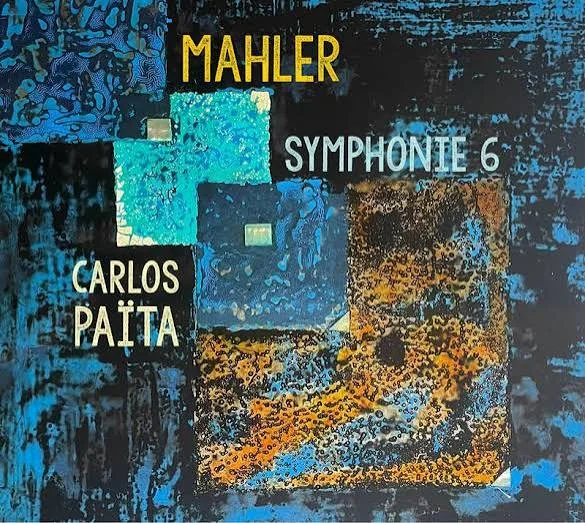
Some live recordings make you feel mainly that you wished you had been present at the concert. This recording of Gustav Mahler's (1860-1911) Sixth Symphony is one of them. The Orchestre Philharmonique de Liège is not always technically flawless here, but what it achieves under the driven leadership of Carlos Païta is extraordinary. The orchestra occasionally runs up against its limits, but the intensity of the performance and the concentration with which Païta builds the symphony make this live recording an experience that is hard to shake off.
The recording quality deserves mention as well. For a live recording from 1997, the sound is surprisingly clear. The orchestral groups remain easy to distinguish from one another, and the finer details stay audible, while the direct tension of the concert is preserved.
From the very first bars, Païta opts for a pronounced approach. He does not seek a smoothed-over Mahler, but contrasts that keep the music under constant tension: energetic versus contemplative, sharp versus hushed, idyllic versus threatening. As a result, attention remains intact throughout the entire symphony.
Under high tension
The first movement begins with a momentum that you rarely hear. "Energico" is not written there for nothing, but Païta immediately turns that indication into a physical experience. The tempo is firm and consistently maintained. The music sounds vehement and striking, without the details disappearing beneath that energy. When the more lyrical passages arrive, Païta does take time to let the music reflect. But the menace remains present and is sometimes already announced by the timpani. That makes the return to the energetic main idea all the more powerful.
His treatment of woodwinds and brass is also noteworthy. These are not constantly deployed as vehicles for orchestral bombast. Even in the monumental passages, attention remains for the individual colours. The cowbells also find their place within the musical whole. In the passage with the cowbells, Païta moreover chooses a strikingly broad tempo, and precisely because of this a strong contrast arises with the turbulence of the surrounding material. The great build-up towards the main theme works particularly convincingly. The brass does not always have an easy time of it, but the dramatic line is not broken by it.
As if there is still hope
The Scherzo begins quickly, sharply accented and nervous. Beneath that restlessness lies a venomous undertone. When Païta then pulls back, the woodwinds and strings are given room for a playful moment of stillness. The contrast is great, sometimes even extreme. Precisely because of this, the tragedy of the symphony becomes palpable: the moments of rest offer no real escape, but form only temporary interruptions of the underlying menace. The music then seems almost capable of ending idyllically, but that impression proves deceptive. What remains is more a feeling of disillusionment than of liberation.
Relatively briskly the Andante begins in the strings, but gradually becomes more contemplative without the tempo really coming to a halt. In the thinner string passages the sound is occasionally somewhat sharp, but when the woodwinds and later the horns are given more room, the atmosphere changes. Païta slows down here and allows the strings to develop a broader undercurrent. This produces a moment of great stillness. The woodwinds then sound almost heavenly idyllic, as if in this dark symphony some form of hope is nevertheless possible.
But here too Païta keeps watch over the dramatic line. The calm does not acquire a definitive character. Slowly he builds tension again, among other things towards the cowbells. As a result, the Andante does not become an isolated lyrical intermezzo, but an essential part of the tragic development. The order of Scherzo and Andante, moreover, works excellently in this performance. After the extreme nervousness of the Scherzo, room arises for stillness, and precisely because of this the tragedy gains even more relief.
No escape possible
The finale begins remarkably restrained. Païta builds the tension steadily and does not force the drama from the first bar. Gradually the movement becomes faster and the contrast also increases. Here he works emphatically with extremes, from ppp to fff. There are moments when the music seems briefly to offer room to breathe, but Païta gives the listener scarcely any time for it. The tension is repeatedly raised again. You are, as it were, drawn into the finale.
That also makes the three hammer blows so effective. Here Païta, like Leonard Bernstein among others, opts for the version in which the third blow, later removed, sounds again. Mahler had removed that third blow from the score after the first performances. There is discussion about his precise motives for this; the often-told explanation that superstition about fate played a role goes back to later recollections by Alma Mahler. In this performance the trio in any case works as a powerful dramatic element. Païta has pushed the tension so far that the blows enter as physical breaks in the musical development.
When the finale is finally over, you remain sitting in your chair for a moment, flattened.
What was this one-time concert like?
A pronounced character of its own
Païta approaches Mahler in a radically different way from Haitink, Bertini and Boulez – for me three very different points of reference in this symphony. Where their performances each seek balance in their own way, Païta resolutely opts for contrast, momentum and dramatic tension. This does not produce a technically flawless performance. Yet it would be too easy to judge this recording from those limitations alone. What matters here is the intensity with which Païta keeps the music under tension from beginning to end.
After three listening sessions, new details and ideas keep emerging: the extreme contrasts, the unexpectedly broad tempi in certain passages, and the way lyrical moments are repeatedly overtaken by menace. Païta never lets the symphony sound casual, and that makes you want to hear it again. It is precisely here that the persuasive power of this interpretation lies.
The historical context gives the recording an especially charged significance. The concert in Liège took place in 1997 and turned out to be the very last concert of Carlos Païta. Shortly before the performance, he had told his son Alexandre that he hoped it would not be his last. At the last moment, Païta moreover objected to the radio broadcast and recording of the concert, and even threatened to cancel the performance. Only after his son intervened did he agree to let the concert go ahead and be preserved.
In hindsight, this knowledge takes on an almost ominous quality. Mahler's Sixth, with its inescapable tragedy and the three crushing hammer blows in this performance, thus unintentionally acquired the character of Païta's musical testament. This knowledge makes the direct, at times raw intensity of this live recording all the more penetrating. But it is not necessary for the recording to retain its power: even apart from that historical context, this remains a performance that imposes itself on the listener with great conviction.
This recording is therefore more than a historical document. Païta turns Mahler's Sixth into an outspoken, uncompromising experience that never tries to soften the tragedy of the music. At times his reading is raw and not technically perfect, but nowhere does the music become casual. It is precisely this combination of risk, intensity and dramatic tension that makes this recording one of the most interesting interpretations of Mahler's 'Tragic' that I know.
