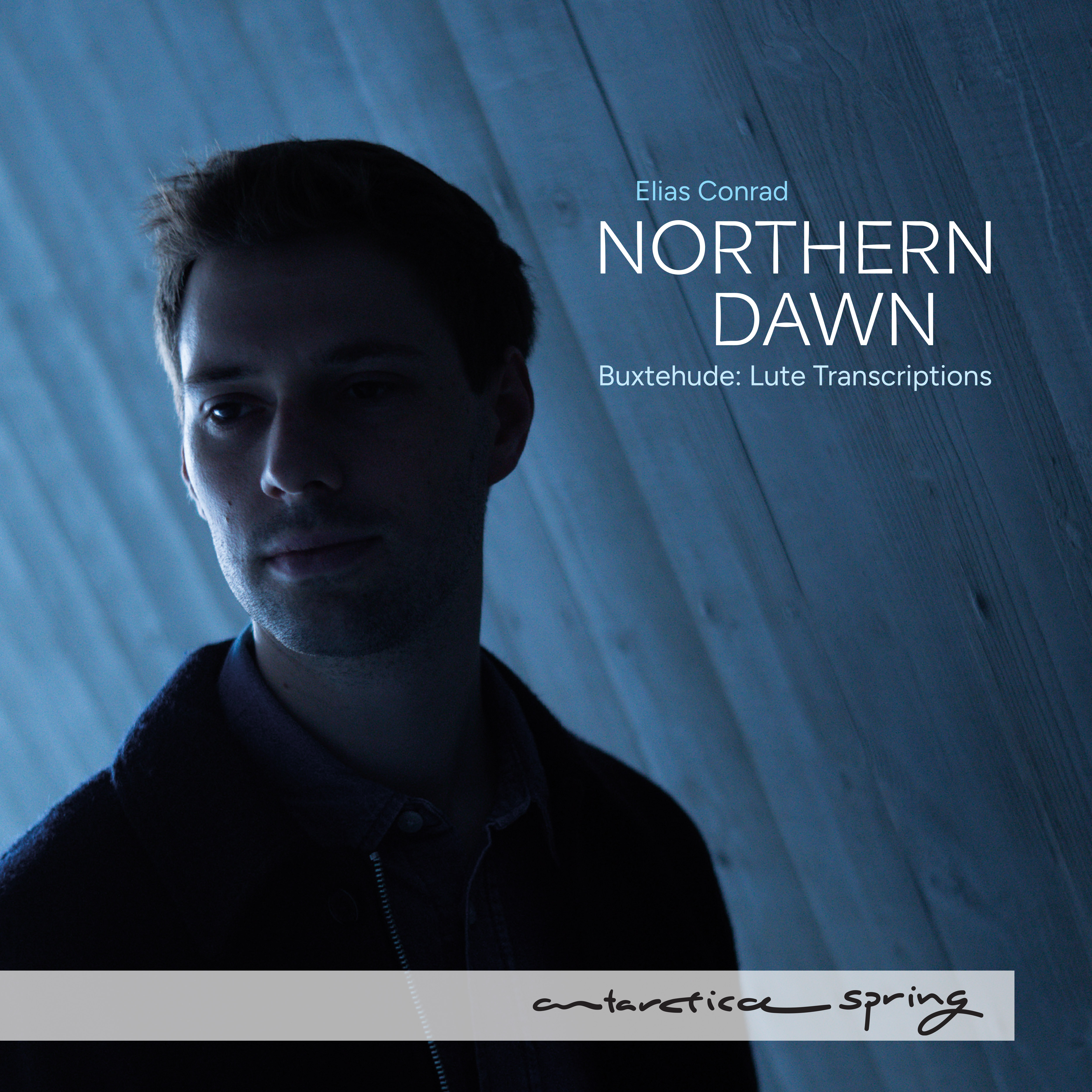
The baroque lute is primarily associated with intimacy and refinement, while Buxtehude's music bursts with contrapuntal energy and harmonic tension. With Northern Dawn, the German lutenist Elias Conrad demonstrates how Buxtehude's music also holds its own beyond its familiar sound world.
Because Dietrich Buxtehude (1637-1707) left no music for lute, the entire programme consists of his own transcriptions of works originally written for organ, harpsichord or ensemble. The result is not a replacement of the original versions, but a different perspective on familiar music. That such an adaptation is possible has to do with the kinship between the seventeenth-century harpsichord and the baroque lute.
From harpsichord to lute
Broken chords, ornamentation and the so-called style brisé play an important role in both instrumental traditions. Above all, the suites lend themselves well to transcription. The sonatas and sinfoniae from Buxtehude's sacred music are a different matter: the original instrumental scoring gives way to a single instrument. As a result, part of the monumental character is lost, but the individual voices come closer.
Conrad also makes deliberate choices in ornamentation. How precisely Buxtehude applied it is not fully documented. His manuscripts point more towards the Italian tradition, while the lute music of his time was strongly influenced by France. Conrad takes this difference into account: in the more distinctly lute-like keyboard works he leaves room for French ornamentation, while in the transcriptions of sonatas and sinfoniae he follows the Italian tradition more closely. These considerations reflect his background: Conrad studied at the Mozarteum in Salzburg and the Schola Cantorum Basiliensis, and has worked with musicians such as Andreas Scholl, Amandine Beyer and René Jacobs.
A cantata in five parts
The programme is structured in five parts, inspired by the dramaturgy of a cantata: seeking, longing, pleading, hoping and trusting. The Sinfonia from Wo soll ich fliehen hin opens quietly: Conrad lets the music breathe and deliberately takes moments of rest that invite reflection. The following Praeludium in G minor and Praeludium in D minor bring more movement, mainly through their accents. Yet the contemplative atmosphere continues to dominate. With a running time of 47'40", the programme remains compact and retains its coherence.
In the Sonata from O Gottes Stadt the musical structure becomes somewhat more complex. The lower voice and the ornamentation give the music relief and, in Conrad's performance, create a fine question-and-answer exchange.
For me, the high point of the CD is the Suite in D minor, 'd'Amour'. Here the lute sings, laments and then seems to revel again. Conrad plays with great sensitivity, giving the music room without letting it sink into sentimentality. It is the most expressive moment of the CD, in which the sound of the instrument and the musical line find each other particularly well.
The Sonata from Gott hilf mir, denn das Wasser geht mir bis an die Seele also makes an impression. The cantata-like structure of the programme proves a good choice here: the works do not form a loose collection, but gain additional meaning through their mutual connection. In the Aria in A minor with variations, Buxtehude's musical idea takes a different turn each time, and Conrad follows these shifts attentively. The Suite in F major then brings out a lighter side of Buxtehude. The music sounds livelier and takes on a dance-like character, without Conrad losing sight of its refinement.
In the Sinfonia from Jesu, meines Lebens Leben a single note immediately catches the ear, like a dissonance. It does not disturb; rather, it suits the piece: in a transcription for one instrument, in which the voices come together in a single sound world, such a small friction gains extra weight. It is a detail, but it illustrates what these arrangements can do: they let you hear what easily disappears in a larger scoring.
A special moment is Ad cor, a movement from Buxtehude's well-known cycle Membra Jesu Nostri. In the transcription for lute, the music acquires something vulnerable. The smaller sound world makes the expression more directly felt and invites you to listen differently to a work that many enthusiasts already know. Here lies one of the most convincing arguments for Conrad's approach: the transcription does not make the music bigger, but makes its expressive core more audible.
An unexpected conclusion
The Andante from Bach's Fourth Organ Sonata BWV 528 closes the CD. This is a curious choice within a programme that is otherwise entirely devoted to Buxtehude. The work sounds livelier and breathes somewhat more freely than the preceding pieces. That contrast is interesting, but as a conclusion the choice is not entirely convincing: at the last moment attention shifts to another composer, while the programme seems to call for a closure of its own.
The title Northern Dawn refers to the light Conrad discerns in Buxtehude's music, despite the wars and misery of the Europe in which the composer lived. The CD booklet also connects that thought to our own time. That perspective, however, does not need to support the music continuously: the persuasive power of this CD lies mainly in what the transcriptions themselves let us hear.
The recording is dry and direct, with hardly any reverberation. The lute seems to sit right beside you, which perfectly suits the intimate concept of the programme: there is no church space to soften the sound or hold it at a distance, and it is precisely this that makes the transcriptions so personal.
With Northern Dawn you learn to listen to Buxtehude's music in a different way. The transcriptions give up part of the original grandeur, but at the same time they reveal the expressive power of the individual voices. Especially in the Suite in D minor and Ad cor, it becomes clear how precise this approach can be. Conrad convincingly shows how much expressive power lies in this music, also outside the ecclesiastical and instrumental context for which it was written.