

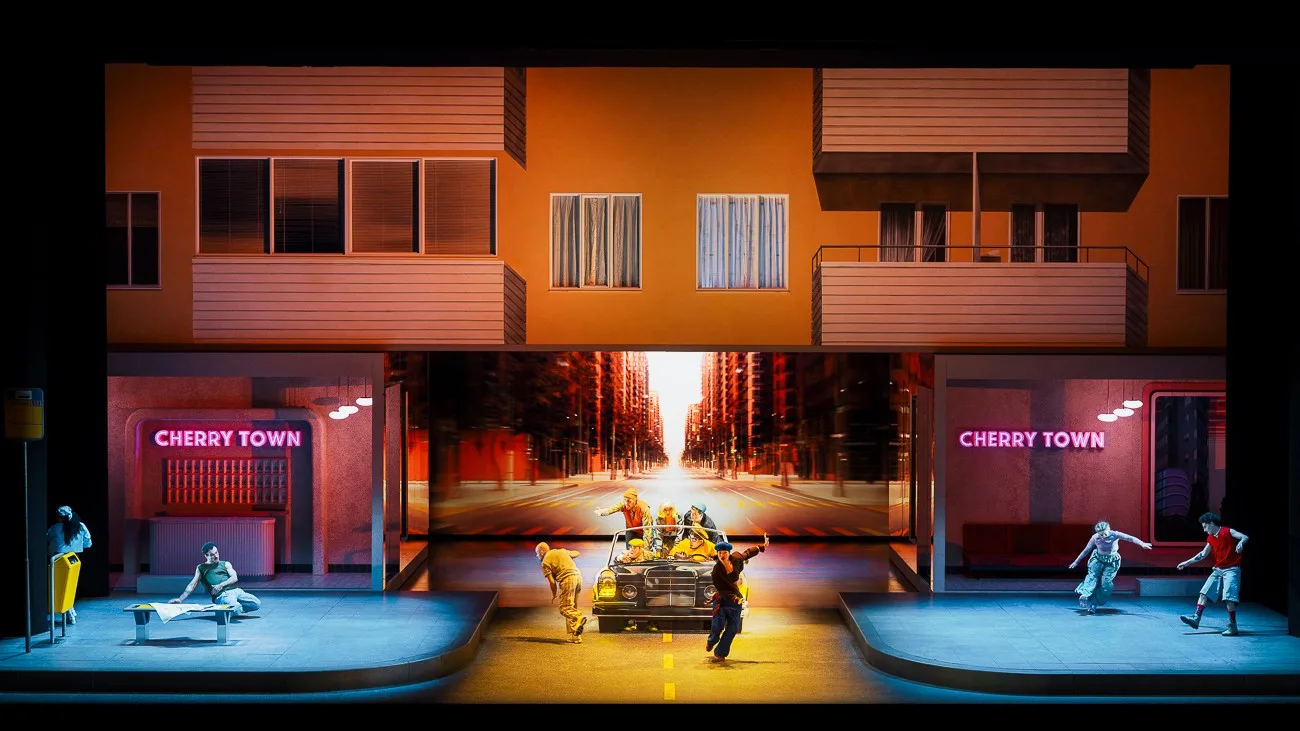
Cherry Town is an adaptation (in a translation by the British opera director David Pountney) of what Shostakovich himself called an operetta, under the title Moskva, Cheryomushki ('Moscow, Cherry Town'), a new housing estate in Moscow. The composer published the work in 1959, during the rule of Khrushchev, when after the reign of terror a certain political 'thaw' set in and satire on politics proved possible.
From the composer's letters it seemed as if he wanted to forget the work himself as quickly as possible, although three years later he collaborated on a film version, for which he even wrote additional pieces of music. No, this work does not have the stature of the composer's most poignant works, but it is certainly easily digestible, especially in the flamboyant staging that the Dutch National Opera and Ballet served us in Amsterdam.
1959. After all the economic failures of the Stalin years, things are going somewhat better for prosperity in the Soviet Union during Khrushchev's political 'thaw'. The state vigorously tries to provide enough suitable public housing. We see this at the beginning of the performance. During the instrumental prelude we see a block of flats being demolished and shortly afterwards we see a brand-new building in fifties style; new, fresh, with the proviso that this kind of block of flats was erected everywhere, not only in the Soviet Union and the communist world, but also in the West; fifties and sixties estates in the West are also full of them. I immediately also think of the set of the production of Boris Godunov last June, directed by Kirill Serebrennikov, which showed us how those housing blocks look today; in his staging, Dmitry Markov's shocking photographs of present-day daily life in Russia played a central role. Images, harrowing impressions of poverty, alcohol abuse and depression. But then, the late fifties and early sixties were also times of progress in the Soviet Union. People finally got their own homes, and there are many cheerful, happy people in the operetta. But bureaucracy and corruption lurk, and that leads to unwelcome complications; fortunately the ending is good, almost everything and everyone is fine.
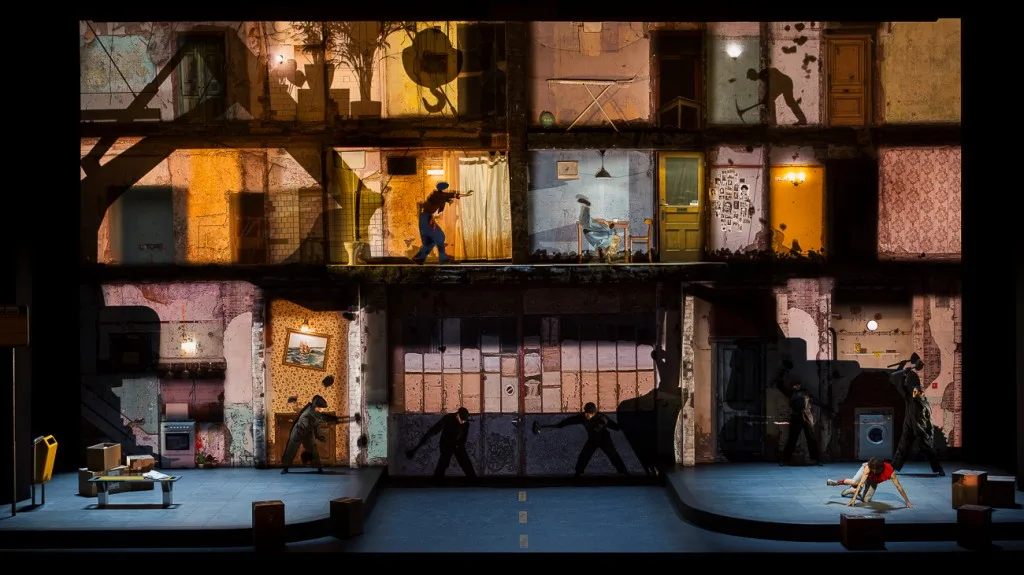
There is a young couple about to finally get their own home, where for the first time they can be together, as we are told – read the suggestion that they can also have sex. There is a father (Babble, actor Leòn Ali Çifteci, who also gets to sing a song) whose previous home has been demolished, precisely because of an urban renewal project, and who finally wants to be able to properly provide for his child (Ella Taylor) again. But there is also a property developer, Noos (a physically unrecognisable, winning Thomas Oliemans), with his mistress, Vava (a wonderful singer from the Dutch National Opera Studio, Madison Horman), who mainly stays with him for the opportunity to move into a home through him, but meanwhile also tries to flirt with Noos's private chauffeur Boris (a vocally and acting-wise phenomenal Michael Wilmering). And there is the caretaker of the block of flats, Blatherbox, who has been bribed by Noos (Martin Mkhize, yet another talent from South Africa, who came to the Netherlands as a member of the Dutch National Opera's studio).
Thus we see how father and child are assigned a flat with a certain house number, whereupon Noos has the number on the front door removed and changed to 50. Because there is no longer a flat number 48, father and child are back on the street and Noos intends to have Vava move into the flat. But after a large number of complications, in which the young couple also seems to end up on the street again, the tables are turned and it is Noos who ultimately ends up on the street.
The most important plot twist is reserved for the chauffeur Boris, who ultimately sides with the father and his child and thus against his employer. Self-interest is also not far away in this case. In Shostakovich, Boris has his eye on the daughter, who is called Lidia. In this production, that is Lidion, a they/them character, the infectious Ella Taylor in a Hosenrolle (trouser role).
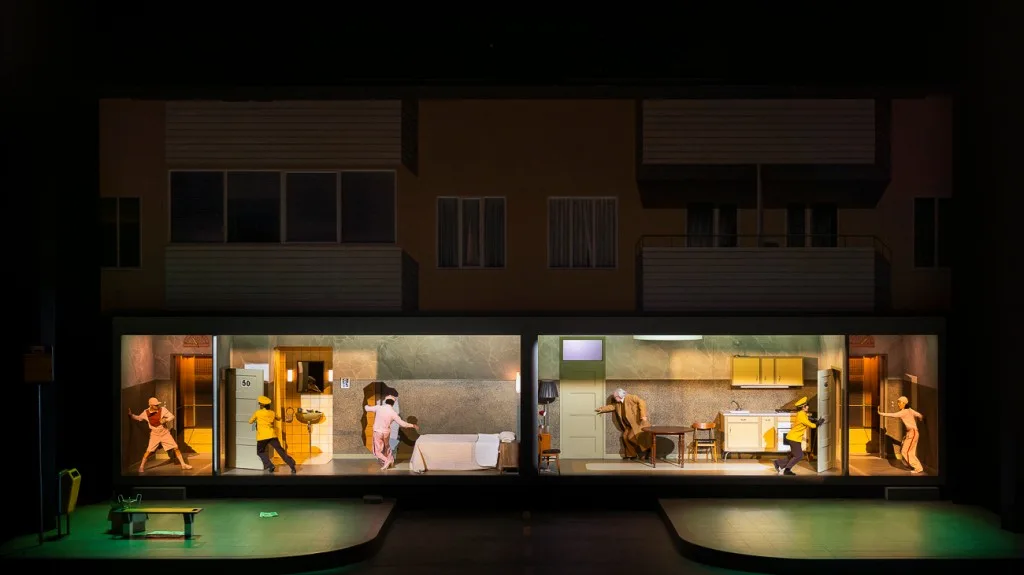 The set turns out to contain dozens of secret doors and gates that are connected to each other via all sorts of sneak-through-crawl-through corridors. Jakop Ahlbom has for years been a star director of a theatre form that lies between mime (theatre in which bodily expression plays a leading role, in his case combined with acrobatics) and object theatre (in which moving objects play a role). In Cherry Town he replaces the spoken dialogue of the operetta with silent play, and to this he adds a series of stunning stunt and dance scenes, developed together with choreographer Marco Gerris, artistic director of ISH Dance Collective, consisting of virtual urban dancers in breakdance and street acrobatics.
Part of Ahlbom's own signature in his direction of actors and, in this case, singers is stoic Buster Keaton and Charlie Chaplin-like physical expression and often almost breathtaking, again Buster Keaton-like stunts with set elements.
Mime is often wordless, and that can work well in combination with opera, when everything is sung. Moskva, Tsjerjomoesjki originally also contains spoken dialogue, and apparently quite a lot of it, as the original version is reportedly three hours long. That seems like far too much to me. In any case, the director's team has omitted all spoken dialogue. Instead, alongside the brilliant cast of singers, the story is also portrayed by an extensive ensemble of mimes and dancers, who further enliven the narrative with whirling movement scenes and breathtaking feats. The singers virtuosically match the mimes and dancers in their use of physical antics. Some deliberately play it clumsily, such as the young couple. But Michael Wilmering seems to have been tailored a second body, in terms of what he gets up to physically: including somersaults and jumps in the air, he hardly lags behind the mimes and dancers.
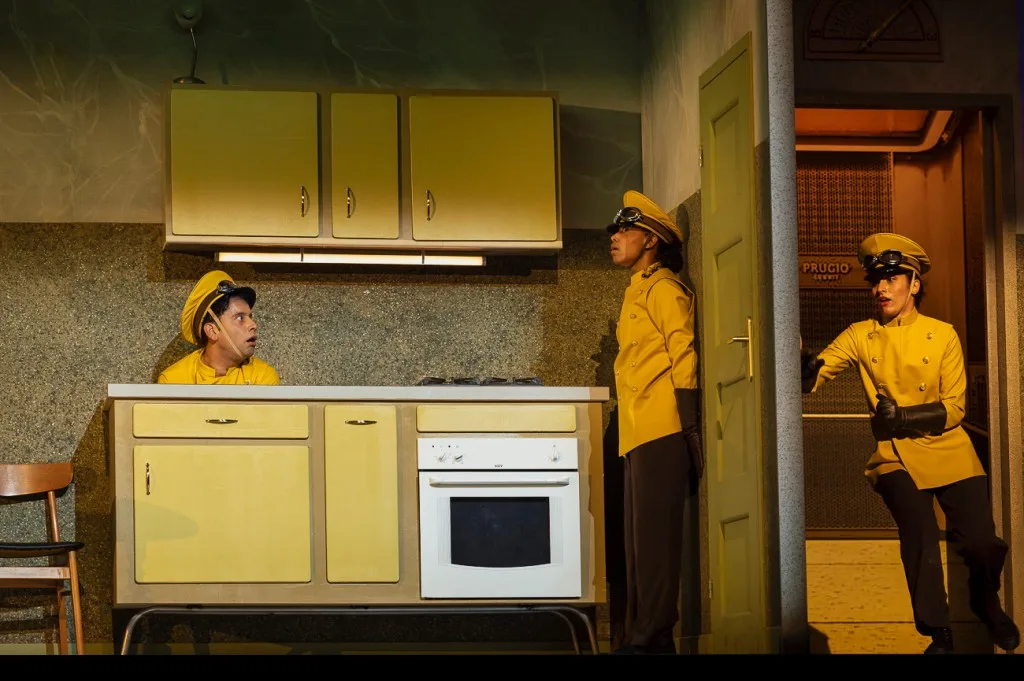 The high point is a miraculously designed pandemonium, around the three-quarter mark of the performance, when some of the dancers and mimes don the same bright yellow bellboy outfit and some ten or more Borises tumble across the stage: into the kitchen cupboard, out of the lift shaft, into the extractor hood, out of the washing machine, in through the door, out through the door, and sometimes three, four, five at once, from left to right, from right to left. But at moments when he "hides" under a lampshade, we see him, but the other characters do not. And when Noos sees through Boris's lampshade disguise and attacks him, this Boris turns out to be a dummy, which falls apart into pieces. All of this happens at a frantic pace, so that you never really notice the technique behind the tricks and never see them coming. The performance is full of gags of this kind. Something is happening everywhere. During some of the mime scenes, electronic or electronically distorted fragments of music have been composed in by sound designer Jurgen van Harskamp, partly based on quotations from Shostakovich.
The music can be compared to Shostakovich's well-known "lighter" instrumental works: less banal than Shostakovich's most banal music, but, apart from a few brilliant harmonic turns (of which there could have been more), not all equally interesting. Yet the whole is nonetheless made more meaningful by the libretto, which in this production has been fully exploited through its coupling with the lightning-fast staging. The satire in Cherry Town is of course not as searing as that in Lady Macbeth of the Mtsensk District (1934), but meaningful winks are given, and the production manages to accentuate them nicely. (And the composer was also 25 years older at the time of this operetta and probably somewhat milder, partly due to the political circumstances that gave rise to it; by 1959, Shostakovich had in any case already partly left behind the years of his most important musical masterpieces.)
During the performance, between the scenes and arias, there were several curtain calls, for the singers and for the physical feats. Although in the row in front of me one person – with carrot-red hair – I heard shouting "boo" – perhaps someone who thought they knew better how this should be staged – the rest of the audience reacted with blazing enthusiasm.
 The opera is very likely also appealing to young people. The Dutch National Opera keeps its ticket prices low and sets aside a special evening for an audience exclusively aged between 16 and 30. It is not uncommon for opera performances for young people to barely connect with what else is on offer at the opera, but that is not the case with Cherry Town.
I think this production is moreover attractive for international revival, but then I think you would have to take this cast along; that would be wonderful.
At the end of last year, after an extremely expensive and unsuccessful performance about the homeless at the Muziekgebouw aan 't IJ, I came across dozens of homeless people under the railway bridge outside, people for whom the budget would have been better spent. After Cherry Town, fortunately a much better, genuinely good production, I saw two homeless people sleeping on the street opposite the entrance to the Muziektheater. It put the performance into yet another perspective.
Cherry Town, musical comedy in three acts
Sung in English
Music: Dmitri Shostakovich (1906-1975)
Libretto: Vladimir Mass and Michail Chervinsky, in a translation by Sir David Pountney
Musical direction: Bassem Akiki
Direction: Jakop Ahlbom
Choreography: Marco Gerris, in collaboration with the performers of ISH
Set design: Thomas Rupert
Dramaturgy: Wout van Tongeren