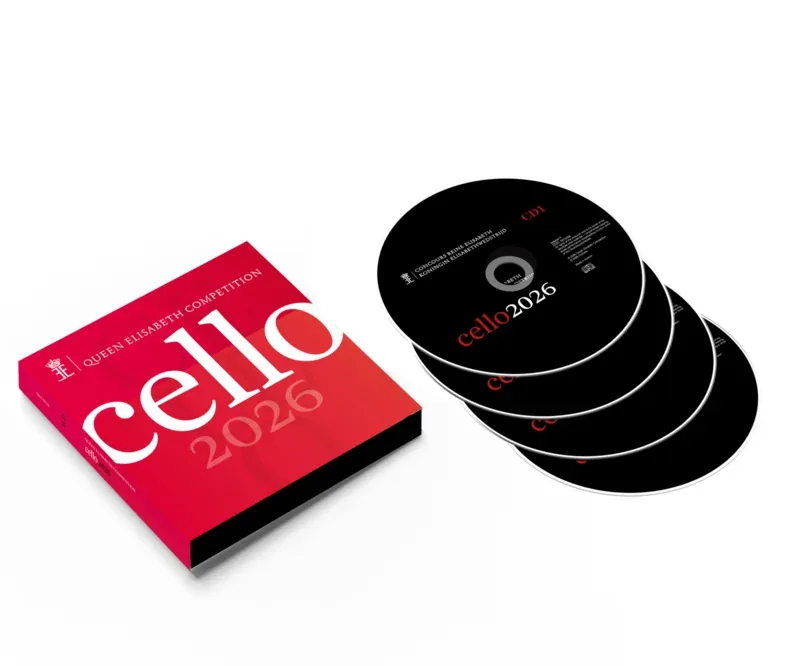
The finest moments are now captured on a 4-CD box, recorded during the live performances under the best possible circumstances. The box is also a keepsake of an anniversary year: the competition turns 75, and it is 150 years since Queen Elisabeth, its founder, and her dear friend, the great cellist Pablo Casals, were born. The edition was held under the auspices of the royal foundations and in particular of H.M. Queen Mathilde.
CDs 1 and 2 contain the concertos of the four highest-ranked laureates, with the Belgian National Orchestra under Antony Hermus. CD 3 presents solo and chamber music by seven laureates. CD 4 concludes with two classical concertos and the mandatory work of this edition. The common thread is the versatility of the repertoire, from classical to avant-garde.
CD 1 – Prokofiev and Lutosławski
The first disc opens with the winner and the runner-up, in two works that lie far apart. In Prokofiev's Sinfonia concertante, dedicated to Rostropovich, Ettore Pagano makes a strong impression. His interpretation yields a rich, full sound, carried by the deep, sensitive timbre of the cello, and the fusion of musician and instrument is remarkable: an intimacy in which the vibrato takes on a narrative character. In the scherzando sounds a deep, late-Romantic lyricism, conveyed through broad string gestures: a rhapsody from distant worlds, with flashes of light. The reconciling final movement rises above the atonal drama built up throughout the work, and in the finale the cello sounds at its most eloquent, and in a bariolage with a persistent rhythm he plays the closing note of the work.
Lutosławski's Concerto (1970) was read by Rostropovich, to whom it is dedicated, as an anticommunist manifesto. The atonality is a great challenge: abrupt shifts without transitions and unexpected changes of mood demand extraordinary virtuosity from the young cellist Tae-Yeon Kim. The three trumpets during the cello's pauses evoke unease, and the brass reinforce the sense of fear, as if the cello were in danger of being crushed. During the live concert I saw the contorted cellist playing barely audible sounds in the high register. The finale is apocalyptic: the cello ends in indescribable suffering, like a traumatized voice.
CD 2 – Shostakovich and Barber
The second disc opens with Shostakovich's Concerto No. 1 by Álvaro Lozano Cames. He naturally shows a fine artistic form: a steady rhythm, excellent vibrato and much sensitivity. He listens attentively to his instrument and vibrates along with it, which had already struck me in the semi-final. The tone colour is very refined, especially in the low register, with a deep, velvety sound. In the cadenza all the themes return in shorter notes, which enraptures the listener. In the moderato the cello and piano sound softer, almost like a flute. Cames makes this concerto a triumph, and perhaps the Spanish string tradition also explains this mastery.
In Barber's Concerto the wind instruments play a major role, and Leland Ko has a special relationship with them. I keep wondering to what extent that choice evoked associations for him with the traditional instruments of his own cultural background. The strange feelings the music evokes go beyond what can be expressed in words.
CD 3 – Solo and chamber music
The third disc presents the laureates from another angle, in works from the earlier rounds. Clara Dietlin and her pianist form a well-balanced duo in Suk's Ballade, in which the cello's vibrato gives richness to the intonation and the listener is swept into the melancholy of the piece. In Schnittke's Sonata No. 1, Maria Zaitseva brings strange atonal worlds to life, thanks to her thorough study and her command of the techniques; the reconciliation at the end, in harp-like colours, seems to reach the angels that until then appeared hidden in the cello.
Harold Noben wrote Caffeine especially for this edition, to thoroughly test technical skill. The composer sat in the audience himself and greeted the performance with applause. Krzysztof Michalski proves that he possesses an extraordinary wealth of inner talent and strength, and gives the impression that he and his cello know no limits. Leland Ko, in Kabalevsky, radiates a certain strangeness: he aims for an impeccable sound, an abstract perfection, yet plays with a certain detachment and coolness.
Lionel Martin stands out in Penderecki's Capriccio for freedom, artistry and a drive to innovate, and remains etched in memory through his highly expressive and virtuosic performance. He plays a piece he has been attached to since his youth, and I think he will still break new ground in cello music. The piece is "dramaturgy for cello", in which the cellist must show that he has acting talent, with bowing beyond the bridge, col legno battuto and hand percussion on the cello body. Ligeti's Sonata, with Dilshod Narzillaev, brings Eastern European folk dances and echoes of Kodály and Bartók, and Andrew Ilhoon Byun closes with Saariaho's Lullaby. That could have been a litmus test for the candidate, but it stays in the selection as one of the most successful moments.
CD 4 – Classical concertos and a new work
The last disc returns to the classical period. The winner proves to be very well versed in Kraft's Concerto: self-confidence, refinement and an extra touch of suppleness characterize his playing, with a personal style in the lyrical passages. Thanks to his precision in fingering and bowing technique, he managed to captivate both the audience and the jury.
Tae-Yeon Kim plays Hofmann with subtlety and sensitivity on her Vuillaume cello, with a soft, whispering tone that sometimes even shows baroque traits. In the semi-final it stood out how introspective she was and how she almost danced during her performance; we had no idea where her mysterious choreography came from. She was the youngest finalist, and you can't help wondering what heights she will still reach.
The surprise piece for the finalists, Fang Man's Four Odes to the Tidings of Flowers, could only be rehearsed for one week. It combines Eastern tradition with Western music: the spirit of Bach, chromatically harmonised in the style of Messiaen. The four movements refer to plants and classical poems: the orchid stands for purity, bamboo for resilience, the chrysanthemum for introspection and the plum blossom for perseverance. The cellists were free to choose the order of the seasons. Yo Kitamura began with winter, a withdrawal into extreme atonal otherness, which gave way to spring, the summery whirlwinds and the reverie of autumn. With a firm command of the demanding techniques, Kitamura takes the listener on a journey into the mysterious worlds of musical sound.
Finally
The selection of the most beautiful musical moments includes concert works, chamber music and contemporary compositions representative of the current cello repertoire: an release worth keeping as a keepsake.
Practical
4-CD box: Queen Elisabeth Competition – Cello 2026
Reference: QEC2026
Barcode: 5400439200265
Total playing time: 4 h 38 min 46 s