

Cardillac by Paul Hindemith is a real challenge to stage. The work is hardly known and can hardly be catalogued as a crowd-pleaser. The period may well intimidate many "traditional" opera lovers, since the work belongs neither to the baroque nor to the bel canto repertoire. But the truly interested spectator may all the more look forward to finally experiencing this work live.
The German composer Paul Hindemith was born in 1895 and studied violin and composition. He played for several years as a violinist in the orchestra of the Frankfurt Opera and also in a quartet. In 1926, Cardillac premiered in Dresden. As a champion of contemporary music, he became professor of composition at the Hochschule für Musik in Berlin in 1927. He also set down his views on music in a theoretical work, Unterweisung in Tonsatz. From 1933 – with the introduction of Nazism – he resided mainly abroad. After three one-act operas he composed in the 1920s, he was soon catalogued as "entartet" (degenerate). Moreover, he was married to the Jewish Gertrud Rottenberg. From 1940 he lived in the United States, where he became a professor at Yale University. In 1949 he returned to Germany, but in 1953 he settled in Switzerland. He died in Frankfurt in 1963. Besides Cardillac, Mathis der Mahler, his opera which premiered in 1938, is also slowly regaining a place in the repertoire. Hindemith composed this opera as a metaphor to denounce his protest and irritation at the Nazi treatment of artists.
Sacred madness in a sober setting
Cardillac is a brilliant jeweller who cannot part with his works of art and repeatedly murders the buyers in order to get his masterpiece back into his own possession. At the same time, he is thus a brilliant criminal. The whole city is in an uproar over the series of murders and wants to catch the killer. His daughter loves an officer who buys a gold necklace from her father as an engagement gift and unmasks him as the murderer. Cardillac reveals the truth and is lynched by the crowd, even though the officer tries to protect him with the argument that he fell victim to "sacred madness": "Er war das Opfer eines heil'gen Wahns".
It has been since September 2009 that Opera Vlaanderen last presented a production by Guy Joosten (Wozzeck by Alban Berg). Meanwhile, he has repeatedly been a guest at the Muntschouwburg in his own country. For the new production he presents here, we are thus close to the period of Alban Berg's Wozzeck. In any case, closer than to the splendid Mozart cycle by this director that is engraved in our memory.
The production of Cardillac begins very soberly with simply the title on the curtain. It immediately seems like a manifesto of the compactness and sobriety with which Guy Joosten wants to approach the opera in the style of Neue Sachlichkeit. Somewhat cinematic too, as the opening scene is a splendid tableau of the chorus denouncing the murders in the city, dressed in black 1920s attire. The very successful mirror effect in the set especially has a cinematic quality. The chorus's appearance at the end of the production also ranks among the most successful passages in the opera.
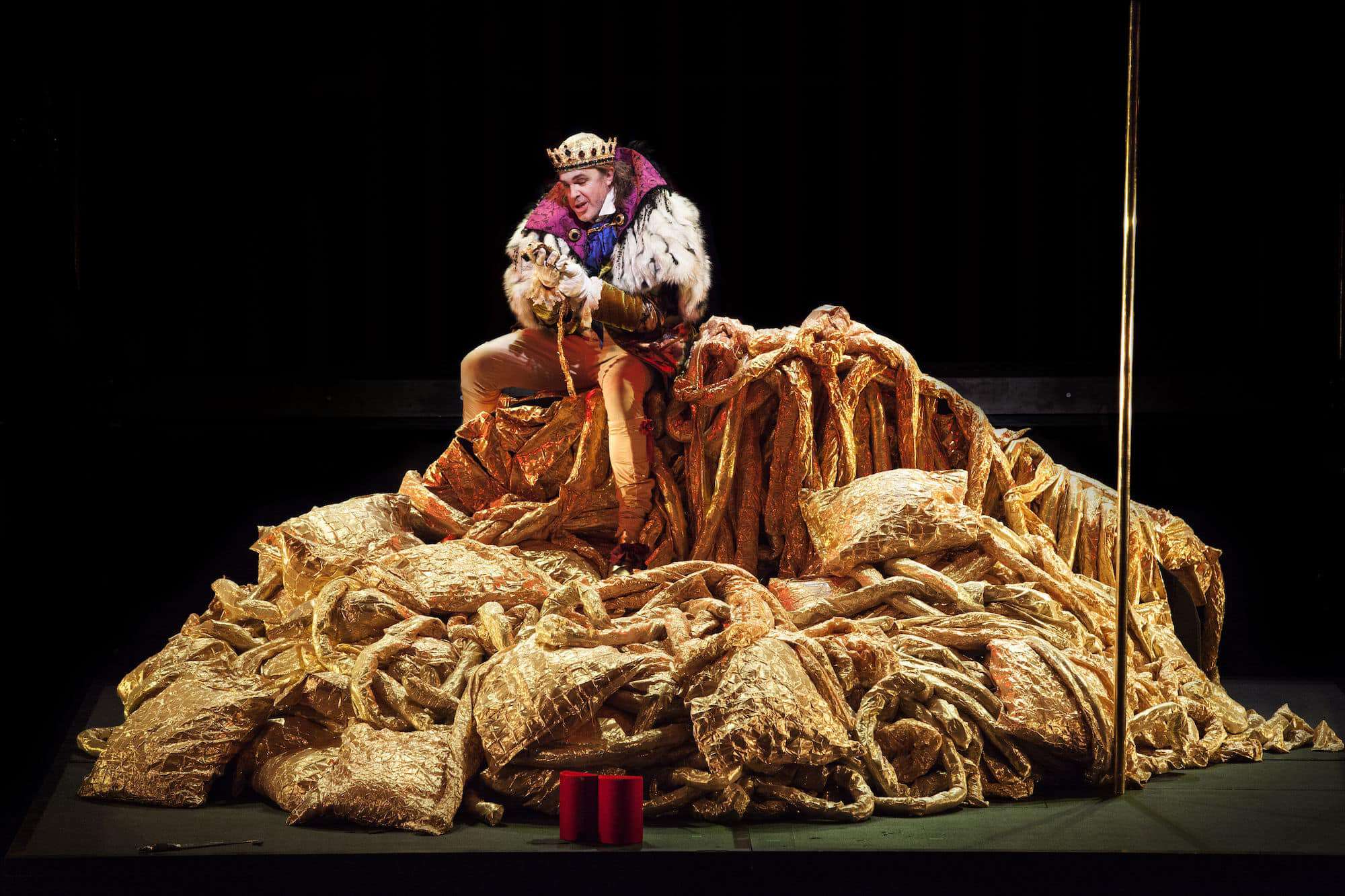
The entire production is set in a sober, almost cubist black set with various levels that are surprisingly slid above or over one another, as in some etchings by Frans Masereel – a perfect contemporary of Hindemith. Visually a beautiful spectacle, in which the black is only broken by the mass of gold that is plopped down like a string of sausages at the end of the first act. Gold that in the second act is declared fake by a dealer, with Joosten winking at the Antwerp diamond scene: the dealer here is, after all, a very orthodox-looking Jew.
Too little psychopath
In the direction of the characters, the portrayal of Cardillac's daughter and her officer are especially successful, with the daughter (Betsy Horne), despite the sobriety of text and music, nevertheless radiating a certain tenderness, and the officer (Ferdinand von Bothmer) performing with character and assurance. Vocally too, they are admirably accomplished. The lady in the first act is characterised as a tart who lets herself be bought for a jewel by the cavalier. Unfortunately, her sexy appearance is performed somewhat clumsily, as a failed pole she clings to is more disruptive (and wobbly!) than it radiates eroticism.
But this is only a detail compared to the portrayal of Cardillac himself. Joosten apparently sees him more as a carnivalesque vain good-for-nothing than as a tormented artist. In this production he does not come across at all as an introverted neurotic man so obsessed with his art that he is driven to criminality. Did Joosten draw inspiration for his character from Hoffmann's novella, Mademoiselle de Scudéry, which lies at the basis of Hindemith's libretto and harks back to the 17th century? He looks like a ridiculous Louis XIV and thus radiates nothing of the tormented and insane that sounds from the music with which Hindemith characterises him. It must be all the more difficult for Simon Neal to sing the demanding role. And although his character does not come across strongly enough, we can only admire him for it.
Fascinating musical language
Hindemith argues with his opera for a new approach to musical language: still tonal, but away from sentiment and pathos. Romanticism and bel canto are not for him. He opts for a musical language that is sharp and witty. No emotional strings, but pointed sounds of percussion and brass. Yet he does not throw the entire tradition overboard. Where it seems fitting to him, he applies certain stylistic features of the Baroque and of Bach. The beginning of the second act, for example, offers a series of brilliant and dramaturgically very efficient fugues. The third act, in turn, contains a passacaglia full of rhythm and liveliness. And the closing music lets a moving polyphonic lament be heard. Cardillac's daughter sings an almost traditional aria, but supported by oboe and percussion.
The vocal style is mostly closer to Sprechgesang, and since the orchestration hardly allows for lyricism, it must be a real feat of strength for the singers to memorise the texts. The music is strongly structured in short passages, which also have their emotional effect, but in a different way than we are used to in opera. Experiencing this opera on stage is, aurally at least, a fascinating voyage of discovery which, if you are open to it, carries you along as a spectator just as well as a traditional work. We were treated to a very precise and committed performance by Dmitri Jurowski and the orchestra of Opera Vlaanderen, with brilliant passages for tenor saxophone, oboe and percussion – to name but these. Musically, an absolutely top-class production.
- WHAT: Paul Hindemith (1895-1963) | Cardillac
- DIRECTION: Guy Joosten
- VOICES: Simon Neal, Betsy Horne, Ferdinand von Bothmer, Theresa Kronthaler, Sam Furness, Donald Thomson
- ORCHESTRA: Symfonisch Orkest Opera Vlaanderen & Koor Opera Vlaanderen o.l.v. Dmitri Jurowski
- WHERE: Opera Vlaanderen, Antwerp
- WHEN: Tuesday 5 February 2019 (performances until 12 February in Antwerp. In Ghent from 21 February to 3 March 2019.)
- PHOTO: © Annemie Augustijns