

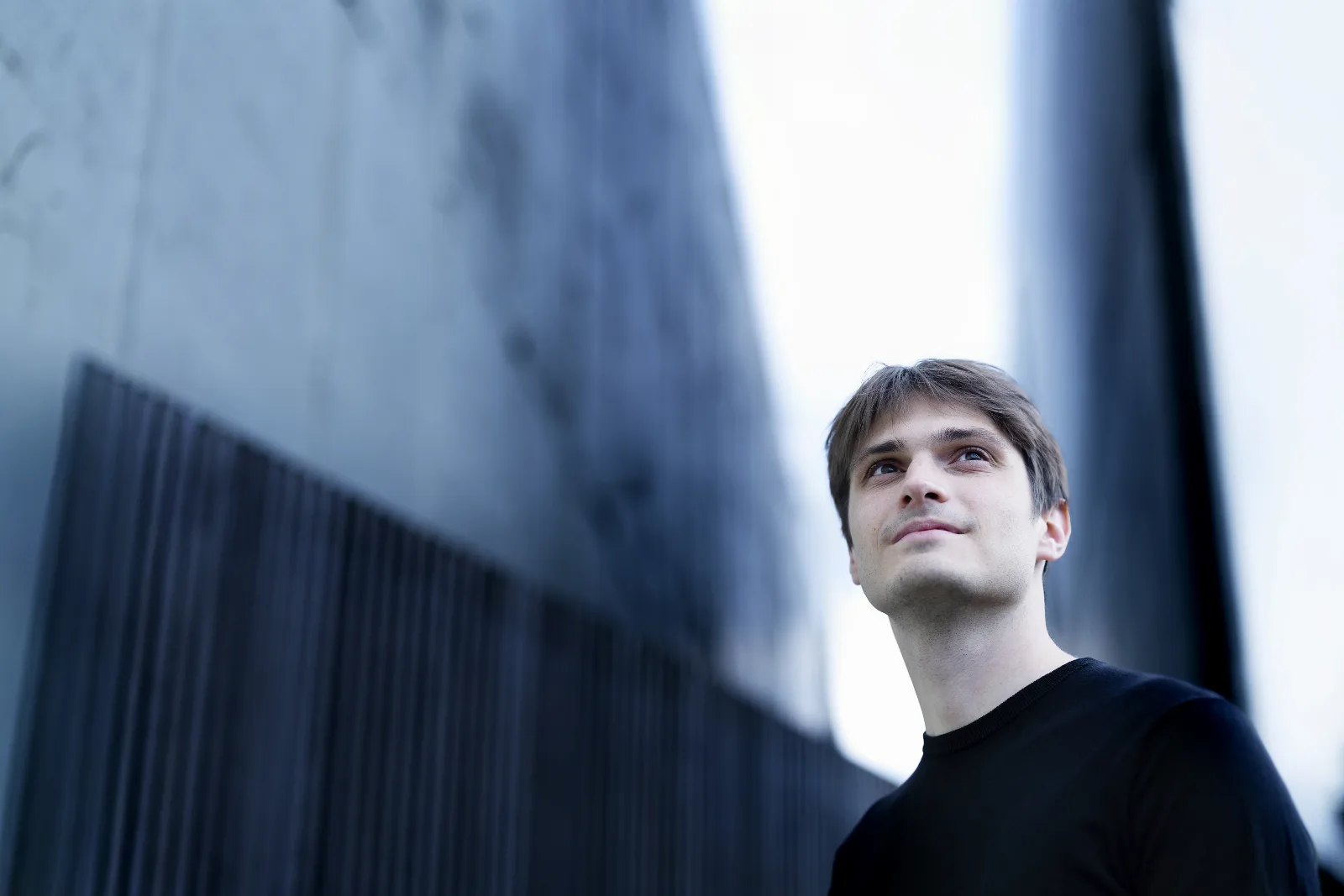
Following his residency at Festival2021, Emma Devillé interviewed Brecht Valckenaers. The article first appeared in De Toonbank and we are now happy to share it with our readers.
After blowing everyone away with his debut concert Ex Nihilo in 2024, the young Leuven pianist Brecht Valckenaers (b. 2000) was asked by Festival 20·21 to become their first festival artist-in-residence. For three seasons, he will play two concerts and thus share his craftsmanship with the world. Meanwhile, he is also building his own professional network. “Festival 20·21 is really the ideal platform for me at this moment to develop myself in exactly the way I want.”
Interview by Emma Devillé
Ligeti as a common thread
A central role in his residency is reserved for the work of the Hungarian composer György Ligeti (1923-2006). Valckenaers aims to have played all of Ligeti's most important piano works by the end of his residency. In recent years he has already performed the Musica ricercata (1951-53) and works for two pianists. This year Brecht begins Ligeti's eighteen etudes, starting with a selection of thirteen. “To be truly complete, I may still play the other studies in 2027, but at the same time there is no need to have played absolutely every work of his.”
Alongside Ligeti, he also includes his own compositions in the programmes, notably his Rhythm Studies. “The idea is to have twelve of those studies by the end of the trajectory, following examples such as Chopin, Liszt and Debussy.” This combination of pianist and composer remains central: “I think it is really important to create something new myself. It would be a pity to treat classical music as a dead language, so I try to approach music as a living language. Not like Latin, but like English. And I truly believe that is where the future lies.” Yet Valckenaers does not neglect tradition: “I see classical music as a city. On one side there is an old cathedral, from which you can learn so much. It is important to keep maintaining it so that everyone can keep discovering it. But it is also important that new buildings are constructed, otherwise you end up with a city that only lives in the past.”
Because Brecht Valckenaers currently focuses heavily on Ligeti in his concerts, his music is regularly compared with that of the Hungarian: “I understand where it comes from, but I myself see more differences than similarities in our compositions. We have such a different approach, live in such a different world. Like him, I have a great fascination for the possibilities of rhythm, but I believe we play with it in a different way.”
A concert as mosaic
Unlike the classical concert structure, he consistently opts for a mosaic-like construction. Instead of playing each piece in its entirety or in its original order, he mixes different pieces together. “I believe that the context in which you perform a piece can have a great influence on how it is perceived. The context can give a piece a different meaning, or simply allow it to shine more. In Musica ricercata I did not always find the transitions from one piece to the next entirely natural within the set itself. And then I often thought: with a different structure, some of those pieces could sound even more special.” And so the idea arose to shift and puzzle with the pieces. He attributes the ease with which he does this to the influence of his father, radio maker Gerrit Valckenaers: “Perhaps I also inherited a bit of that from my dad, who was always busy at the radio with which pieces fit well together. He would often come to me proudly to let me hear transitions between pieces: sometimes you barely noticed that a new piece had started.”
With this approach, Valckenaers ensures that each concert takes on a personal character. When he writes compositions himself, he is strongly influenced by the concert programme. “Before I start writing, I know very well what the context is. How the beginning or the ending needs to be in order to fit naturally into the programme. I find that very inspiring for the creative process.”
Solo recital On a Devil's Staircase
Those curious about the result can attend Valckenaers' solo recital On a Devil's Staircase on 28 September at the Maria Theresa College in Leuven. Here he combines Ligeti's etudes with three new studies of his own and fragments from Palais de Mari (1986) by the American composer Morton Feldman (1926-1987). Feldman's work, which had long been on Valckenaers' wish list, forms a perfect contrast with Ligeti's rhythmic complexity. “Feldman works as a kind of total counterpart that brings calm, like built-in 'active' pauses in a concert that is a continuous whole. For me, Palais de Mari is like an eternal, endless stream of more or less recurring motifs, which feel as if they were already flowing long before the piece starts and will keep flowing long after it stops. By playing only fragments of a work that normally lasts half an hour during the concert, this idea becomes reality: it is as if you are seeing small parts of an endless river,” Valckenaers explains.
Satellite concerts NEW!
Because it would be a pity to only let audiences hear excerpts from the masterpiece Palais de Mari, Festival 20·21 is also organising a satellite concert this year, in which Brecht Feldman's work will be performed in full and Maarten Beirens will provide an introduction (24 September). The new format of the satellite concert will also be applied to two other festival concerts, namely with Schubert's Fantasie in f (1828) and Britten's Lachrymae (1950) in a leading role.
Collaboration with the Karski Quartet
In addition to his solo recital, on 13 October Valckenaers will perform the piano quintets (1952 and 1965) of the much-admired Polish composer Grażyna Bacewicz (1909-1969) together with the Karski Quartet. This choice fits his ambition to bring lesser-known but outstanding works to the attention of audiences. "I got to know Bacewicz a few years ago through my girlfriend, and then we spent a whole week listening to nothing but her music, including her piano quintets in particular. It is really just fantastic music." When asked whether he would like to play those two pieces with the Karski Quartet, Valckenaers could therefore only answer an emphatic "yes."
Future plans
What the future holds is still uncertain. In 2027 Brecht Valckenaers will conclude his residency with a performance of Ligeti's piano concerto, together with Spectra Ensemble. For his solo recital, he hopes to complete his Rhythm Studies series: to reach twelve studies, he still has to compose four more. The collaboration with Festival 20·21 will in any case not come to a complete end: "The intention is always to remain somewhat involved, or at least to return regularly. It might no longer be annual, but that bond will remain. It is the festival I grew up with myself. It has also actually helped shape me. And there are currently many ideas in the air; it would be a shame to leave them hanging there."
With his residency at Festival 20·21, Valckenaers proves that classical music need not be a museum piece. Those who wish to experience his vision and craftsmanship for themselves can visit Festival 20·21 in September and October in Leuven.
Monday 28.09.2026 20:30 Leuven - Piano recital On a Devil's Staircase + link
Tuesday 13.10.2026 20:30 Polish(ed) - Power with Karski Quartet + link
TICKETS festival2021.be