


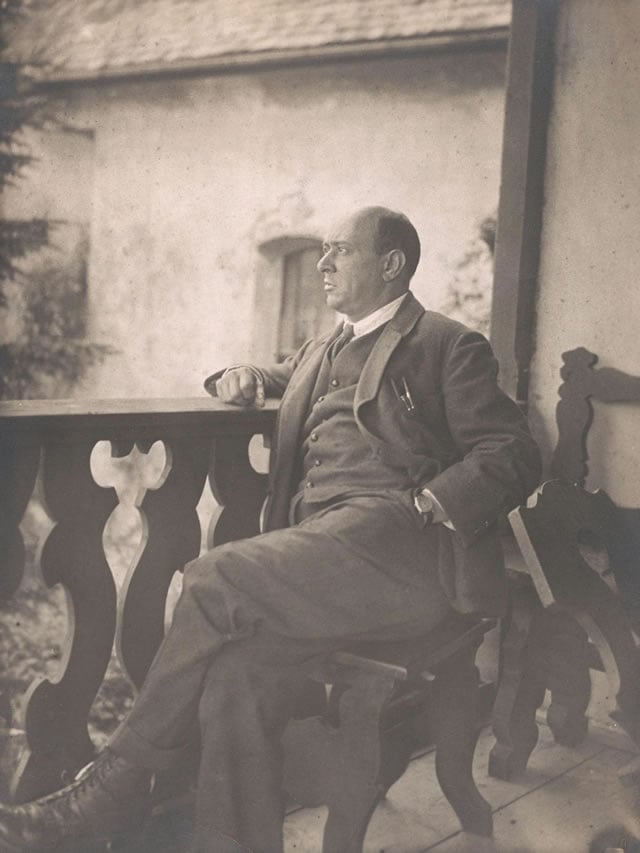
For Arnold Schönberg (1874-1951) it was crystal clear: the music of the Late Romanticism was for him as a composer the endpoint. Continuing down the same path seemed pointless to him. His string sextet Verklärte Nacht, completed in 1899, was that endpoint, in its full late-romantic glory, a final convulsion with which he once again made history.
Delayed orgasm
Seven years later, in 1906, novelties were bubbling and fizzing in his Kammersymphonie op. 9, whose bright tonality (E major) might suggest something quite different. But it is this chord that experiences a continually delayed orgasm and only comes to sound after twenty minutes. That familiar tonality is already stretched considerably by the harmonic construction in fourths rather than, as is customary, in thirds. The dissonances released from the accumulation of fourths can no longer be resolved in classical or romantic fashion, the scorching tensions are unprecedented.
Seismic shift
Yet it will still take considerable time before that last important step is taken: that of the 'zwölf nur aufeinander bezogenen Töne', in the Suite for piano op. 25 completed in 1921 in Traunkirchen. If there is ever truly a seismic shift in terms of music history, it is through this work. Gone is the oasis clothed in sound, the comfort zone: from one moment to the next we find ourselves in the midst of the ongoing movement of thematically fixed-in-place sequences.
Antisemitism
Schönberg's 'tragedy' was not that of the end of tonality, this revolutionary modernist, evolutionary traditionalist, reactionary romantic, solitary prophet, irrational expressionist, cerebral mathematician, the composer who drew new music into the domain of science, thus Joseph Auner. If there is something of tragedy in it at all, then it seems to dwell mainly in the human dimension. Thus Schönberg wrote to Kandinsky on April 19, 1922: '[...] For I am not a German, not a European, not even a human being, but a Jew'. He had just declined Kandinsky's invitation to become director of the music school in Weimar. The antisemitic mood prevailing at the Bauhaus, in which Kandinsky himself also participated, had not escaped his notice.
Roots
Schönberg had his roots in a Jewish family in Vienna, he made the transition to Lutheranism in a predominantly Catholic climate, faced a deeply cutting marital crisis (his wife Mathilde Zemlinsky was involved with the painter Richard Gerstl who later committed suicide, a deep misery that in 1909 left indelible marks in the monodrama Erwartung), worked alternately in Berlin and Vienna, and ultimately in 1933 returned to the Jewish faith and settled shortly thereafter—forced by the Nazi terror spreading all around him—as a permanent exile in America. From Schönberg to Schoenberg.
Musical no man's land
[caption id="attachment_41142" align="aligncenter" width="643"]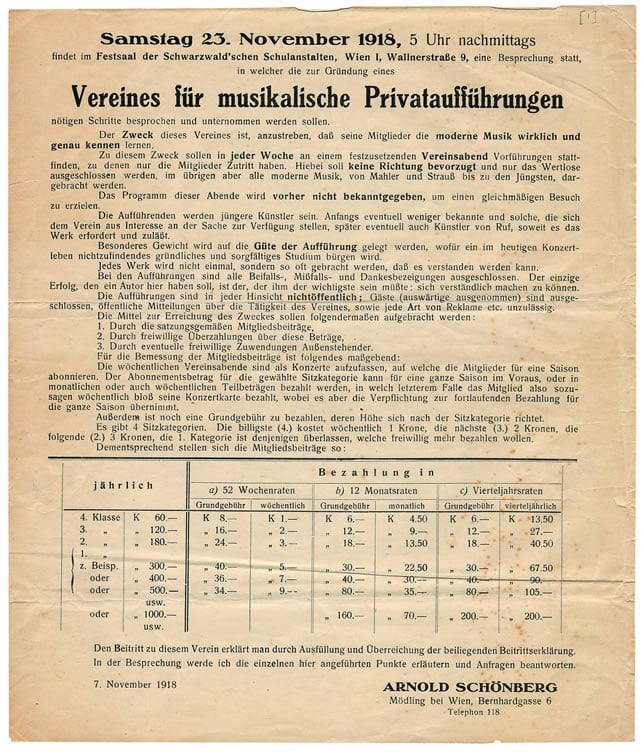 Announcement of the founding of the 'Verein für musikalische Privataufführungen'[/caption]
Once in America, the Jewish theme was given a more prominent role in his music. Not really surprising, as was also the case with the rather limited interest in his atonal compositions and when there was interest it was found almost exclusively within that small circle of followers and faithful supporters. It was the irrevocable consequence of that self-chosen journey through musical no man's land. And when it came to the performance of new music? That remained mainly confined to the concerts of the Verein für musikalische Privataufführungen, founded by Schönberg in 1918 and unfortunately disbanded again in 1921.
But Schönberg was not entirely alone, for there was also a bubbling in the various artistic circles in Vienna around the turn of the century. There was the razor-sharp critic Karl Kraus and the far from decadent writer Peter Altenberg, the progressive architect Adolf Loos, painters such as Gustav Klimt, Oskar Kokoschka (Schönberg himself was no unaccomplished painter!), and not far away, in Germany, Wassily Kandinsky (with Franz Marc in 1911, the same year in which Schönberg's Harmonielehre ('Dem Andenken Gustav Mahlers') appeared, founder of the artist group 'Der Blaue Reiter'). Other important art movements were those of the Wiener Werkstätte and the Wiener Secession.
Against Art Nouveau and cultural complacency
With Karl Kraus (primarily known for Die Fackel and Die letzten Tage der Menschheit) and Adolf Loos, Schönberg vigorously opposed the encroaching Art Nouveau movement
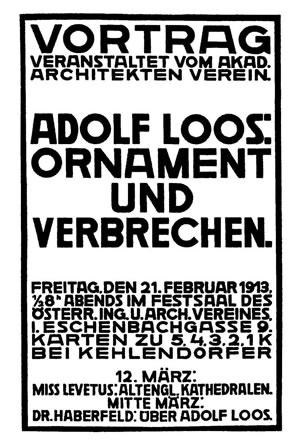 with its fondness for exuberant decoration, with the main consequence that in all art forms one had to refrain from all superfluous ornamentation: a kind of 'neue Sachlichkeit' that Loos elaborated further in 1908 in his Ornament und Verbrechen. The starting point was that culture in the broadest sense could only progress if ornamentation was abandoned. Moreover, it was considered an outright 'crime' to waste precious time on ornaments that in the long run would only be considered hopelessly outdated, end up in a melting pot or otherwise fall victim to demolition. Which, incidentally, did not happen, as was the case for many of Otto Wagner's structures. But for Schönberg, Kraus and Loos, the function of ornamentation was nothing more than the lazy consumption of an art form that obliged no one to anything. At the same time, it was a direct attack on both Viennese complacency and the encroaching materialism and superficial cultural consumption. Loos would later, incidentally, considerably soften his stance by, among other things, richly adorning the famous Michaelerhaus at Michaelerplatz 3 in Vienna with ornaments.
It is cultural complacency that serves as the key concept in the foreword to Schönberg's Harmonielehre:
'Unsere Zeit sucht vieles. Gefunden aber hat sie vor allem etwas: den Komfort. Der drängt sich in seiner ganzen Breite sogar in die Welt der Ideen und macht es uns so bequem, wie wir es nicht haben dürften. Man versteht es heute besser denn je, sich das Leben angenehm zu machen. Man löst Probleme, um eine Unannehmlichkeit aus dem Wege zu räumen. Aber wie löst man sie? Und daß man überhaupt meint, sie gelöst zu haben! Darin zeigt sich am deutlichsten, was die Voraussetzung der Bequemlichkeit ist: die Oberflächigkeit. So ist es leicht, eine 'Weltanschauung' zu haben, wenn man nur das anschaut, was angenehm ist, und das Übrige keines Blickes würdigt. Das Übrige, die Hauptsache nämlich. [...] Der Komfort als Weltanschauung! Möglichst wenig Bewegung, keine Erschütterung. Die den Komfort so lieben, werden nie dort suchen, wo nicht bestimmt etwas zu finden ist.'
And further, now in his role as teacher:
'Der Lehrer, der sich nicht echauffiert, weil er nur sagt, 'was er weiß', strengt auch seine Schüler zu wenig an.Von ihm selbst muss die Bewegung ausgehen, seine Unrast muss sich auf die Schüler übertragen. Dann werden sie suchen wie er. Dann wird er nicht Bildung verbreiten, und das ist gut. Denn Bildung heißt heute: vor allem etwas wissen, ohne irgendetwas zu verstehen. [...] Dann wäre es klar, daß es die erste Aufgabe des Lehrers ist, den Schüler recht durcheinanderzuschütteln. Wenn der Aufruhr, der dadurch entsteht, sich legt, dann hat sich wahrscheinlich alles an den richtigen Platz begeben. Oder es kommt nie dahin! Die Bewegung, die auf solche Art vom Lehrer ausgeht, kommt wieder zu ihm zurück.'
Closer to Kokoschka than to Picasso
Schönberg's views radiated a certain degree of non-conformism if not rebellion. In any case, they were filled with a radicalism that was completely foreign to the Viennese of those days. It had to result in practice that it was a fight against the tide, in a city whose social structure exhibited strong feudal traits and which was more oriented towards commerce, industry and luxury consumption than towards unrelenting, intellectually or creatively driven innovation. Schönberg's Harmonielehre was created precisely in an environment filled with Jugendstil and which had little to nothing to do with the new impetus-driven individualism that so typified the movement around Schönberg. Schönberg stood closer to Kokoschka than to Picasso. On the other hand, it is clear that the Viennese culturally aesthetically complacent milieu provided excellent soil for the practice of 'Schönberg's theory'. In other words, it was precisely Viennese indifference that brought the greatest talents to fruition, a phenomenon not far removed from what happened exactly a century earlier, when young Beethoven flouted convention and went his own way with arms crossed on his chest, against oppression. A revolutionary from Bonn who took up the struggle against the 'comfort' that Haydn in particular, but Mozart in part before him, had set the tone for for years. It was Beethoven who already confronted musical society with 'problems' and 'inconveniences' of a high and above all groundbreaking quality.
The image of Loos and Schönberg thus fits together almost perfectly, with functionalism (the form that follows the function) in architecture. Indeed, in Schönberg's twelve-tone system it is also about intellectually driven, functional relationships within design and construction, with the serial technique as its reflection. He built further in America on what he was forced to leave behind in Europe, composing, writing and teaching.
 Still close to Brahms...
In many musical circles, the music of Schönberg is often nonchalantly associated with inaccessibility, referring to the dodecaphony inherent in it. As if Piet Mondriaan had spent his entire artist's life only with the geometrically abstract and non-figurative.
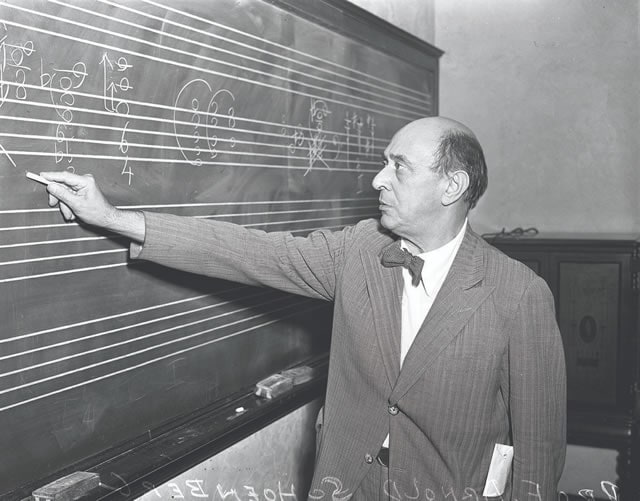
Schönberg's Drei (Klavier)stücke op. 11 from 1909 represented on this album (also catalogued in Schönberg's arrangement for ensemble) can, contrary to what one might think - at least when viewed from the later twelve-tone technique - be regarded as a counter-movement. For we encounter therein (over)familiar, traditional scenarios, such as repetition, variation within repetition, the ostinato and the pedal point. The tonal colours do not even substantially differ from those of Brahms or Schumann. Unlike in the surrounding works, no 'classical' boundary is crossed, there is no tonal tension field, and the dissonances inherent to it resolve easily and smoothly into consonance.
'Unendliche' melody
The Sechs kleine Klavierstücke op. 19 have a different genesis. The first five of them were created in just one day (19 February 1911), moreover in the midst of all sorts of revision work and correspondence with his music publisher about various ongoing projects (Pelleas und Melisande, Gurre-Lieder, Orchesterlieder op. 8). The sixth and final part was created, equally spontaneously, a few months later, on 17 June, shortly after the death of Gustav Mahler on 18 May, an event that deeply affected Schönberg. The chord with wide spacing contained therein (a-fis-b) unmistakably recalls Mahler's final period as a composer. On his sickbed, shortly before his death, Mahler said of Schönberg: 'Wenn ich gehe, hat er niemand mehr.'
The six miniatures are conceived in entirely closed form. Unlike in his op. 11, every (possible) repetition is avoided, although in the second part there is an ostinato struck no fewer than twenty-six times that also serves as a tonal anchor point (g-b). The third part is dominated by bitonality, with a four-voice chord (d-fis-b-cis and b-d-g-a respectively) in alternating positions at both the beginning and the end. The opening part is the most complex and also the longest of the six, built on a five-voice chord, of which the pianist, advocate and contemporary of Schönberg, Eduard Steuermann, once remarked that it had the properties of an 'unendliche' melody. From the perspective of the tonal cadence, it is the sphere of influence of the leading tone that literally sets the tone here, both in ascending and descending motion. The parts are, all in all, quite demanding, and not only for the performer. They stand, viewed from the perspective of musical 'grammar', quite close to the Stücke für Kammerorchester completed almost a year earlier.
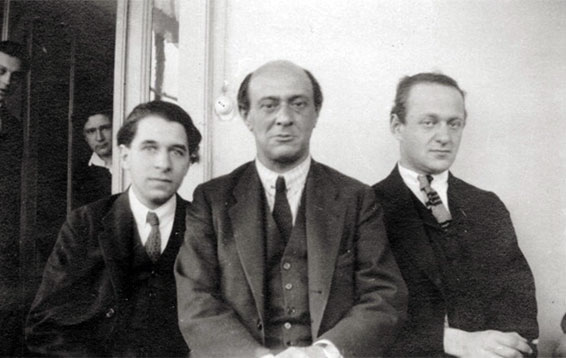 Traditional form, but then...
The Suite op. 25 completed in 1923 has the characteristics of the baroque suite, including the corresponding dance forms (Präludium, Gavotte, Musette, Menuet, Gigue). Appearances are deceiving, however, for Schönberg took the important step of consistently applied twelve-tone technique in this work. A technique, moreover, that - the first 'proof' of which lay before it - did not have to stand in the way of musicality, the joy of playing and rhythmic vitality. The lyricism certainly does not fall short either, especially in the somber-toned Intermezzo, in which the extended melodic lines are beautifully spun out and can rival the strongly contrasting, restless lower voices. The Gigue alone makes an impression through the manic hectic with which it is permeated. Of the nine parts in total (including two da capos), seven are short and concise, with only Intermezzo, Menuet and Gigue as exceptions (although the longest part, the Intermezzo, lasts less than five minutes). Anyone who ascribes to twelve-tone technique as a 'medium' of dryness or tedium could not do better than listen to this Suite, in which humour, lyricism, expressive layering, rhythmic pregnance and invention as well as the eccentric come together in a very contagious, but also cleverly constructed manner.
Webern as a student
In the autumn of 1904, the decisive meeting between Anton Webern (1883-1945) and Schönberg took place. An advertisement had appeared in a Viennese newspaper by Schönberg calling for music students to enroll at the 'Schwarzwaldschule', a private gymnasium founded by Doctor Eugenie Schwarzwald (1872-1940), located on the Viennese Regierungsgasse. Schwarzwald enjoyed great prominence in Vienna, both as an important arts patron and as a teacher who possessed great pedagogical qualities. She had opened the gymnasium on Sundays for both lectures and special courses by leading scientists and artists, including Schönberg. It had developed into a highly regarded meeting place involving many prominent figures, including Kokoschka, Loos and the composer and conductor Alexander Zemlinsky (who taught form and orchestration at the gymnasium). Schönberg was honored, at Schwarzwald's recommendation, to serve as patron of the institute and to teach harmony and counterpoint.
And so Webern, who had already shown interest in Schönberg's music earlier (in the first year of Webern's university studies he had been able to become acquainted with the score of Pelleas und Melisande thanks to the composer Karl Weigl and had been fascinated by it), came into direct contact with the composer. About his impressions of Pelleas, he wrote three years later, on 2 September 1907, to his revered teacher:
'Weiß der Teufel, die Sache hat mich nicht mehr losgelassen, ich mußte immer nur denken, wie etwa diese Musik sei; ich weiß ganz genau, wie ich den darauffolgenden Sommer fast ausschließlich von diesem Gedanken beherrscht war.'
In the same letter about Verklärte Nacht (Webern heard the piece for the first time in the 1903-1904 concert season): 'Der Eindruck davon war einer der größten, die ich erlebt hatte.'
And to think that Schönberg was only nine years older than Webern and could not claim any academic background when he reported to him as a student in the autumn of 1904.
As far as is known, Webern was Schönberg's first student in Vienna, soon followed by his friends Karl Horwitz and Heinrich Jalowetz, and not long after by Alban Berg and Erwin Stein. In October 1905, Egon Wellesz also joined this group. Meanwhile, the teaching position at the 'Schwarzwaldschule' had moved to that of the studio in Schönberg's apartment at Lichtensteinstraße 68-70.
Webern and Isaac
It will undoubtedly sound strange to many, but anyone who wants to understand Webern's compositional style and technique cannot avoid the Dutch polyphonist Heinrich Isaac (1450-1517), and in particular the second part of his three-part Choralis Constantinus, of which Webern made an arrangement, published in 1909 in Denkmäler der Tonkunst in Österreich, with the title Heinrich Isaac 'Choralis Constantinus'. Zweiter Teil. Graduale in mehrstimmiger Bearbeitung (a capella). bearbeitet von Anton von Webern.
It was also Webern who published this second part, consisting of twenty-five two- to six-voice Graduals, at his own expense.
In the lengthy introduction to this edition, Webern points to the special characteristics of Isaac's music (motets, masses, psalms and secular chansons in which the Dutch, Italian and German stylistic elements are perfectly integrated):
'We experience here that wonderful effect of polyphonic musical art, which is achieved by the fact that the voices proceed side by side with equal rights, but that nonetheless the one which gains significance in its development comes to the foreground, and that while this one is declining, another begins to emerge, in short through fine articulation in the juxtaposition of the voices [...] He has fulfilled the ideal of the most lively and most independent voice-leading in a wonderful manner. Each voice has its own development and is a completely self-contained, self-explanatory, wonderfully ensouled entity [...] Heinrich Ysaac devotes all the arts of counterpoint to the ideal of presenting the individual voices as independent, highly individual beings, and from this ideal arise the boldnesses of his compositional technique [...] Ysaac employs canonic arts in the second part of his 'Choralis Constantinus' in the most extensive manner: two-part canons in unison, in upper and lower fourths, fifths and octaves or in the twelfth. It then happens that one voice follows from another in such a way that it imitates this, beginning at the same time with it, at intervals twice as large, or likewise beginning simultaneously, transposing the others to the upper third [...] Furthermore, Ysaac forms three-part canons, one four-part canon, three double canons and finally two crab canons. Longer and shorter imitations, strettos, augmentations, diminutions are found continually in all the offices; imitation forms the starting point of each voice [...] It is admirable how Heinrich Ysaac achieves the most diverse tonal effects with the means at his disposal. To this is added the finest observation of the timbral qualities of the different registers in human voices. This forms one of the reasons for the often complete interlocking of the voices and their disjunct voice-leading [...] It must be noted that through Ysaac's music of the 'Choralis Constantinus' the chorale continually winds through, remaining recognizable to the comparison despite all variations, but for the listener scarcely distinguishable due to its intimate union with the others. It is wonderful how Heinrich Ysaac grasps the spirit of the chorale with the greatest inwardness and absorbs it within himself, so that within the music of the Master the chorale appears not as something alien to its nature, but merged with it in the highest unity - a magnificent testimony to the greatness of his art.'
It is this passionate plea by the then 26-year-old Webern that paves the way towards a good understanding of his later composing as well, in which the characteristics of Isaac's art enumerated by him are represented throughout. The mastery of compositional craft goes hand in hand with Webern's refinement condensation and contrapuntal discipline refined to the utmost. It was no different with Isaac...
Such a precise description of Isaac's art also indicates that Webern, when he applied as a student to Schönberg in the autumn of 1904, was certainly no beginner: he had already mastered considerably more than just the basic principles of both composition and analysis. For Webern, Schönberg functioned above all as a stimulator and curator, later also as a colleague and friend.
Variations
The first performance of the Variationen für Klavier op. 27 dedicated by Webern to Eduard Steuermann took place on 26 October 1937 with Peter Stadlen (1910-1996) at the piano. Four days later the repetition took place, also in Vienna, but this time as part of the concert series of the Verein für neue Musik. The music critic of the Neue Freie Presse noted on 6 November in rather uncomplimentary terms: 'Here the musical solution of the so hotly disputed problem of atomic fission has succeeded.'
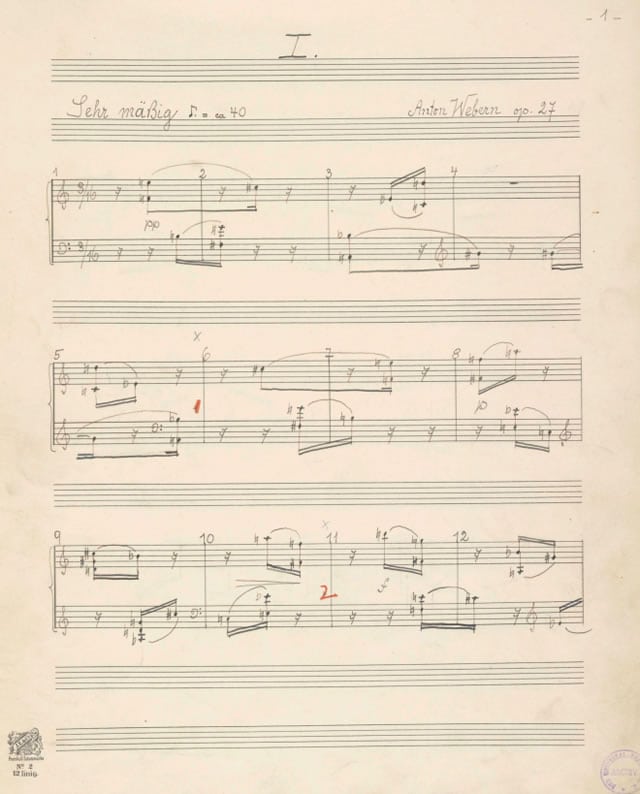
It also turned out to be the last time Webern could attend a public performance of his music in his native city. He had by then become fully aware of the consequences that applied to him as well, which were linked to the Nazi stamp that had meanwhile been placed on his music in Germany: that of 'degenerate' music.
Stadlen has documented in Serialism Reconsidered (click here) the rehearsals (perhaps it is more appropriate to speak of preparations) in Webern's presence in greater detail (a facsimile of the score used by him on that occasion, provided with Webern's annotations and alongside it the extensive commentary of the pianist, was published in 1979 by Universal Edition). Stadlen:
'For weeks he (Webern, AvdW) spent countless hours discussing and determining the performance down to the smallest details with me. When he sang and shouted, waved his arms and stamped his feet, trying to clarify what he called the content of the music, I was astonished to see how these few fragmentary notes were treated like cascades of sounds. He repeatedly spoke of the melody, which, as he believed, had to come as eloquently as a spoken sentence. Sometimes this melody could be found in the high notes of the right hand and then again for a few bars divided between right and left hand. It was shaped by an enormous number of constant rubati and a highly unpredictable distribution of accents. But there were also pronounced tempo changes every few bars, which were meant to emphasize the beginning of a 'new sentence'. Then Webern's extreme demands for differentiation of sound, especially in the pianissimo range, at that time gave rise to a well-meaning rumor that he had now also invented the 'pensato'. What was meant by this was that a note had to be so unimaginably tender and soft that one could only think it.'
Stadlen also noted that in the Scherzo there was no avoiding the (as he experienced it) unpleasant crossing of hands, but that Webern held the view that 'the unavoidable difficulties in its performance would give it the correct way of phrasing.' Another problem cited by Stadlen concerned the realization of the heavily syncopated rhythm within the already complex meter, alongside the generous use of the pedal, not only to vary the tone color but also to counterbalance the slender linear texture and to mark certain highlights with a larger sound volume.
The use of the pedal alone proves to be a sensitive point in virtually all performances (including those by Leonskaja) because—curiously enough—the official printed edition provides insufficient guidance on this. This means that the facsimile edition must actually be consulted, which unfortunately turns out to be more the exception than the rule.
Anyone studying the piece more closely will quickly discover in the first two sections the mirrored horizontal (melody) and vertical (harmony) symmetry (one of many aspects of serial technique). What is not immediately apparent, however, is that these sections were created only after the variations (Webern wrote to composer and friend Josef Polnauer on July 26, 1936 that he was now only realizing that the Variations could 'go further'). The final measures, however, leave no doubt: they lead directly back to the opening section. It is the 'germinal idea' that thus experiences its organic continuation, the germinal cell or the motif as we also know it from Beethoven, Brahms, Schönberg or... Willem Pijper.
In Uncertainty
But what exactly about the serial technique employed by Webern? He told his students: 'A composer must learn to listen to the tone row and force it to reveal its secrets.' As for the performer and the public, however, he did not deem it necessary to become acquainted with the many possibilities for manipulating the series. This seems to align with what Stadlen observed about it: that during the many weeks of preparation, Webern never wanted to discuss the serial aspect of his Klaviervariationen. Even when the pianist specifically asked about it, the composer remained firm in his conviction that how the work was performed was more important than how it was created.
Berg and his Op. 1
Like Webern, Alban Berg (1885-1935) was also an important student of Schönberg, and this study period left its mark on Berg's oeuvre. The three of them, each in their own field, with unprecedented inner strength managed to break through the bonds of prevailing convention and, despite all resistance, also maintained this stance. In this they did not differ essentially from Beethoven, Bruckner or—closer in time—Pierre Boulez.
Berg, like Webern, first met Schönberg as his future teacher in 1904 through an advertisement (his brother Charly had pointed it out to him) in a Viennese daily newspaper. From autumn onwards, he belonged together with Webern, Horwitz, Stein and Jalowetz to the group of students who proudly called themselves the 'Schönberg School'.
Soon a close friendship developed between Berg and the fourteen-year-older Webern, which ended only in 1935 with Berg's death. The fact that their paths would ultimately diverge on the creative level placed no personal weight on this.
[caption id="attachment_41143" align="aligncenter" width="640"]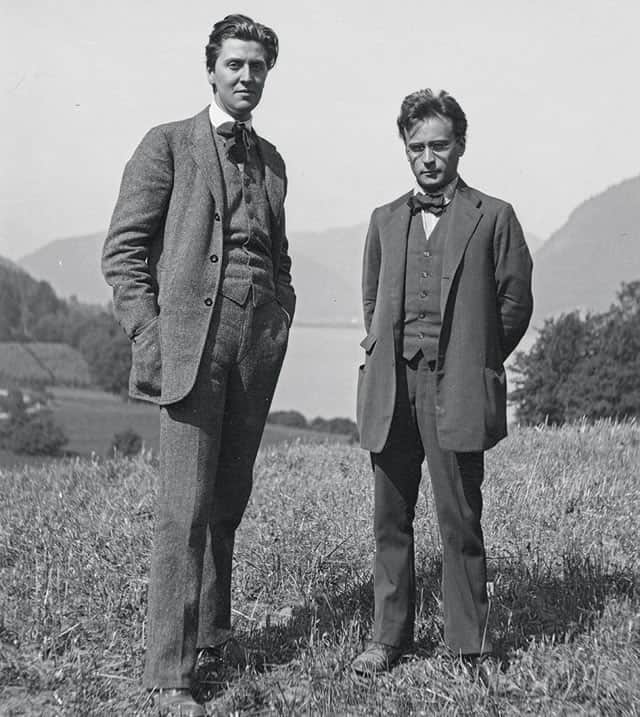 Anton Webern (r.) and Alban Berg (ca. 1905)[/caption]
Berg's Piano Sonata from the period 1907-1909 (in the words of Glenn Gould 'the language of musical Weltschmerz') did indeed receive the official opus number 1, but it was certainly not his first work. More than fifty songs had preceded it (including the Sieben frühe Lieder). However, the sonata was his first published work. Five earlier attempts to compose a piano sonata had ended in failure, although it is unlikely that he lacked self-confidence in that creative process, as Schönberg encouraged him wherever he could. While his teacher had meanwhile sought out the tension field around crumbling tonality, Berg's one-movement Piano Sonata, however, still circles around the dark tonic of B-flat minor.
The original plan was that of a three-part work (opening movement, slow movement, finale), but the ideas for it would not come. Schönberg's advice must therefore have been a real relief: that in that one movement, as far as he was concerned, everything that needed to be said had been said.
The structure is that of classical sonata form, to which Berg remained so attached later: we hear the usual exposition, the development and the recapitulation. What strikes us all the more through this is the extremely restless chromaticism, the inventive use of whole tone scales and the many changing keys, often even far removed from B-flat minor. They were not models for it, but they did have it, each in their own way, thoroughly tried: Wagner (chromaticism) and Bruckner (the discourse of the far-removed keys). In Berg's Sonata, feelings of nervousness, hurriedness, even agitation impose themselves almost continuously, until finally at the end a solution to them is found. South Korean pianist and composer Chiyoon Chung has provided an impressive analysis of it here, both as regards the antecedents of the work and the (possible) interpretation of it.
Of course, the influence of Berg's teacher is also unmistakable in this work, such as the development from the motif as a core idea and that of the developing variation emerging from it. It is primarily to this that the structural coherence is due, despite all the detours.
However much Schönberg's influence also presses on the sonata in the most positive sense, it is a fact that from a stylistic point of view there are indeed points of contact in the work with Berg's songs and instrumental pieces from his earlier creative period. There is, at least in part, a unifying 'Grundgestalt', conceptual and methodological, notwithstanding the fact that the aforementioned developing variation technique is clearly derived from Berg's teacher, as is also the case—albeit to a lesser extent—with the motivic and harmonic characteristics.
Then and now
Historicising performance practice is usually primarily associated with music from the Renaissance and the (Early) Baroque, but is no less important for music from the (Late) Romanticism and even extending into the interwar period. As far as the latter is concerned, this also applies to the music of the Second Viennese School.
Until the 1960s, hardly anyone asked themselves whether this music could come into its own within the then prevailing performance practice. Specific specialisms were (not yet) in question; we simply knew no better.
This picture changed considerably at the end of the 1960s. First came the Renaissance and the Baroque, then Viennese Classicism, then Romanticism and finally twentieth-century music (which had to wait the longest for interpretative 'rediscovery').
Those who knew no better at that time were the composers themselves, because performances found their justification in transmitted traditions, while there was no such thing as 'Urtext' based on musicological research. Nor were there initiatives in that direction.
That is certainly different nowadays, with our richly stocked discography in addition, which can easily bring us into contact with performances from then, often perceived as 'dated' by it. Perhaps this has produced the greatest change in the Western music domain: the opportunity we have to literally listen to the past and thereby gain new insights, a phenomenon that did not really gain a foothold until the mid-1920s, when the making of electrical recordings became possible. After which the processes connected with it were caught in a real acceleration, only briefly interrupted by the Second World War. Meanwhile, the conclusion is justified that the CD has far surpassed live performances as the most important musical source for the majority of music lovers. One of the best books on this subject is Robert Philips' Performing in the Age of Recording. It is the historical recordings that allow us to learn and thereby enrich our insights into how composers played or conducted their own work, and how other interpreters dealt with it.
The name that frequently appears with regard to the performance of music by the Second Viennese School is that of Austrian-American pianist Eduard Steuermann (1892-1964), who studied with, among others, Ferruccio Busoni, Engelbert Humperdinck and Arnold Schönberg, and who later played an important role in both promoting and performing Schönberg's piano works. And like Schönberg, he emigrated to the United States after the rise of the Nazis, where he was a teacher at the famous Juilliard School of Music. In 1952 he was awarded the Schönberg Medal by the Society for Contemporary Music.
Steuermann was, certainly as far as his performances of Schönberg's music are concerned, an authority, as Peter Stadlen was with regard to, among other things, the piano works of Webern.
But that question is not raised without reason: whether authority also means that it had to be that way and (therefore) could not be otherwise? Of course that is not the case and a single example makes that clear. Thus Steuermann's interpretation of Schönberg's piano works radiates coolness rather than rich expression, was thereby the opposite of Stadlen, who indeed attached great importance to expressive gesture, but which does not detract from the fact that Schönberg was very fond of Steuermann's playing, regarded him as a representative champion of his piano oeuvre.
Two voices
On the 6 cd-set Darmstadt Aural Documents released by the music label Neos (among others on Spotify), both Eduard Steuermann and Peter Stadlen are represented and what is striking about this is that Steuermann's sobriety proves clarifying from an analytical point of view and that Stadlen lets expressive power prevail above
does indeed know how to connect itself in an individualistic sense with Stadlen's greater range of expression: that they are two 'voices' that each tell the story in their own way and thereby convince.
It is also clear that Leonskaja, as far as Webern's Variations are concerned, either did not know the facsimile edition published by Universal Edition or did not attach any particular value to it. Which Stadlen of course did.
What a good interpretation also makes clear is that the system of the 'zwölf nur aufeinander bezogenen Töne' allows sufficient expression. Schönberg fought throughout his life against the view of tedium inherent in the serial technique, while Berg and Webern likewise made short work of it in the practice of composing. I need only recall the already mentioned preparations for the performance of Webern's Variations in this regard, but also Webern's extreme demands with regard to tonal differentiation (which Leonskaja unfortunately did not take sufficiently to heart).
Alban Berg said it already: that music is the outcome of feeling and knowledge, that it demands of its followers, both composers and performers, not only talent and enthusiasm, but also knowledge and perception, but only after prolonged study and reflection.
He said something else important: that the call for tonality has less to do with the need to actually feel the tonic, but rather on the basis of familiar chords, and especially the triad. As long as such triads are present in sufficient quantity, it will not give offense, even if it clashes very violently with the sacred laws of tonality.
Elisabeth Leonskaja
That brings me to the piano playing of Elisabeth Leonskaja (Tbilisi, 1945), one of the most prominent pianists of her generation, but who has not entirely convinced me in this recital devoted to the Second Viennese School.
Her playing style is rather methodical than individualistic, quite heavy-handed and more pedagogical than inventive. The technique is in excellent hands, but the commitment is quite uneven. What this music – and that applies to all the pieces recorded here – does not tolerate (but which music does?) is superficially tinged expressivity. It sounds as if Leonskaja has appropriated these works in one fell swoop and thereby produces them with so little differentiation.
The booklet, which does not excel in a thorough commentary (at least desirable with a repertoire like this) on the genesis of these works, leaves in the middle which version of Berg's Piano Sonata is being played: that of respectively 1910 (the first version), 1920 (second version) or 1926 (third version).
How was that, by the way, with those different publications? The first edition, published by Schlesinger in Berlin, was sold out shortly after publication. A reprint had to come as soon as possible. Berg wrote about it on May 25 to his German music publisher Robert Lienau. Not only was that reprint urgently needed, but also that of the likewise sold-out Four Songs op. 2.
Berg took the opportunity to propose a number of corrections from the first edition, but left it to the publisher whether and to what extent they would find a place in the new edition. He did not want to make too much of it in the interest of a reprint as soon as possible. So it came down to setting priorities in advance.
The reprint appeared later that same year, in December 1920, in which indeed a number of changes had been incorporated, although we do not know whether this concerns all the corrections made by Berg (the correction copy used by the composer has unfortunately been lost).
[caption id="attachment_41141" align="aligncenter" width="481"]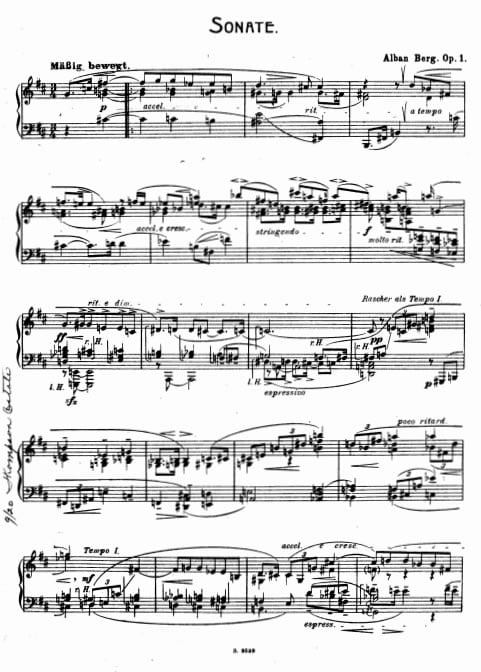 Opening page of the 1920 reprint[/caption]
In 1926 a 'new, revised edition' appeared through the publisher. These revisions were not initiated by Berg, but by the publisher in order to establish American copyright but also to give the publication wider international recognition. For Berg it was also a makeover that went further than a few cosmetic adjustments here and there. In fact, this is the version that should be performed, because it is the last one, representing Berg's 'letzter Hand'.
In 1950 the second edition of the score (1920) was reproduced photographically, apparently due to the absence of the original printing plates. The consequence was predictable: it was this edition that was performed everywhere in the post-war years, thanks to two major publishing houses: Peters and Universal Edition.
However, in 2006 light finally appeared on the horizon with the publication of two musicologically prepared editions: by Henle (in the well-known Urtext series) and Universal Edition. The most important source was - fortunately! - that of the 1926 edition, with those of 1910 and 1920 as secondary sources. This rectified many discrepancies and the two 2006 editions quickly gained worldwide recognition from virtually every performer - including Elisabeth Leonskaja.