


On May 27 (Ghent) and 28 (Antwerp), the world premiere of the piano concerto by Annelies Van Parys takes place. She has developed an impressive portfolio of chamber music, orchestral works, vocal and music theater in which timbre is central. A conversation about the creation of this concerto, the challenges of contemporary classical music and about her mentor Luc Brewaeys. A composer who also thinks architecturally.
Annelies Van Parys: "The commission from the Antwerp Symphony Orchestra (ASO) was completely open. I've wanted to write a piano concerto for a long time. In addition, pianist Jan Michiels asked me long ago to compose a concerto sometime. At the ASO they said: yes, excellent idea, let's just do that. I was allowed to choose the size of the ensemble and went for a modest instrumentation for practical reasons. I had just had to postpone a work with the Concertgebouw Orchestra from Amsterdam because of Covid restrictions because the ensemble was too large. Moreover, a smaller ensemble has the advantage that smaller orchestras can also program the work."
Classical structure
"I actually held myself quite traditionally to the three classical parts. The reason is perhaps that I am myself a pianist and have thus listened to all those concertos ad nauseam. That still sticks with you somewhere. It begins with a first part that is almost a toccata. All in all, a very solid, spicy piece. The second part is a slow movement, rather lyrical. The orchestra is especially important there. And then the last part is a fairly traditional rondo. So the large forms. But then comes the organization. My music is not tonal but spectrally organized, so according to timbre. I explore how you can evoke tensions between consonance and dissonance with non-tonal music. A technical complication is that a piano only has whole or half tone intervals but spectral music knows smaller tone intervals. This means that the orchestra takes the lead in the spectral part of this concerto. Sometimes I have to shift the orchestra by a quarter tone to fit the piano in it. Because a piano has no quarter tones. This play occurs especially in the middle section where a consonant becomes increasingly dissonant. In this way I let the spectrum work in a disturbing way and I conjure up all sorts of things with it."
"Gradually towards the end there is a reduction, a return to relaxation. I find that very exciting because I have never tried it that way before and am not entirely sure if it will work. Very exciting. That's a bit of a disease of mine: that I always want to try other things. And then at the time of the premiere I often think: 'why didn't I just play it safe once? Have I done something again that I'm not sure will work'."
Mentor
"Luc Brewaeys (1959-2015) has been an important mentor for me, both technically-compositionally and aesthetically and organizationally. How did I notice it clicked with him? I felt a great mutual respect, a great understanding. His guidance came from what I was trying to say. And not from what he thought I should be saying. That's the big difference. And I also learned that from him. I now teach composition myself and always try to convey that to my students: what do you want to say?"
"The ball really started rolling when I unexpectedly won the Flandres/Quebec prize with my chamber music piece Phrases V in 2001. From then on, commissions started flowing in. And then I knew: okay, this could be something. For me it went fairly organically. On the one hand, I slowed it down a bit myself or gathered the right people around me. And so I built my career step by step. Not aiming too high right away. On the other hand: I am from West Flanders. That means: keep both feet a bit on the ground."
Program more often
"This concerto doesn't tell a story. But the classical form does give a certain framework. There is a kind of built-in knowledge of how a "classical" concerto should sound. But with new music there is no starting point. You can't then expect listeners to be on board from the first time. That's a utopia. But there is a way to give new music better access. By giving some explanation or simply programming it more. So that people learn to hear it more.
I use my parents as an example. They both had an interest in music and could appreciate various types of music, but new music was rather unknown to them until I started writing it. At first they often thought: What is that? What a noise! What are you writing? But nowadays when they hear a concert with old music next to a work of mine, they are really genuinely most fascinated by what I've written. Not because I'm their daughter. But because they know the rest and find what I write cool and exciting. Precisely because it's new. So that seeped in after they heard a lot of new music."
Versatile
"When I think of Jan Michiels, who is soloist in my concerto, I think of a very versatile pianist who especially can make very beautiful colors. He can make his instrument sing incredibly beautifully but can also come across sparkly and virtuosic. I also appreciate his transparency. You can hear that he understands the piece completely and lets every voice be heard. With many pianists it gets a bit crowded as soon as they play something polyphonic. But with him it stays open. It stays clear. "
Graphic
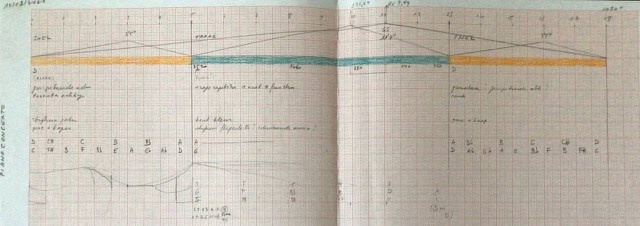
"I sketched out the formal structure like an architect, completely graphically, on graph paper, to get the proportions right. I apply the golden ratio. That means the proportions within the parts correspond to the proportions within the large whole. It's a good way to control your timing and intuitively give the listener a foothold.
Another advantage of those sketches is that you know better where you'll end up. It's a bit like building a bridge. That you know where the anchor points are. That's where I want to end up. So I don't want the bridge to be too short because then you get wet feet."
Lyrical
"Yet I do work in a very lyrical way. I always enjoy it when the individual melodic lines of the musicians are lyrical. And almost have their own score. That it could stand on its own. But it's simply part of a whole. My compositions are usually very technical but I always try to make sure it's interesting. When I see that a certain part has 60 bars of rest, I think: that can't be, they're going to get bored. I don't want musicians to count for that long. Then I try to find something with a re-orchestration here or there so they remain part of the whole."
Language of the heart
"On the one hand, I want to touch people, move people. But that sounds strange for contemporary music because very few people have an affinity for it. Yet for me, music is a language of the heart, however corny that may sound. I'm always working on musical expression that you hope will get through. But it's also a language that many people feel you have to be erudite to understand. I actually don't agree with that. Because very often you notice that people who have little prior knowledge, let alone are involved with classical music, and then come into contact with contemporary music for the first time, they're not so distant about it at all. And they are directly moved by it. That it really does get through. They think: oh, but that's actually more exciting than Mozart or Beethoven.
When I see that, I think: indeed, just listen for once. I think it's beautiful when people can listen unguarded and just say what it did to them. Some come with whole stories, for example, I saw a bird at the beginning and then a forest and then…
Then I think: Oh! Wow! Great!
WHAT: Piano Concerto, world premiere by Annelies Van Parys
WHO: Antwerp Symphony Orchestra with Jan Michiels [piano] conducted by Martyn Brabbins [conductor]
WHERE: De Bijloke, Gent and Koningin Elisabethzaal, Antwerpen
WHEN: Friday 27 May (Gent) and Saturday 28 May (Antwerpen, 20h00
TICKETS: debijloke.be and tickets@antwerpso.be