Since Riccardo Chailly became music director of the Scala in Milan, he has wanted to open each season with a work that is representative of that venerable institution with a glorious past and representative of the Italian opera repertoire. This time he chose Andrea Chénier the opera by Umberto Giordano (about the French poet who died under the guillotine) which was premiered there on 28 March 1896 and was regularly on the bill until 1960.
Back then Mario Del Monaco and Franco Corelli alternated in the title role, Renata Tebaldi sang the part of Maddalena and Ettore Bastianini was Carlo Gérard. Then "Andrea Chénier" disappeared from the Scala's repertoire until 1982 when the young Riccardo Chailly conducted a new production directed by Lamberto Puggelli and José Careras performed the part of the French poet. That same production was revived again in 1985, again under the direction of Riccardo Chailly and with José Carreras as Chénier, Eva Marton as Maddalena and Piero Cappuccilli as Gérard among others. Then Andrea Chénier disappeared from the Scala bill again for more than thirty years.
Now Andrea Chénier returned, again under the musical direction of Riccardo Chailly, who with this opera wanted to commemorate the fiftieth anniversary of the death of conductor Victor de Sabata (together with a photo exhibition in the Toscanini foyer). Chailly believes that Andrea Chénier is representative of the verismo of the young Italian school of the late 19th century. It is a work in which Giordano proved his stylistic independence from his great contemporary Puccini who also, in his own way, evoked the 18th century in his Manon Lescaut, an opera which Giordano moreover greatly loved. Because Chailly admires the symphonic structure of Giordano's score and the remarkably "modern" orchestration for its time, he wanted those to come fully into their own as well as the dramaturgical unity of the work. So he decided to have the first two acts played one after the other without a break and the same with acts three and four. He emphasized the continuity of the musical discourse by letting the various arias flow into the subsequent music without interruption. So no stopping the orchestra to provoke or allow applause. And it must be said that it was exciting and the musical performance held you in its grip. Riccardo Chailly's direction gave the performance a strong dramatic élan, was tightly wound and nervous but still let the melodies bloom abundantly, supported the singers and knew how to build impressive ensembles. He received an excellent response from the superb Scala orchestra which, like the expanded choir, fully committed itself.
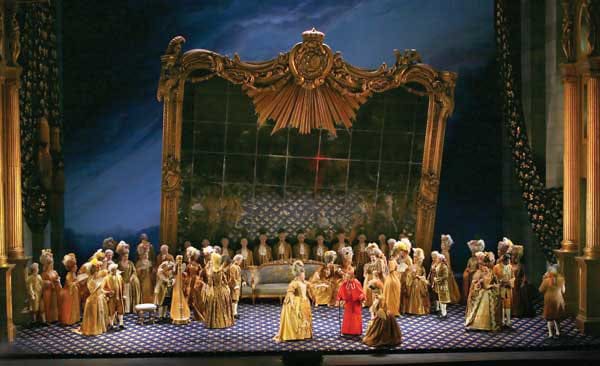
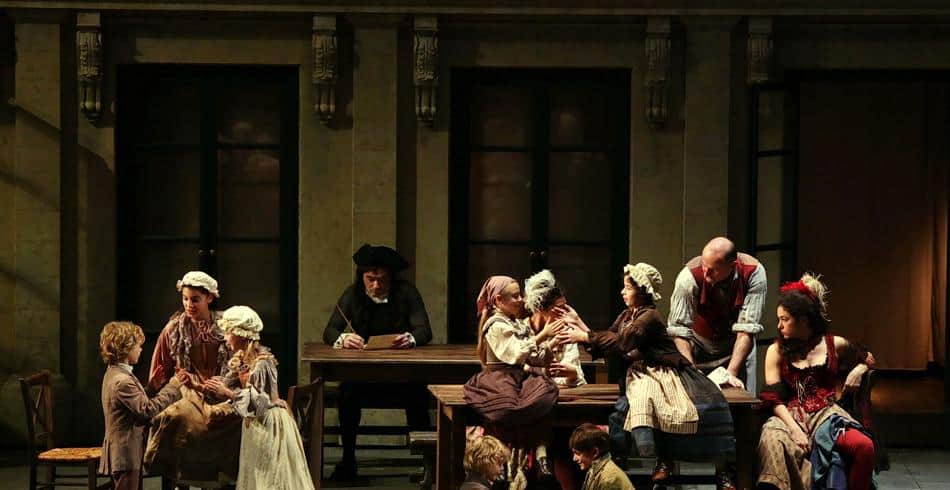
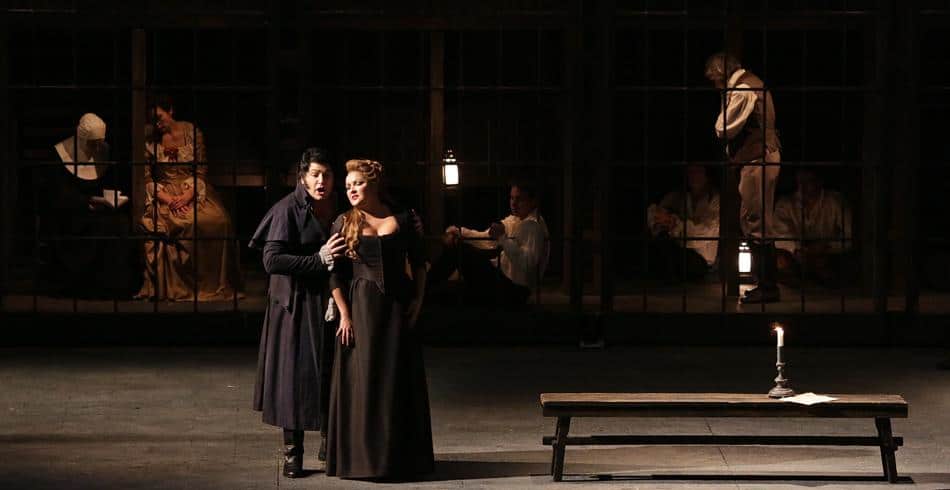
Mario Martone staged it in sets by Margherita Palli and costumes by Ursula Patzak, respected the historical context (French Revolution), the libretto and the musical dramaturgy of the work but nevertheless failed to make it a truly exciting theatrical evening. The revolving set was mainly practical but the stage picture came across as rather poor and had little atmosphere and the interaction between the protagonists could be more engaging. Not that they didn't fully commit but the whole lacked somewhat in cohesion and conviction. There was great anticipation and some skepticism about the performance of the title role by Yusif Evyvazov, the tenor from Azerbaijan, who has owed his fame (so far) mainly to the fact that he is the husband of the celebrated Russian soprano Anna Netrebko. But he passed the test with success and apparently managed to convince the demanding Scala audience. Although. The voice is powerful and homogeneous but does not have a particularly beautiful timbre. Nuance and legato are not his strongest suits but he has endurance and reaches the high notes effortlessly. The actor has a certain allure. Anna Netrebko does not find her best role in Maddalena, or was it not her best evening? She does not really bring the character convincingly to life, or was it the staging that gave her fewer chances? With her ample, warm soprano she gave a beautiful rendition of "La mamma morta" the aria that interpretatively can gain more depth. Luca Salsi brought his Verdi baritone to bear in full force for the role of Carlo Gérard. Annalisa Stroppa was a rather insignificant Bersi, Mariana Pentcheva a wearily sounding Contessa di Coigny and Judit Kutasi a still young Madelon with warm mezzo-soprano. Carlo Bosi delivered a convincing Incredibile with clear tenor, Gabriele Sagona was a beautifully sounding but scenically awkward Roucher and Francesco Verna (Mathieu) and Romano Dal Zovo (Schmidt) displayed sonorous voices.
- WHAT: Andrea Chénier
- WHO: Giordano, Riccardo Chailly, Mario Martone, Anna Netrebko, Yusif Evyvazov, Luca Salsi
- WHERE: Milan
- WHEN: December 2017
- Photos: ©Teatro alla Scala