American composer John Adams never writes an opera with just a casual story. Opera must not only move people emotionally for him, but above all denounce injustice; not only touch the heart, but especially the conscience. Girls of the Golden West is no exception. Together with his regular director Peter Sellars, who also wrote the libretto, he succeeds in this, although the impact does take some time to make itself felt.
The idea for the opera actually came from director Peter Sellars when he was directing Puccini's La Fanciulla del West. He sensed that the opera deals with an episode that can be regarded as a dark page in the history of California. He wanted to conduct further research into the events during the Gold Rush period in the 1850s, with the aim of exposing the brutal mistreatment of "Native Americans" by the settlers (especially blacks and Mexicans). His proposal to John Adams to compose an opera on this subject found immediate resonance, especially since the composer lives in the beautiful nature of the California Sierra Nevada. As a resident of the region, he wanted to deliver the message about the atrocities that had taken place there. In the meantime, the issue of Mexican immigrants in the US became topical, which was an extra trigger. Sellars therefore states in the magazine of De Nationale Opera: "This opera also carries the DNA of our time within it". The source for the libretto is mainly the letters of Louise Amelia Clappe to her sister. She lived as the wife of a gold prospector in the area and wrote about the harsh and brutal life among the gold prospectors, a gang of adventurers driven by greed. She is the main character Dame Shirley in Girls of the Golden West. In the opera, she has come to the Sierra with Fayette, a dull doctor (no singing role), whom she married only in order to be able to travel as a woman at that time. She lives in the harsh male world, where exploited settlers are beaten – sometimes to death – men drink, women prostitute themselves and Native Americans are killed like savages.
Austere appearance
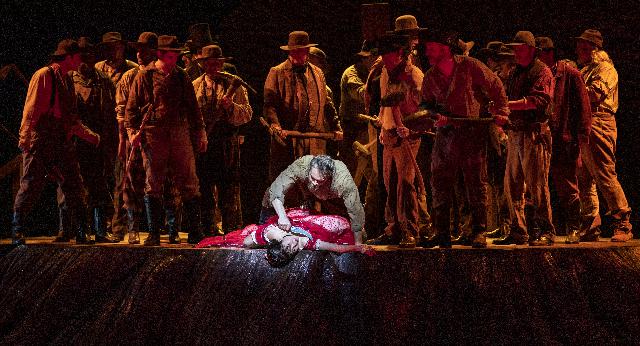
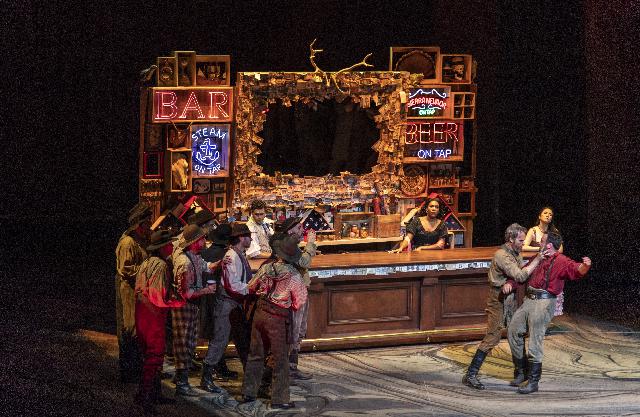
The set of the opera is very austere. On the large empty stage are tall rust-brown strips that look like fabric but turn out to be pieces of wall, sometimes with doors in them. A large old black-and-white photograph of the California Sierra Nevada is also sometimes shown. Against this background, changing set pieces and props are moved: chairs, a suitcase but equally well a bar in the first act and in the second act a black rock block, which serves as a kind of platform. A second piece of rock stands steeply upright. I find those rock blocks to be an ugly set. Yet at the end of the piece, when ultimate tragedy has struck and Dame Shirley nonetheless has the courage to admire the California mountain landscape, they provide the most beautiful image of the opera: with a reference to the "Gold Rush" they are lit to a beautiful golden glow. The costumes are true to the period, with the male chorus in gold panner outfits and the ladies sometimes in elegant couture dresses.
Deferred tension
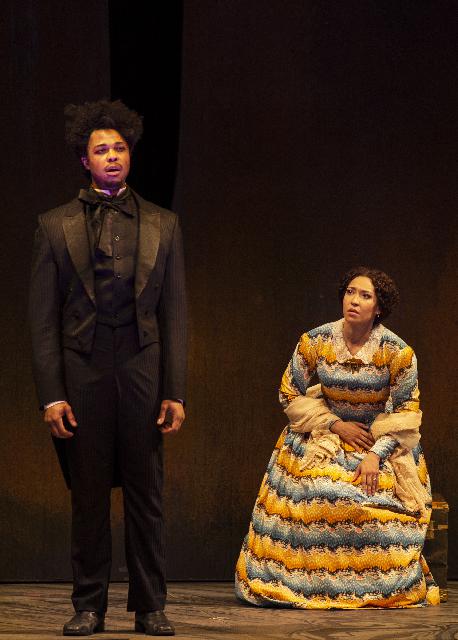
The opera certainly has a story that can move – and as it progresses, it does. What I find a shame is that there is no continuous narrative thread, so you don't follow any character in an evolution towards tragedy. The opera is divided into short episodes that follow almost like a "number opera". It begins with the arrival of Dame Shirley and her escort Fayette, which is not engaging at all and, with the mounted mule being ridden onto the stage, even borders on the ridiculous. We meet the Chinese prostitute Ah Sing. In the next scene, Josefa, a beautiful Mexican woman, is almost raped by drunk Joe. Ned, an Afro-American guy, discusses the increasing brutality in the community and indulges Shirley with a fictitious dinner, a scene that you'd best take as funny to not also find it ridiculous. So in the first act we have already met the most important characters and picked up a bit of the atmosphere, but experienced nothing that moves us. In the second act there is pace, and the events that cause tragedy and increasing tension also occur there. At least after the Fourth of July party, and thus after the silly dance steps of the majorettes (perhaps to be interpreted as irony on American chauvinism?) and the bit with Dame Shirley as Lady Macbeth, who theatrically holds the reins for a moment and prophetically alludes to a murder. The Fourth of July festivities are particularly seized by American prospectors to drink, sing exuberantly and humiliate anyone who is not white even more. In this second act, the cruelties escalate. First there is the arrest of the Afro-American Ned, Shirley's friend. Then there is the death of Joe, who tried to rape Josefa, but in defending herself against him she has stabbed him. Shirley takes her side in a beautiful duet. Josefa then has a beautiful scene – the most beautiful of the entire opera – in which she defends herself, but she is nonetheless executed. Then follows the epilogue by Dame Shirley.
Suggestive value
If the story is rather thin and drags on somewhat, the simplicity in Sellars' direction has a positive counterpart, namely suggestive value. In this way, he evokes more than he directly shows. To mention just a few examples: Sellars avoids nudity in his direction to show sexuality, when someone is beaten you only see arm movements, no sticks or whips. The execution of Josefa by the noose is suggested rather than depicted. Also in the confrontation between Dame Shirley and Ned or Ah Sing, there is more suggestion than reality. It not only feeds the viewer's imagination, but it also seamlessly aligns with the suggestive music of John Adams, who with a wonderful palette of instrumental sounds brings about an incredibly auditory effect and penetrates deeply. While you regularly escape the story, you never escape the music, it keeps you constantly on track with all kinds of rhythmic pulses. Certainly not "ordinary" repetitive music, but far less monotonous and of a fascinating complexity. Conductor Grant Gershon performs wonders with the once again fantastic Rotterdams Filharmonisch Orkest, which not only plays super-dynamic moments but here and there also lyrical passages. You hear tones in the winds, basses or percussion that you've never heard before and that wonderfully suit the emotion and accentuate it.
The singers are excellently cast. Julia Bullock is a warm and charismatic Dame Shirley with both strength and softness in her voice. Truly brilliant is the performance of J'Nai Bridges as Josefa. Not only does she act her role as an indignant and self-assured Josefa with pride, but she also sings it with incredible persuasiveness. Her final scene just before her execution is truly moving and matches the strongest belcanto aria. Ned Peters (Davóne Tinnes) has a few beautiful convincing solo passages and also in the duet with Julia Bullock he is warm and engaged. Ah Sing is given a genuine coloratura soprano with Hye Jung Lee and Joe Cannon is strongly portrayed by Lucas van Lierop, a singer from De Nationale Opera Studio who replaces Paul Appleby in this production – and brilliantly! The Choir of the National Opera gets plenty of its share with the songs of the gold diggers, for which the librettist draws on authentic songs from 1850. In their gold digger clothing and with pickaxe and hatchet, the Choir performs them with verve. Let us finally mention that sound effects were realized by Mark Grey, the composer whose opera Frankenstein is currently running at the Munt.
Thanks to the stronger second part, this Girls of the Golden West is altogether a compelling production that, for me, does not achieve the strong impact of The Death of Klinghoffer, the opera by John Adams that was created in 1991 at the Muntschouwburg in Brussels. I also thought back to Gershwin's Porgy and Bess, however different: coincidentally, just as on my previous visit to De Nationale Opera in Amsterdam, I saw an opera with a strong connection to American society and a critical approach to discrimination.
- WHAT: Girls of the Golden West | John Adams (°1947)
- DIRECTION: Peter Sellars
- VOICES: Julia Bullock, Davóne Tines, Lucas van Lierop, Hye Jung Lee, J'Nai Bridges, Elliott Madore
- ORCHESTRA: Rotterdams Philharmonisch Orkest & Koor van De Nationale Opera conducted by Grant Gershon
- WHERE: De Nationale Opera, Amsterdam
- WHEN: Sunday 17 March 2019
- PHOTOS: © Petrovsky & Ramone