

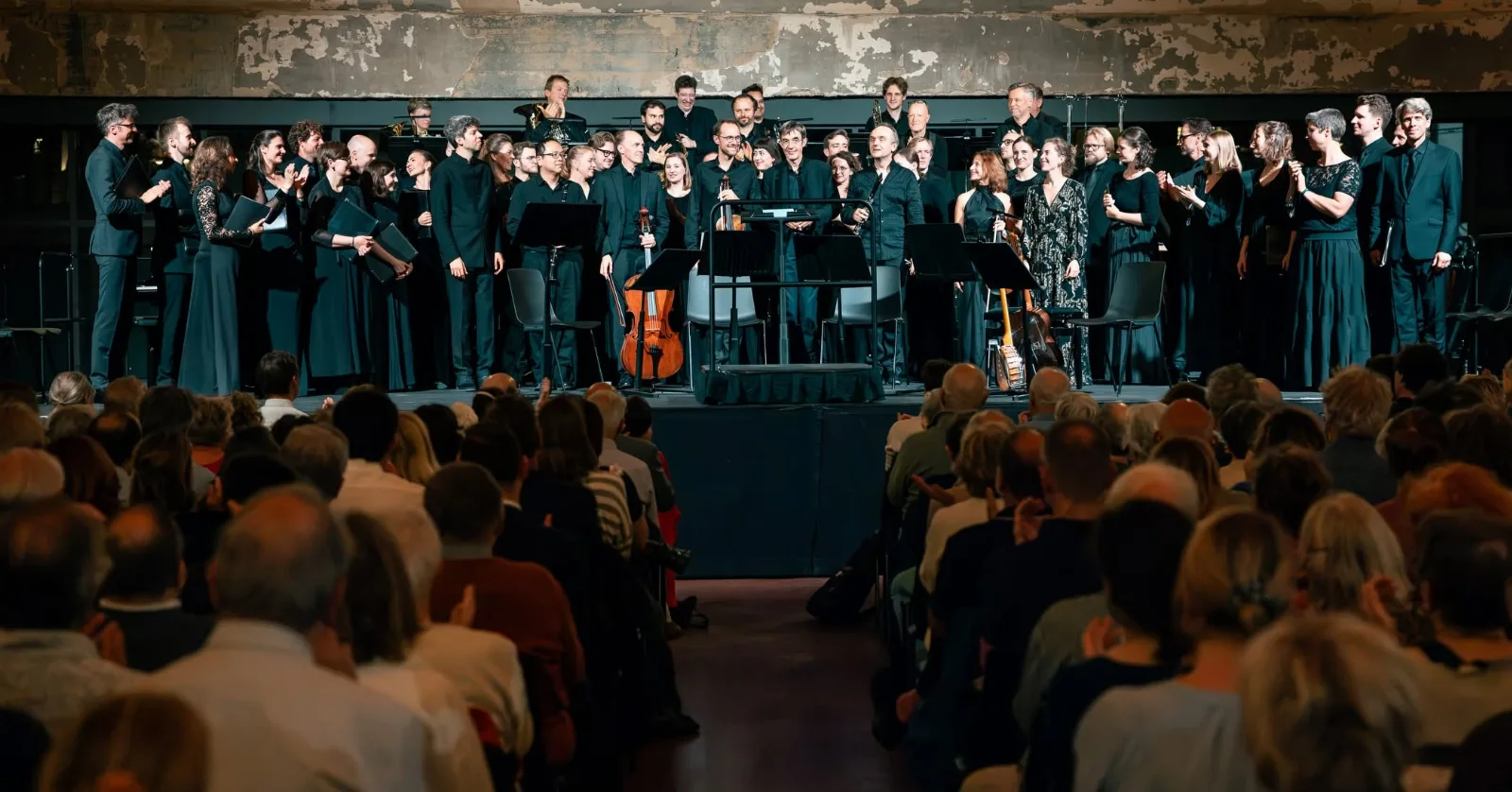
A concert about war, death and destruction doesn't sound like a light evening on paper. Yet Against the War, the concert that I SOLISTI and CHORWERK RUHR gave on Tuesday evening at the Wintercircus in Ghent, proved surprisingly accessible. The programme was beautifully structured around peace and war and brought together music by, among others, Hessenberg, Stravinsky, Kurt Weill, Hanns Eisler, Rudolf Mauersberger and Arnold Schönberg. Under the direction of Yuval Weinberg, it became a varied evening in which music, text and movement were skilfully interwoven.
The collaboration between the two ensembles is not a coincidence. I SOLISTI is a Belgian ensemble that originally grew out of a wind octet and today has a core of around twenty musicians. The ensemble has a distinct focus on wind instruments, but at the same time presents itself as a music production house that likes to explore the boundaries between concert, music theatre and other art forms. This also explains why the instrumental passages in this programme played such an important and colourful role.
CHORWERK RUHR, on the other hand, has existed since 1999 and is one of the leading German chamber choirs. The ensemble has built a reputation with repertoire ranging from early music to contemporary music and has in recent years devoted itself strongly to new music. The choir is moreover known for being able to handle both solo configurations and a fully blended choral sound. The latter was regularly audible this evening.
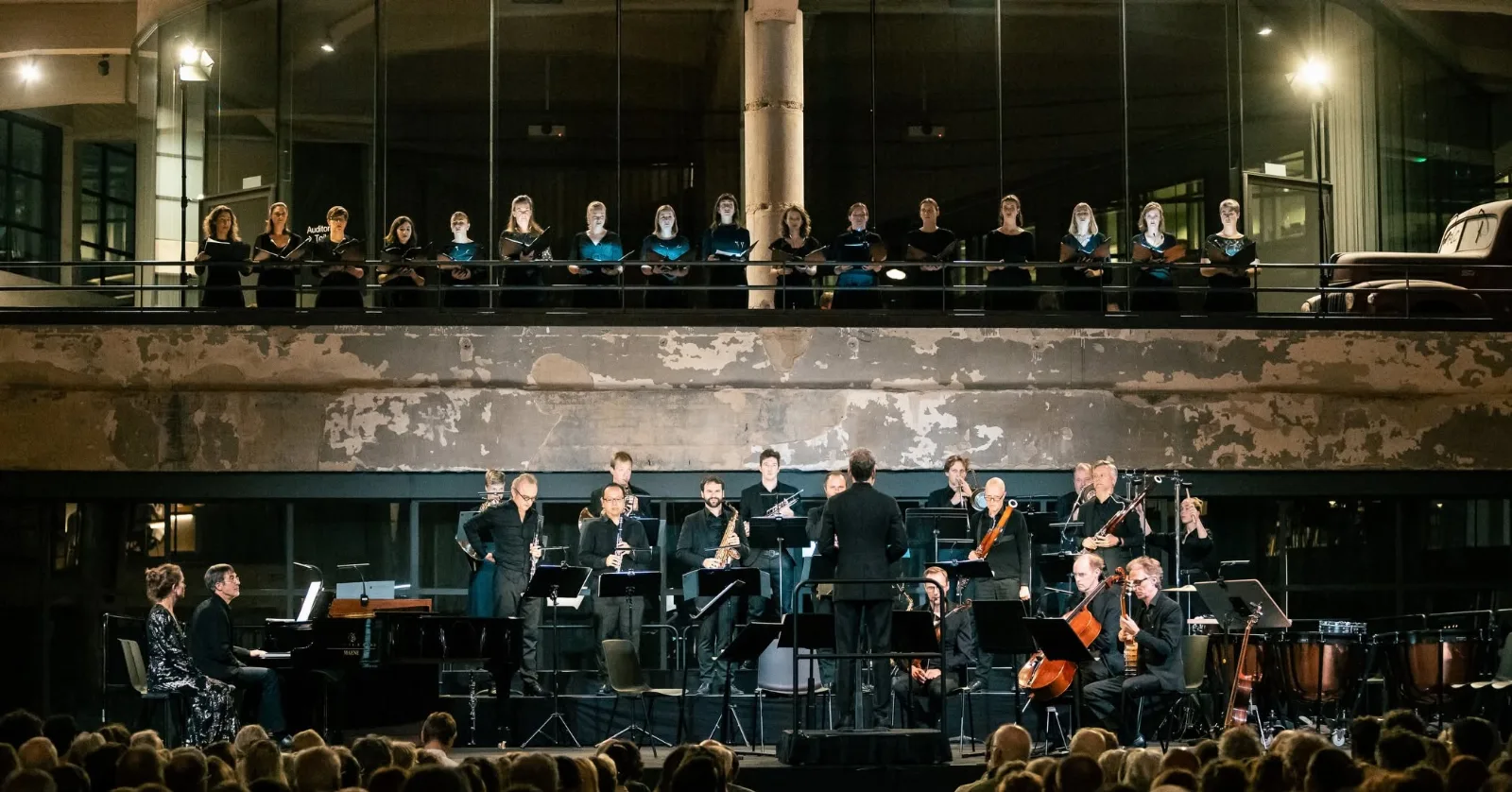
The concert opened with O Herr, mache mich zum Werkzeug deines Friedens by Kurt Hessenberg, after Francis of Assisi. The first sounds of the choir hit the mark immediately. The sopranos and altos sounded tender and full, with a sustained bass and tenor underneath. The whole had something strikingly sunny about it. In the Wintercircus the choir had positioned itself a little further back, and in the dark space mainly the small lights of the scores were visible. This created a particularly beautiful image.
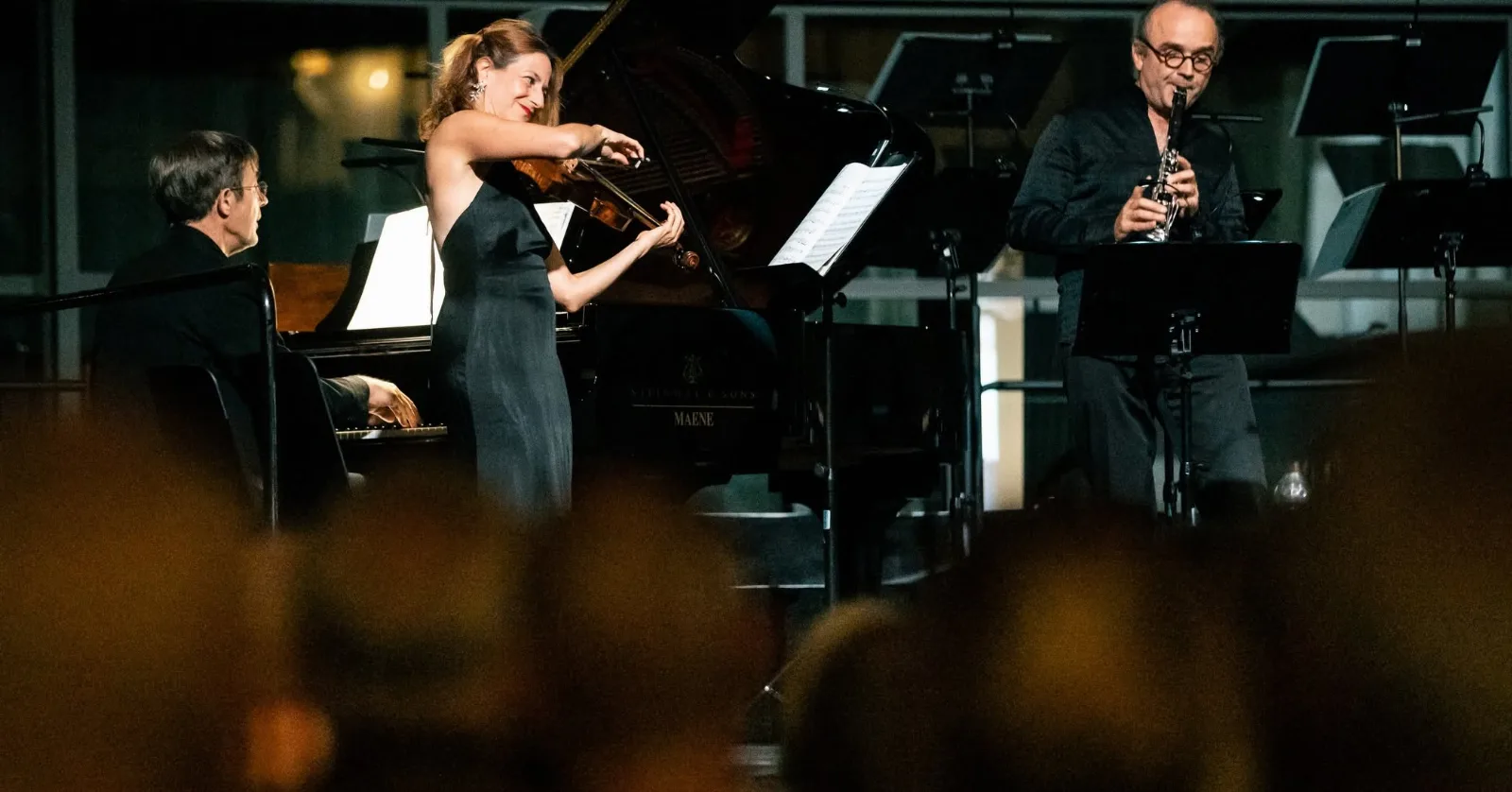 From that peaceful opening the programme moved to L'Histoire du soldat by Igor Stravinsky. This was for me one of the surprises of the evening. I know Stravinsky from the choral world but am considerably less familiar with his instrumental music: this performance clearly left me wanting more. The work was full of colour, playful and imaginative, and was presented in a highly interactive way. The three soloists clearly sought contact with each other and with the audience. Despite the subject matter, there was even some humour now and then.
The third part of the evening brought us to Hanns Eisler and Kurt Weill. Here the text became increasingly important. Lore Binon performed the vocal part in Eisler's Römische Kantate with great conviction. She sang in a sustained and at times almost recitative manner, which brought the text very clearly to the fore.
The Römische Kantate, opus 60, is incidentally an interesting work to place within this programme. Eisler wrote it in exile and based the text on work by the Italian writer Ignazio Silone. The cantata consists of four short movements, with titles such as Das große Rom, Der Gestank, Woher kommt er? and Die Angst. The scoring is strikingly small: one singing voice with two clarinets, viola and cello. It is therefore not a large choral work, but rather a sharp and concentrated musical narrative. The image of Rome, and above all of the stench that no one seems able to explain, takes on a clear political charge in Eisler's hands.
And here lies for me a small point of attention. I missed a translation. My German is sufficient to understand part of the text, but with this music there is a lot of text and often complex content. Part of it therefore escaped me, and with it probably part of the meaning Eisler gave to his work. The same problem arose later with Weill's Berliner Requiem. A Dutch translation in the programme or on a screen would really have added value here.
Apart from that, the performance of Eisler was highly convincing. The transition to Weill's music, moreover, proceeded very naturally. Zu Potsdam unter den Eichen stayed with me. Partly because the song was performed several times, each time with a different character. The first time smoothly and convincingly by the women in the gallery high above us, then by the male voices in a particularly colourful way, and the third time it was downright impressive. The men came forward from the back in a kind of procession while singing. That simple movement gave the piece an additional meaning in itself. The combination with the winds worked particularly well, and when the banjo and timpani joined in as well, a moment arose that genuinely gave me goosebumps.
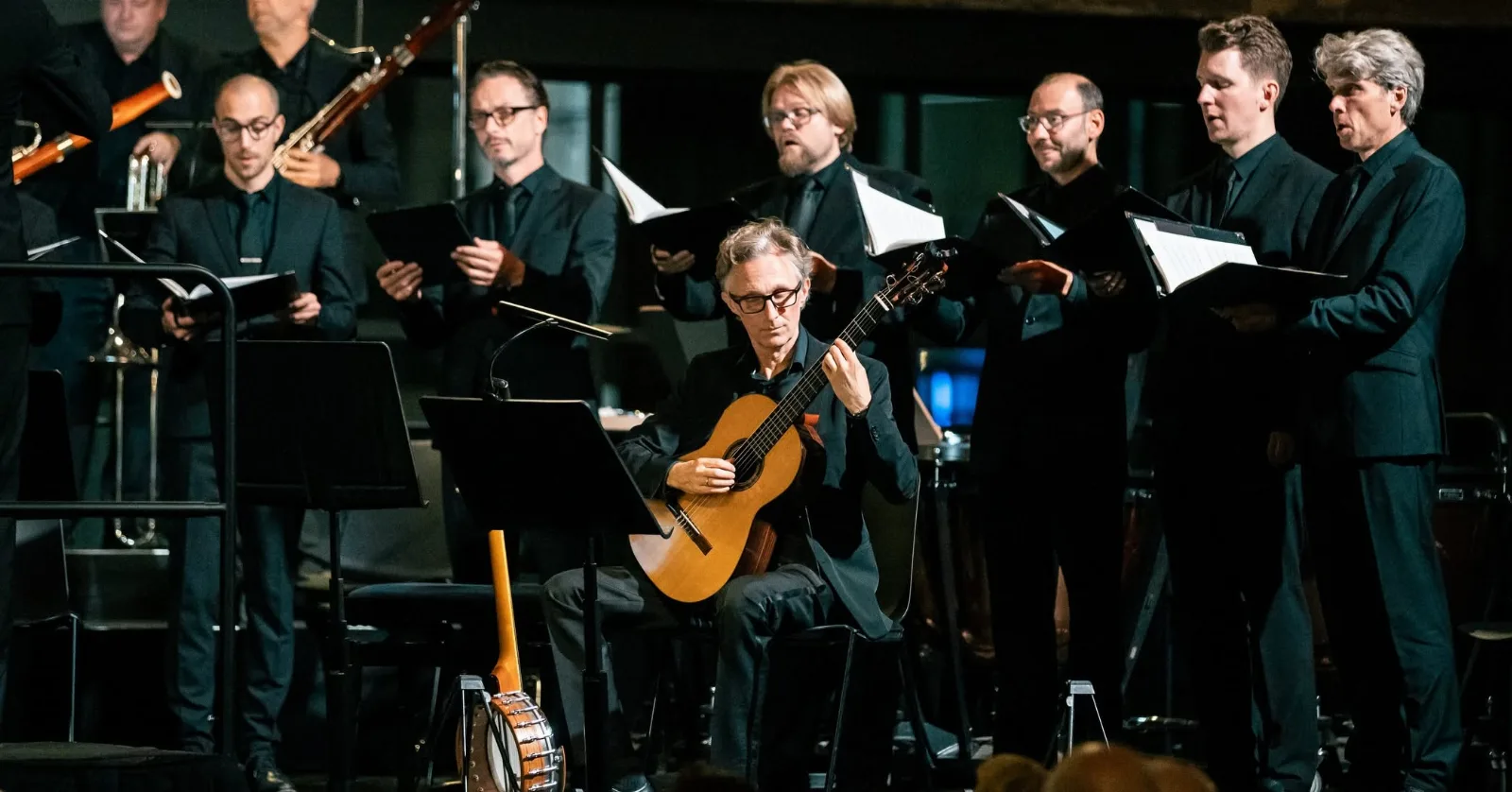 This was followed by Kurt Weill's Das Berliner Requiem, to texts by Bertolt Brecht. It is not a requiem in the classical, liturgical sense, but a work in which Weill and Brecht, in their characteristic way, address war, death and society.
The background here is also interesting. Weill wrote the work in November and December 1928, shortly after the enormous success of Die Dreigroschenoper. It was originally written for tenor, baritone, male choir and wind orchestra and premiered on 22 May 1929 on Radio Frankfurt. It was, quite literally, a work for the modern mass media of that time. Moreover, Brecht's poems are about forgotten dead: war victims, but also victims of violence who have remained nameless. That makes the title Requiem clearer straight away: it is not about a liturgical mass for the dead, but a kind of musical memorial for people who would otherwise easily be forgotten.
The male voices came in powerfully right away with the Grosser Dankchoral. Together with the winds, an impressive sound emerged, which at certain moments rightly sounded violent. And that was exactly what the music needed. The interpretation was also particularly convincing. When it spoke of darkness or cold, you got that not only from the text but also from the sound.
The Ballade vom ertrunkenen Mädchen, with guitar accompaniment, then brought a completely different character. Smaller, more intimate and almost fragile. The soloists in the following movements were also fantastic. With Weill, the focus again lies strongly on the text and on telling a story. The tenor and baritone did this with great interpretive sensitivity. At times they were almost speaking rather than singing.
It is also striking that Das Berliner Requiem did not have a simple life after its premiere. The work was revised several times and several versions exist. The original score has not even been fully preserved. That makes the work even more interesting today, but also explains why performances do not always take exactly the same form.
 After Weill followed Wie liegt die Stadt so wüst by Rudolf Mauersberger, based on the Lamentations of Jeremiah. Mauersberger wrote the work in 1945, after the destruction of Dresden. The music is pervaded by sorrow and desolation. Especially the repeated Warum struck me strongly.
This motet was a real discovery for me. The male choir sang it beautifully, without ever falling into excessive pathos. It is the kind of work of which you think afterwards: this is something I want to hear again.
And then came Arnold Schönberg with Friede auf Erden. Peace on earth. Together with the women's voices. After everything that preceded it, there could really be no better conclusion.
Singing Schönberg is not an easy task, however. You don't quite see the singers sweat, but you do see the effort and the commitment. That is precisely why you have to hear this kind of music live. On a CD you hear the sound, but in the hall you also see what it costs the singers to produce that sound.
The choir sang remarkably dynamically, from almost whispered softness to an enormous sound. And then ultimately comes that idea of peace on earth. After war, violence, death and destruction, the programme thus ends where it began: with peace.
Yuval Weinberg held everything firmly together. You can see that he knows and lives this music. He conducts with large arm gestures where needed, but can at the same time work with remarkable concentration and intensity. The way he tried to postpone the applause between the different parts also suited the structure of the evening.
The applause lasting several minutes made it clear that the audience had thoroughly enjoyed the evening.
War and violence form the common thread, but ultimately it is mainly that other idea that lingers: peace.
For me, Festival 20.21 and the Gent Festival van Vlaanderen have, with Against the War, presented a programme that will stay with me for a while. This production can still be heard at de Singel on 24 February '27 and afterwards in Bochum, Berlin and Dessau. Be sure to follow Festival 20.21 via Facebook or the website for this.