

From the church orchestra to the conservatory
Servais was born on 6 June 1807 in Halle, in the Handbooghof. His father Jean-Baptiste Servais (1773-1838) was a shoemaker and violinist in the orchestra of the Basilica of Saint Martin; his mother Joséphine Bande (1784-1878) was a maidservant. From the age of twelve the boy played in that church orchestra, most likely as a clarinettist. Around 1825 he received violin lessons from Corneille Vanderplancken, violinist at the Brussels opera.
The cello came only later. In 1827 Servais began studying with Nicolas-Joseph Platel (1777-1835) at the Ecole Royale de Musique in Brussels, the forerunner of the conservatory. Two years later he won the first prize for cello; from 1829 to 1833 he was repetiteur in Platel's class and principal cellist in the orchestra of La Monnaie.
In the winter of 1833-1834 he travelled to Paris, and in 1835 to London. The public had never heard a cellist like him: Gioachino Rossini (1792-1868) and others saw in him "the Paganini of the cello". When Hector Berlioz (1803-1869) watched him at work at the Conservatoire de Paris on 31 January 1847, he called him a "Paganinian" in the Journal des Débats.
Nine tours, from Scandinavia to Turkey
Between 1838 and 1866 Servais undertook nine major concert tours, in an era without aircraft and with a railway network that was only just beginning. He travelled through Germany and the Baltic countries to Russia (1838-1840), then to Poland, Austria and Bohemia (1841-1842), to Finland (1844-1846), to Moldavia, Ukraine, Romania and Turkey (1851-1852), and to Denmark, Sweden and Norway (1862-1863). His last tour, in 1866, took him once more to Poland and Russia.
Along the way he played with the greats of his time: in The Hague in 1837 with Franz Liszt (1811-1886), in Vienna in 1842 with the Wiener Philharmoniker, and in 1844 at the Leipzig Gewandhaus, where he performed the Archduke Trio with Felix Mendelssohn (1809-1847) and Ferdinand David (1810-1873).
Russia became his second homeland. He was a guest of Tsar Nicholas I and of Prince and Princess Yusupov, and in June 1842 he married Sophie Feygin (born 1820) in Saint Petersburg, the daughter of a steward of the tsar; in 1848 a civil marriage followed in Halle. The couple had six children and in 1847 moved into the Villa Servais, a townhouse designed by architect Jean-Pierre Cluysenaar. Their daughter Sophie married the Polish sculptor Cyprien Godebski (1835-1909) in 1865; their daughter became the Parisian salon queen Misia Sert (1872-1950), a granddaughter Servais never knew.
The bow, the pin and the Belgian cello school
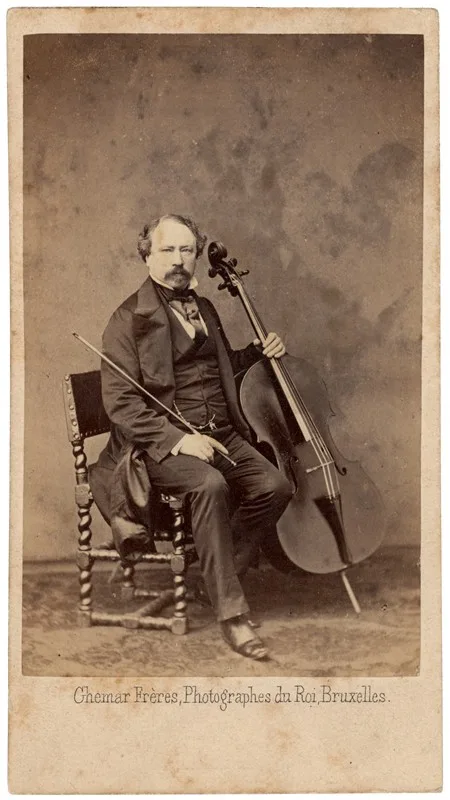
Servais never wrote his innovations down in a method. He passed them on in lessons and incorporated them into his music, especially in the Six Caprices, op. 11, which to this day rank among the most demanding study material for cellists. His contemporaries heard an unusually powerful tone, an acrobatic left hand with free use of the thumb and high positions, and a vibrato that some found excessive and others a discovery.
History also credits him with inventing the cello endpin, the metal spike on which the instrument rests today. That credit needs qualifying. He was probably the first cellist to always play with an endpin, a practical solution for his unusually large cello, but he did not invent the endpin, and it was only in the early twentieth century that most cellists adopted it: Alfredo Piatti (1822-1901) played his whole life without one.
From 1848 until his death Servais taught at the Brussels conservatory. There arose what came to be called the Belgian cello school, the line that continued through his youngest son Joseph Servais (1850-1885). Joseph won the first prize in his father's class in 1866, became principal cellist of the court chapel of the Grand Duke of Weimar, and in 1872 became a teacher at the Brussels conservatory himself. Henri Vieuxtemps (1820-1881), a regular guest at the Villa Servais, wrote his two cello concertos for him.
A Stradivarius bearing his name
No cellist has lent his name to a more famous instrument. The Servais Stradivarius was built in 1701 in

Cremona by Antonio Stradivari (1644-1737), then 57 years old, and is one of the just over sixty surviving cellos by his hand. It is an exceptionally large specimen: the body measures 78.7 cm, the upper limit of what is considered a standard cello size. That very size explains why Servais turned to an endpin.
How he acquired the instrument is not entirely clear. The vzw Servais dates the acquisition to around 1840 without naming a donor; other sources state that Prince Yusupov bought the cello for him around 1845. After his death the instrument passed to his son Joseph, and then, in the words of the association, "after many wanderings", in 1981 to the Smithsonian in Washington, as a gift from Charlotte V. Bergen. There the cello belongs to the collection of the National Museum of American History, which does not currently display the instrument.
It is not entirely silent: in 1992 Anner Bylsma (1934-2019) recorded Johann Sebastian Bach's (1685-1750) six cello suites on it for Sony Classical (S2K 48047). Anyone who wants to hear how Servais' cello sounds will find the closest answer there.
The composer behind the virtuoso
Servais wrote for himself, like every touring virtuoso of his generation. Some seventy works were published, and from 1836 onward hundreds of editions appeared from some seventy publishers, from Mainz to St. Petersburg. The list includes four cello concertos: the Concerto in b, op. 5, the Morceau de concert in e, op. 14, the Concerto militaire in c, op. 18, and a posthumous concerto in a.
The bulk of his oeuvre consists of fantasias, caprices and salon pieces, often on opera melodies or folk tunes he picked up on his travels. The titles read like a travel diary: Souvenir de Spa, op. 2, Souvenir de la Suisse, op. 10, Fantaisie sur 2 Airs russes, op. 13, Souvenir de St. Petersburg, op. 15, Souvenir de Bade, op. 20 and Souvenir de Czernowitz, op. 21, a salon piece on Romanian airs. His arrangement of La Romanesca, a dance air from the late sixteenth century, became his most popular piece.
In addition he wrote 30 duos with colleagues, mostly on operatic themes: with Vieuxtemps a Grand Duo on motifs from Les Huguenots by Giacomo Meyerbeer (1791-1864), with violinist Hubert Léonard (1819-1890) four concert duos, including one on themes by Ludwig van Beethoven (1770-1827) and one on L'Africaine, and with pianist Jacques Gregoir (1817-1876) he wrote 24 opera arrangements together with Gregoir. That music disappeared from the concert halls for a century, but has been republished and recorded again since the 1980s.
Halle, 26 November 1866
His last concerts were given in Spa, Arras and Baden-Baden. On 26 November 1866 Servais died in Halle, aged 59. Three days later he was buried at the city's expense; his grave was moved in 1897 and on 26 November 2006, exactly 140 years after his death, it received a commemorative plaque.
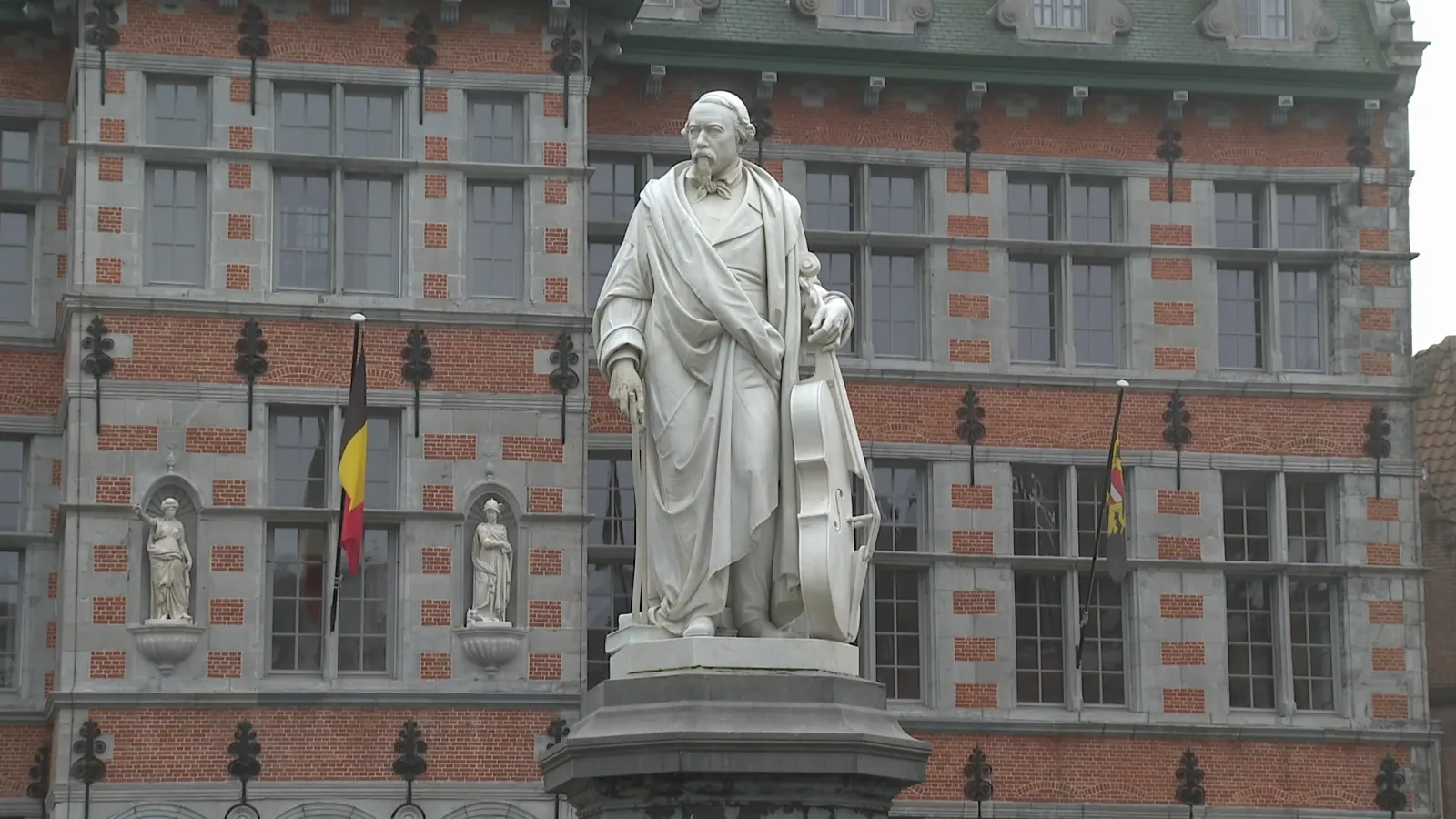
As early as 1871 a statue stood on the Grote Markt, carved in Carrara marble by his son-in-law Cyprien Godebski, with Vieuxtemps and François-Auguste Gevaert (1828-1908) among the guests. According to vzw Servais, this made him the first cellist in the world with a statue of his own. That association, founded in 2003, manages the Servais Collection, which since 2016 has been partly on display in the city museum in den AST on the Meiboom in Halle. The Villa Servais still stands there, and the Servais Academy has borne his name since 1997.
The commemoration in Halle culminates in the 36th Servais Concert on Friday 27 November 2026 at 19:30 in the Sint-Martinusbasiliek, the church where Servais took his first steps in music. Ettore Pagano, winner of the Queen Elisabeth Competition Cello 2026, will perform there. The concert is completely sold out. In 2027 a commemorative year follows, and vzw Servais is preparing the publication of a biography by chairman Peter François, titled François Servais, de Paganini van de cello.
Listening tip for this commemoration: the Six Caprices, op. 11, for anyone who wants to know how much Servais dared to ask of a cellist, and then La Romanesca, for anyone who wants to hear why the public of 1850 queued up for him.