The American composer John Adams never writes an opera around a merely detached story. For him, opera must not only move emotionally, but above all indict injustice; not only touch the heart, but above all strike the conscience. In Girls of the Golden West this is no different. Together with his regular director Peter Sellars, who also wrote the libretto, he succeeds in this, though the impact does take its time to arrive.
The idea for the opera actually came from director Peter Sellars, when he was directing Puccini’s La Fanciulla del West. He sensed that the opera deals with an episode that can be regarded as a black page in the history of California. He wanted to investigate further the events of the Gold Rush period in the 1850s, with the aim of denouncing the brutal mistreatment of the newcomers (mainly Black people and Mexicans) by the “native Americans.” His proposal to John Adams to compose an opera on this subject found immediate resonance, all the more so because the composer lives in the magnificent nature of the Californian Sierra Nevada. As a resident of the region, he wanted to convey the message about the atrocities that had taken place there. That the problems of Mexican immigrants in the US had in the meantime become topical was an additional trigger. Sellars accordingly headlined in the magazine of De Nationale Opera: “This opera also carries the DNA of our time.” The source for the libretto is mainly the letters of Louise Amelia Clappe to her sister. She lived as the wife of a gold prospector in the area and wrote about the hard and brutal life among the gold miners, a band of adventurers driven by greed. As Dame Shirley she is the main character in Girls of the Golden West. In the opera she has come to the Sierra with Fayette, a simple-minded doctor (no singing role), whom she married only in order to be able to travel as a woman at that time. She lives there in the harsh men’s world, where exploited newcomers are beaten – sometimes to death – men drink, women prostitute themselves, and Indians are killed as savages.
Sober appearance
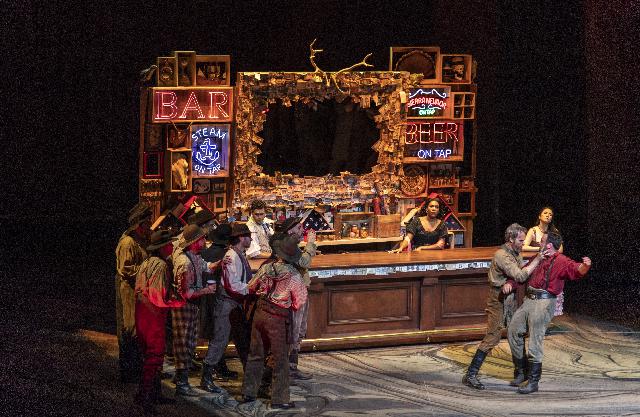
The set of the opera is very sober. On the large empty stage stand tall rust-brown strips that look like dust but turn out to be sections of wall, in which doors are sometimes set. A large old black-and-white photograph of the Californian Sierra Nevada is also sometimes shown. Against this backdrop, changing set pieces and props are moved about: chairs, a suitcase, but equally a bar in the first act and, in the second act, a black rock block that serves as a kind of platform. A second piece of rock stands steeply upright. I find those rock blocks rather an ugly set. Yet at the end of the piece, when the ultimate tragedy has struck and Dame Shirley, despite everything, has the courage to admire the Californian mountain landscape, they produce the most beautiful image of the opera: with a reference to the “Goldrush,” they are lit into a splendid golden glow. The costumes are kept faithful to the period, with the male chorus in gold-digger garb and the ladies sometimes in handsome couture dresses.
Delayed tension
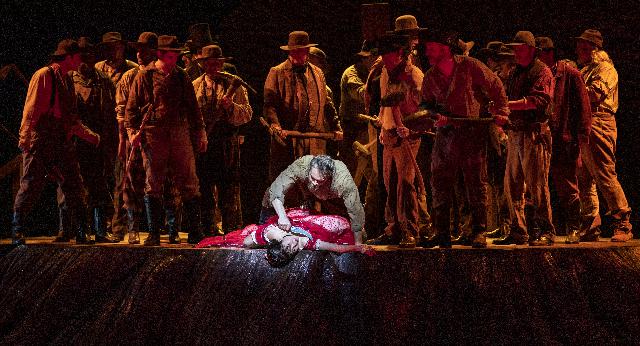
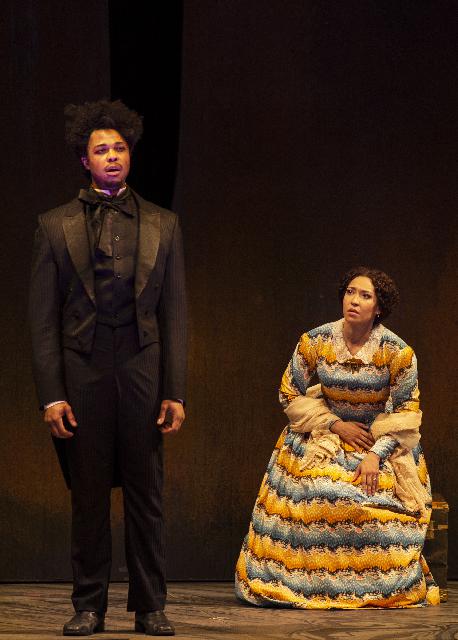
The opera certainly has a story that can move – and as it progresses, it does. What I find a pity is that there is no continuous narrative thread in it, so you also don't follow any character in an evolution toward tragedy. The opera is divided into short episodes that follow one another almost like a “number opera.” It begins with the arrival of Dame Shirley and her companion Fayette, which is not at all an engaging piece, and with the stuffed mule that is wheeled onto the stage, which even borders on the ridiculous. We become acquainted with the Chinese prostitute Ah Sing. In a following scene, Josefa, a beautiful Mexican woman, is nearly raped by the drunken Joe. Ned, an African-American fellow, discusses the growing brutality in the community and pampers Shirley with a fictitious dinner, a scene you had best take as humorous so as not to find it ridiculous as well. Thus in the first act we have already been introduced to the main characters and have sniffed a bit of the atmosphere, but nothing moving has yet been experienced. In the second act there is momentum, and there too the events that bring tragedy and ever more tension take place. At least after the Fourth of July celebration, and thus after the foolish dance steps of the majorettes (perhaps to be interpreted as irony on American chauvinism?) and the bit with Dame Shirley as Lady Macbeth, who for a moment holds the reins theatrically and prophetically hints at a murder. The festivities of the Fourth of July are eagerly seized upon by the American gold miners to drink, sing exuberantly, and humiliate further anyone who is not white. In this second act the cruelties escalate. First there is the arrest of the African-American Ned, Shirley's friend. Then there is the death of Joe, who tried to rape Josefa, but in her defense against him she stabbed him. Shirley takes her side in a beautiful duet. Josefa then has a magnificent scene – the most beautiful of the entire opera – in which she defends herself, but she is nevertheless executed. Then follows the epilogue by Dame Shirley.
Suggestive power
Ist die Handlung eher dünn und schleppt sie sich etwas dahin, so hat die Schlichtheit in Sellars' Inszenierung einen positiven Gegenpol, nämlich ihren suggestiven Wert. Er deutet mehr an, als er direkt zeigt. Um nur ein paar Beispiele zu nennen: Sellars vermeidet in seiner Inszenierung Nacktheit, um Sexualität zu zeigen; wenn jemand verprügelt wird, sieht man nur Armbewegungen, keine Stöcke oder Peitschen. Die Hinrichtung von Josefa durch den Strick wird eher angedeutet als abgebildet. Auch in der Konfrontation zwischen Dame Shirley und Ned oder Ah Sing steckt mehr Suggestion als Realität. Das nährt nicht nur die Vorstellungskraft des Publikums, sondern fügt sich auch nahtlos in die suggestive Musik von John Adams ein, die mit einer wundersamen Palette instrumentaler Klänge auditiv enorm viel bewirkt und tief eindringt. Dem Geschehen auf der Bühne kannst du dich gelegentlich entziehen, der Musik jedoch nie; sie hält dich mit allerlei rhythmischen Pulsen ständig bei der Stange. Es ist keinesfalls „gewöhnliche“ repetitive Musik, sondern viel weniger eintönig und von einer fesselnden Komplexität. Dirigent Grant Gershon vollbringt Wunder mit dem einmal mehr fantastischen Rotterdams Philharmonisch Orkest, das nicht nur superdynamische Momente, sondern auch hier und da lyrische Passagen spielt. In den Bläsern, Bässen oder im Schlagwerk hört man Klänge, die man nie zuvor gehört hat und die wunderbar zur Emotion passen und sie akzentuieren.
Die Sängerinnen und Sänger sind ausgezeichnet besetzt. Julia Bullock ist eine warme und charismatische Dame Shirley mit Kraft und Sanftheit in der Stimme. Geradezu glanzvoll ist die Leistung von J'Nai Bridges als Josefa. Sie gestaltet ihre Partie der empörten und selbstbewussten Josefa nicht nur mit Stolz, sondern singt sie auch mit unglaublicher Überzeugungskraft. Ihre Schlussszene kurz vor der Hinrichtung ist zutiefst ergreifend und kann es mit der stärksten Belcanto-Arie aufnehmen. Ned Peters (Davóne Tinnes) hat einige schöne, überzeugende Soloabschnitte, und auch im Duett mit Julia Bullock wirkt er warm und engagiert. Ah Sing wird von Hye Jung Lee als regelrechte Koloratursopranistin verkörpert, und Joe Cannon wird stark von Lucas van Lierop gesungen, einem Sänger des Nationale Opera Studio, der in dieser Produktion Paul Appleby ersetzt – und das mit Glanz! Der Chor der Nationale Opera bekommt mit den Liedern der Goldsucher reichlich Gelegenheit, die der Librettist auf die authentischen Lieder von 1850 zurückgreifen lässt. In ihrer Goldgräberkluft und mit Spitzhacke und Beil bringt der Chor sie mit Verve zur Geltung. Abschließend sei noch erwähnt, dass die Geräuscheffekte von Mark Grey realisiert wurden, dem Komponisten, dessen Oper Frankenstein derzeit in der Munt läuft.
Dank des stärkeren zweiten Teils ist diese Girls of the Golden West alles in allem eine fesselnde Produktion, die für mich jedoch nicht die starke Wirkung erreicht, die The Death of Klinghoffer hatte, die Oper von John Adams, die 1991 im Muntschouwburg in Brüssel uraufgeführt wurde. Ich musste auch kurz an Gershwins Porgy and Bess denken, so verschieden sie auch sind: Zufällig sah ich, wie bei meinem letzten Besuch an der Nationale Opera in Amsterdam, eine Oper mit einer starken Verbundenheit zur amerikanischen Gesellschaft und einer kritischen Haltung gegenüber Diskriminierung.
- WAS: Girls of the Golden West | John Adams (°1947)
- REGIE: Peter Sellars
- STIMMEN: Julia Bullock, Davóne Tines, Lucas van Lierop, Hye Jung Lee, J'Nai Bridges, Elliott Madore
- ORCHESTER: Rotterdams Philharmonisch Orkest & Koor van De Nationale Opera u.L.v. Grant Gershon
- WO: De Nationale Opera, Amsterdam
- WANN: Sonntag, 17. März 2019
- FOTOS: © Petrovsky & Ramone