

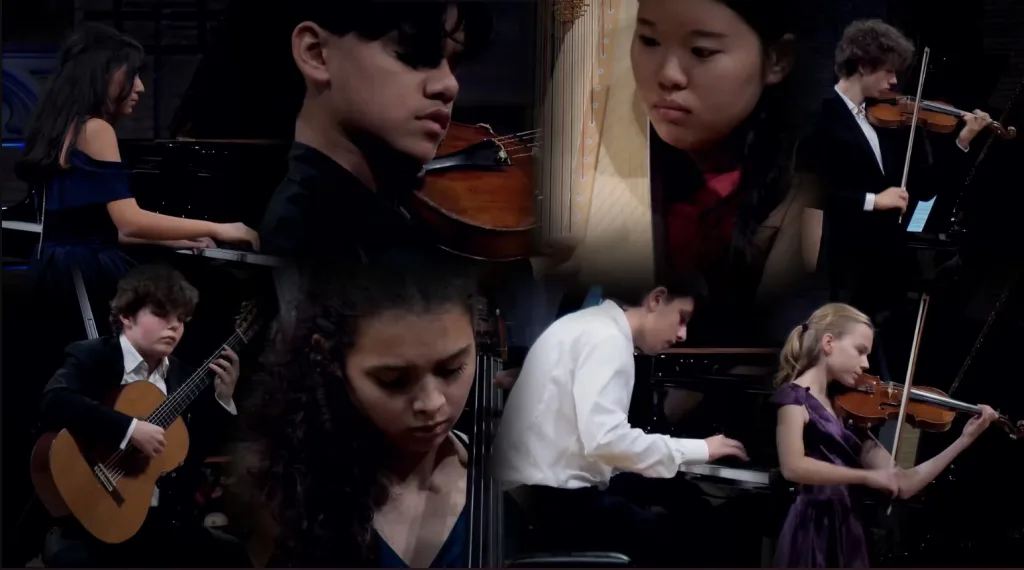
Rich flower arrangements on the stage, an extensive presentation, well-known and lesser-known works performed by some eighteen students, a generously spread reception: a host of ingredients that together deliver a high-quality product that has no equal in our own country or in the neighbouring countries. It is a kind of luxury to be able to experience this, like a member of the family. For indeed, this school is, as it were, a family: the children are the students, the parents the teachers, (sugar) uncles and (sugar) aunts the audience. Recently the school has even come under the patronage of Queen Mathilde.
Discussing the 18 young soloists is an impossible task. As in previous reviews, we single out a few students. Know that the piece they performed was first rehearsed only about five weeks ago, say from the second week of this school year. It is bold to already have such young musicians, who also attend school with a demanding programme apart from music, perform a solo piece so soon on stage before a full hall. The hall is always full. In the little more than seven years that the institute has existed, a loyal audience has been built up. It is almost impossible for others to secure a seat at the concerts.
Let us begin with the South Korean Chaewon Kim (16), who played the Spanish Dance No. 1 from the opera La Vida Breve by Manuel de Falla (1876–1946), in an arrangement by Marcel Grandjany (1891–1975), on the harp. A very pure playing, fresh and at the same time warm, bound, singing in full lines and sparkling in a way as if it were the umpteenth time she had played this repertoire piece. It moved the audience. Then the violin sounded... Performing with great technical strength, the Belgian-Polish 17-year-old Antyoni Jarosz played the first movement of the violin concerto by Jules Conus (1869–1942), which sounded very supple and youthful, even though it was a work by the young violinist herself.
Pianist Liam Nassereddine from the Netherlands (15) is no longer an unknown in the Dutch classical music world, where he has been taken under the wing, among others, by the winner of the 2025 Queen Elisabeth Piano Competition, Nikola Meeuwsen. That says a lot. He breathtakingly played the third movement of Beethoven's Appassionata. This flamboyant young man with a mischievous gaze is a true "stage animal" who undergoes a metamorphosis the moment the first note sounds, just as with nearly all the greatest of the great. Another brilliant pianist is the now 17-year-old Argentinian Joaquín García, a rather modest young man who at the piano becomes the composer he performs, in this case Chopin with the second movement of his second piano concerto. Both the finesses and the dark colours come fully into their own under his hands.
On the cello it was a fellow countrywoman, Angelina de Nigris (15), who played a sonatina by Zoltán Kodály (1882–1967). She is not only virtuosic and already very well-developed, her musical maturity is strongly apparent with a full understanding of this work. On the viola, that other full string instrument, Diana García (14) from Spain introduced the audience to the first movement of the concerto by York Bowen (1884–1961). A very good choice to place such a fine work by a forgotten composer on the programme. In this way not only the young soloist but also the audience learns to know something different from the "ordinary" pieces that are always performed again. And when this is then done by a talent of high calibre, everyone benefits even more.
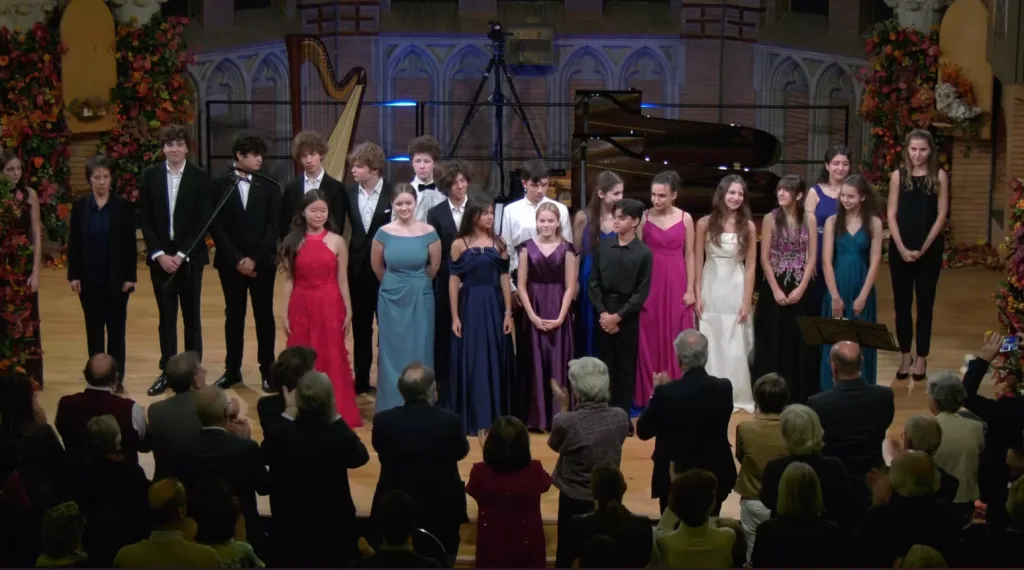
The audience's hearts were most won over by the 12-year-old Luciano Petik. Already the way in which he, self-assured as a grown-up soloist who knows the ins and outs of the trade, comes onto the stage and tucks his instrument under his chin. Although, "tucks"? He holds his violin firmly in hand, his head moves along with it, as does his facial expression, here on the notes of Fritz Kreisler's (1875–1962) Prelude and Allegro in the style of Gaetano Pugnani (1731–1798). A very strong composition full of virtuosity and musical hidden corners that only a true musician can perceive and interpret. This remarkable young teenager does that like no other. Do not forget his name and all the other names: they are, every one of them, young people with a future who will command the stages for many years to come, each in their own way.
The piano accompanists deserve an extra word; they take up their positions unobtrusively, making music at the highest level just like the young people they accompany. A round of applause for Karine Sélo, Sofia Raychenko and Nargiz Aliyeva.
Those who could not attend can listen to the whole concert again via the school's YouTube channel
Make a note already of the next concert on 16 December 2026, at the (hard-to-reach) Musica Mundi School in Waterloo. It is best to order tickets well in advance. Turning up on the evening itself is, especially with the Christmas concert, not possible. Check the school's website and follow the concert agenda on our website.